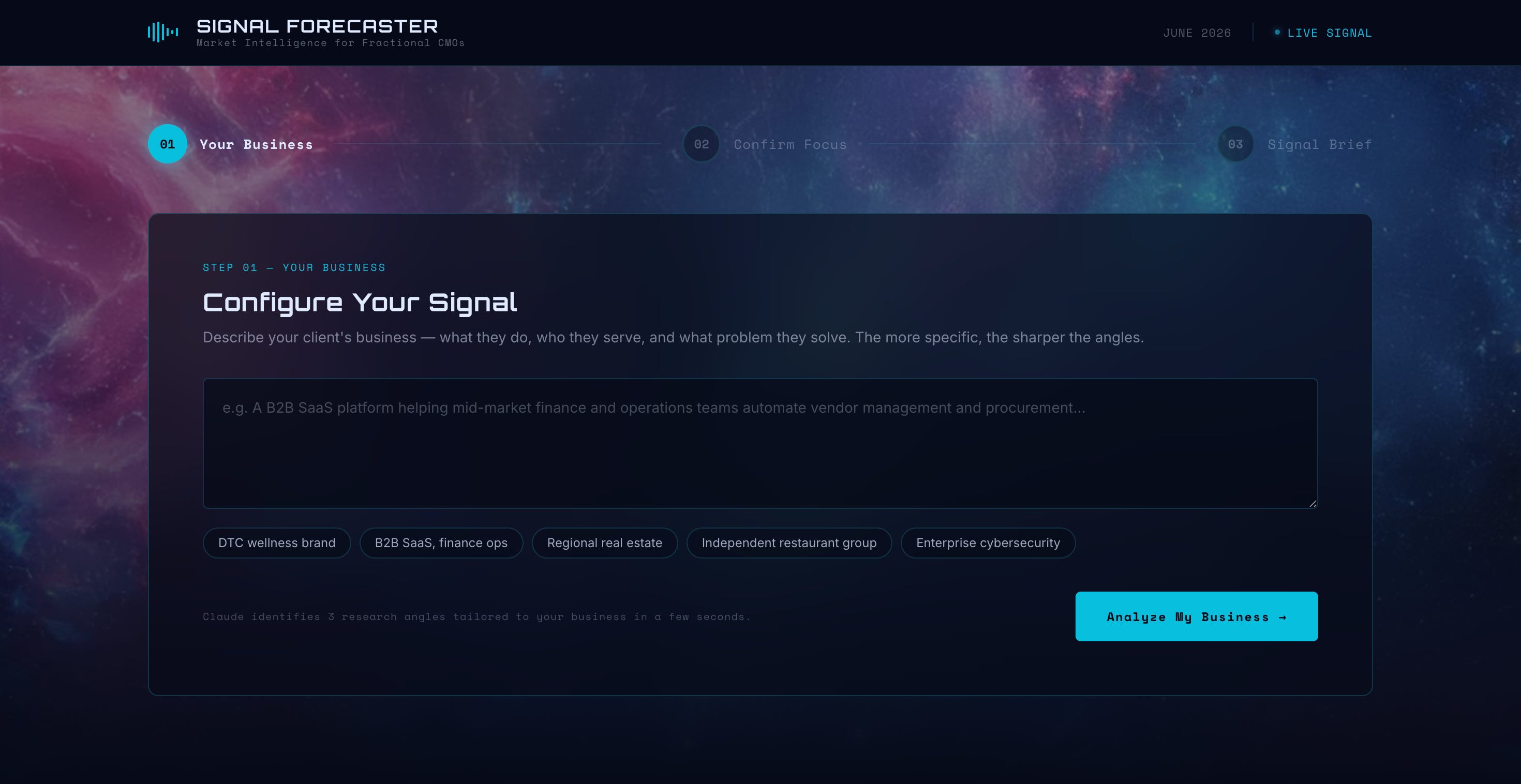
Your buyer can’t see the problem you solve. The best B2B brands of 2026 are dramatizing it instead.
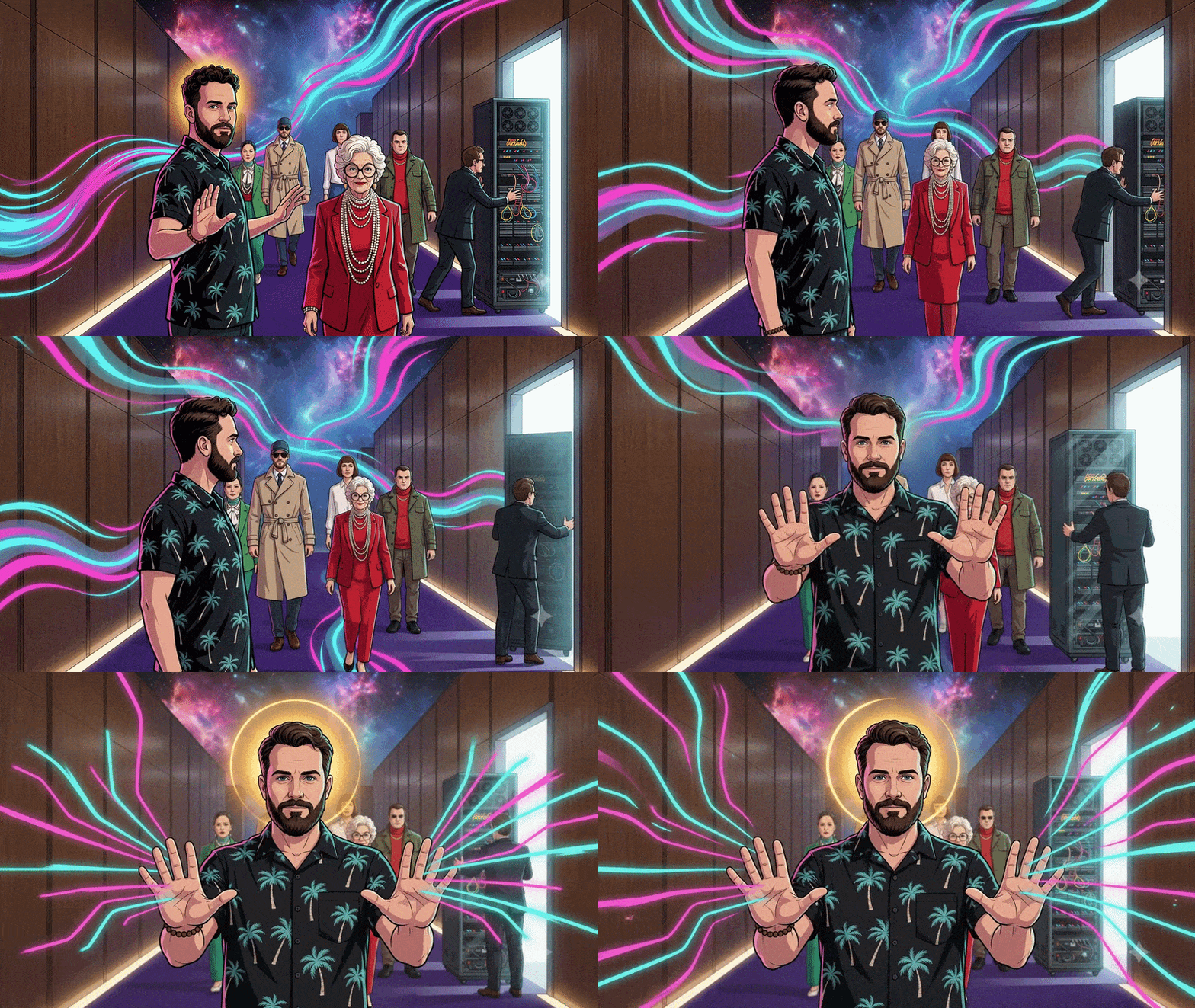
Picture a CFO at 11pm.
Your one-pager is closed in another tab.
She’s staring at a reconciliation that won’t close, a fraud flag from a system that doesn’t talk to the other three systems, and a payment that’s been “pending” for nine days. She can feel that something in the plumbing is broken. She cannot point to it.
And nobody on her vendor shortlist is describing the thing she’s actually afraid of.
So she does nothing. Again.
That paralysis is the most expensive thing in B2B, and almost no one markets to it. We sell features to people who are drowning in anxiety. We send the spec sheet to someone who needs permission to believe their gut.
Here’s the number that should stop us here.
In June, the most decorated B2B campaign of 2026 won Best in Show at the ANA B2 Awards on its fiftieth anniversary. The brand was FIS, an enterprise fintech company most people have never heard of. The work reportedly drove a 57% lift in demand and lead-generation effectiveness, generated $26 million in attributable contract value, and returned 700% on a $6 million media investment. (ANA press release; LBBOnline.)
Those are FIS’s own numbers from its award entry, so hold them loosely. No third party audited them.
We’ll come back to that.
But the move underneath is real, and it’s spreading. FIS stopped selling fintech infrastructure.
It started selling the felt experience of not having it.
Prefer to watch? The full breakdown of the Failure-State Frame is on YouTube.
Watch the 14 minute breakdown →
The proof of concept: FIS in 2025
FIS sells the boring, invisible machinery of money.
Core banking.
Payments.
Capital markets infrastructure.
The kind of category where every competitor talks about uptime, throughput, and compliance.
FIS and its agency, Sid Lee USA, made a different choice.
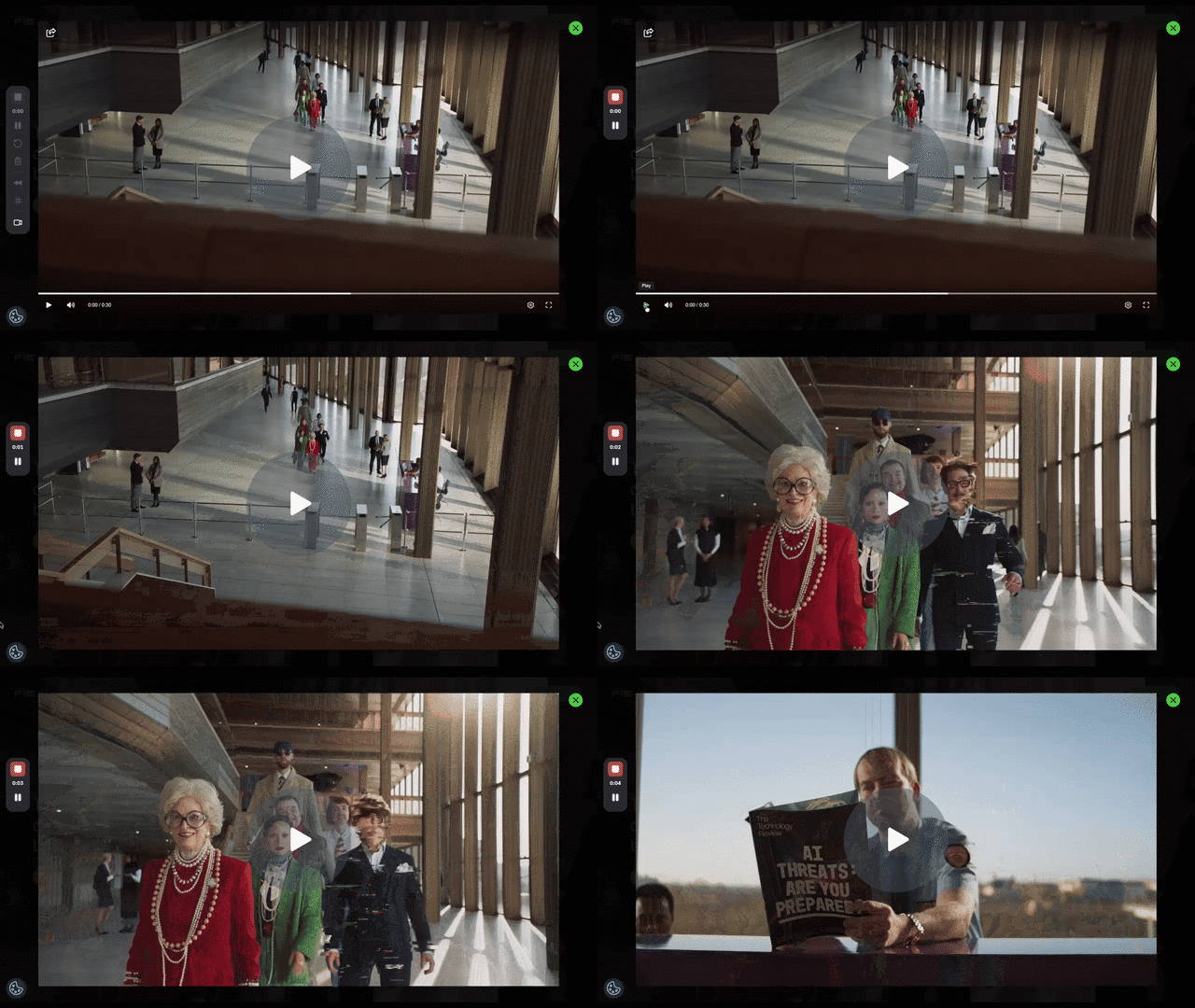
They built a brand platform called “Unlocking Financial Technology: Bringing the World’s Money into Harmony,” launched in November 2024. The name says harmony. The creative did the opposite.
The films dramatized disharmony: a synthetic identity slipping through the cracks, cash flow turned into a game of chance, payments stuck in an endless loop of pending. Each spot resolved on one line. “Let FIS bring your world back into harmony.”
They skipped the dashboard and showed you the nightmare it prevents.
Then they did the part most emotional B2B work skips. They built the money path before they shot a frame. The account-based layer ran tight: Marketbridge’s “Money Lifecycle” ABM program for FIS targeted 53 named accounts (Marketbridge + FIS campaign video).
The media ran as a deliberately reversed funnel: connected TV for emotional reach, then LinkedIn and YouTube to route warmed buyers into demand capture (LBBOnline). Emotion at the top. A specific conversion action at the bottom.
Nothing left to evaporate as “awareness.”
And they gave the whole thing a spine of proof. FIS commissioned research with Oxford Economics called the Harmony Gap, which put the average annual cost of financial “disharmony” at $98.5 million per company (FIS press release; Oxford Economics). So when a CFO felt the emotional gut-punch of the film, there was a hard number waiting to justify the meeting.
Emotion to earn the attention.
Research to survive the CFO.
A funnel built to catch what the emotion stirred up. That’s the whole machine.
The pattern: the Failure-State Frame
Bring Harmony to Your Payments With FIS - 27 June 2026 - Watch Video
I’m calling this the Failure-State Frame.
You take a complex, invisible, technical problem. You dramatize the cost of it staying unsolved and leave your solution implied. You make the failure state visible, visceral, and a little frightening. Then you anchor it with owned research so it survives a budget review.
Then you route the warmed audience through a narrow paid funnel into a conversion you defined first.
3 parts, in this order.
Dramatize the problem, not the product. Prove the cost with your own data. Engineer the funnel before the creative. Pull any one of the three and it collapses, either into pretty brand advertising that converts nothing, or into another dry feature campaign nobody feels.
The reason it works is older than marketing.
People don’t buy infrastructure to gain a little efficiency. They buy it to make a fear go away. Loss aversion runs deeper than feature envy, and a vivid picture of the failure state speaks to the fear directly, before the rational buying committee ever opens a spreadsheet.
There’s a pastoral version of this I think about often.
The first move in sitting with someone in pain is not to fix it. It’s to name it accurately enough that they feel seen. A vendor who can describe your 11pm dread better than you can has already earned a different kind of trust than the vendor with the better feature grid.
Naming the wound is the work.
Watch it repeat across 3 industries
The Failure-State Frame shows up everywhere once you see it.
HP “The Wolf.”
HP needed to sell enterprise print and endpoint security, possibly the most ignored line item in corporate IT.
So in 2017 it hired Christian Slater to play a hacker who walks through a company’s defenses from the mailroom printer to the boardroom. It was a cyber-thriller about the chaos of a single unsecured device.
The first film pulled more than 12.5 million views and over 100 million earned media impressions, and HP credited the series with lifting B2B printer sales in a shrinking market.
The product barely appears.
HP sold the terror of the problem and let the solution become obvious.
Workday. “Rock Star.”
Different emotional lever, same architecture.
Workday dramatized the gap between how its buyers see themselves and how the world treats them, casting Ozzy Osbourne, Joan Jett, and Travis Barker, launching at the Super Bowl, then threading the warmed audience through ABM, LinkedIn, and a tour bus built for one-to-one sales conversations. Workday reported a 65% lift in consideration, a 24% lift in trust, and slow lead growth turning into a 50% uptick, with the CMO reorienting her dashboard around contract value (Mi3; case study at The Drum).
Emotion at the top, pipeline at the bottom, the same machine.
GE. “What’s the Matter with Owen?”
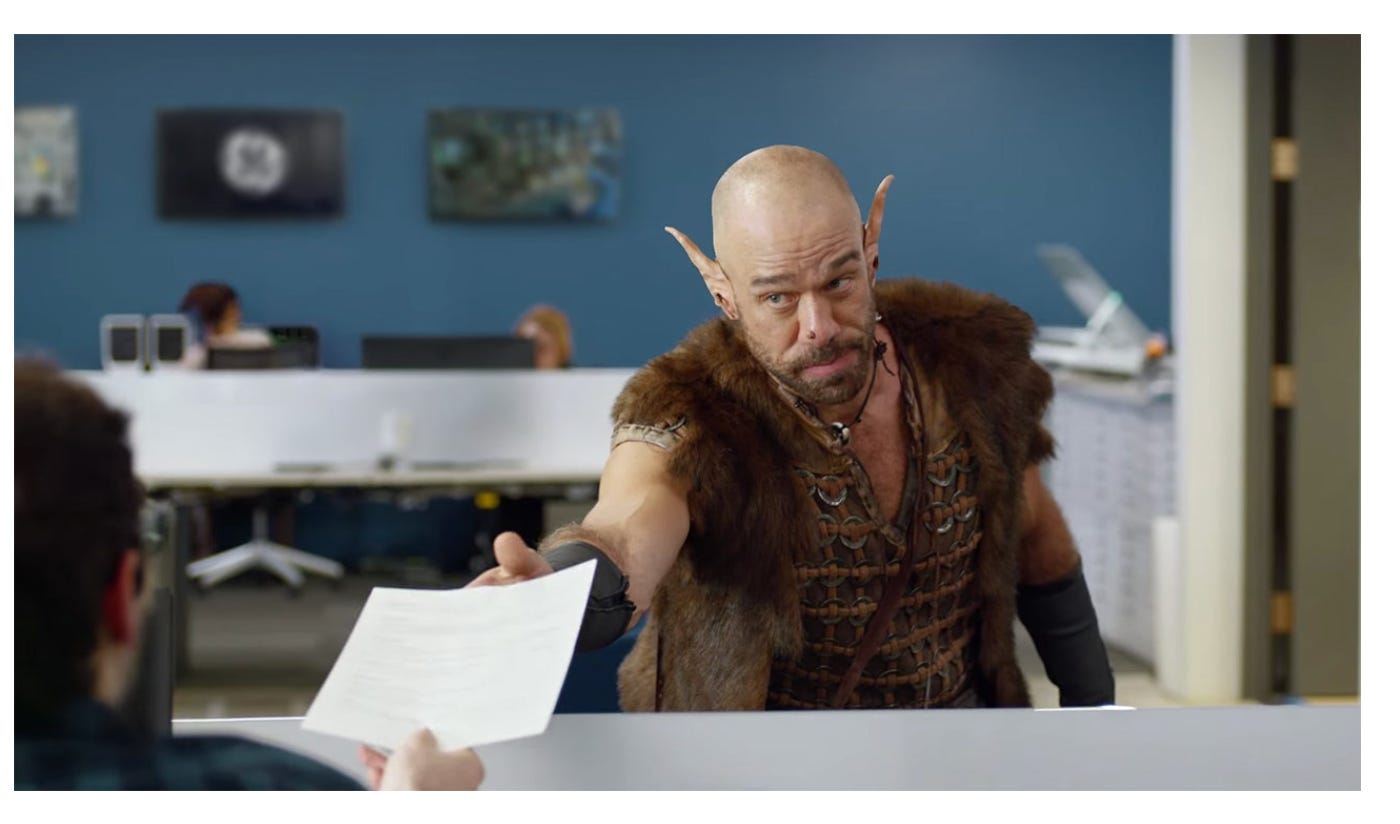
Image capture from fastcompany
GE needed software engineers to take it seriously as a digital company, so it dramatized the social pain of a brilliant young programmer whose friends can’t understand why he’d pick GE over a fruit-hat app startup.
The demand here was talent. GE reported an eight-fold increase in job applications (LBBOnline; Fast Company). Intangible category, character-driven emotion, one conversion destination. Same structure, different currency.
In summary. Fintech, enterprise hardware, industrial software, recruiting. Different stakes, one psychological engine.
One marketing pattern per week. Each issue breaks down what worked, why it spread, and what it means for the next 12 months. Free.
Why this works right now
3 forces are converging to make the Failure-State Frame land in 2026.
The first is structural.
B2B finally accepted what Ehrenberg-Bass has argued for years: roughly 95% of your buyers aren’t in the market today, so most of your job is building memory in people who can’t buy yet. Feature ads only work on the 5% who are shopping.
A vivid failure state plants itself in the 95% who will be shopping later, and it’s still sitting there when the pain finally spikes.
The second is technological, and it’s the interesting one.
Generative AI is flooding every channel with perfectly optimized feature copy. Speeds and feeds are now free, infinite, and identical. When every vendor’s rational marketing reads the same, buyers go blind to all of it. Emotion becomes the only thing that still cuts through, because it’s the one thing the commodity content engine can’t fake into resonance.
The third is media.
Connected TV keeps expanding as a B2B reach channel, and LinkedIn has become the default capture layer underneath it. The CTV-to-LinkedIn path that FIS, HP, and Workday all used isn’t exotic anymore. It’s becoming the standard plumbing for moving a warmed enterprise buyer from feeling to form-fill.
There’s a quieter truth under all three.
When you can no longer out-feature the competition, the brand that names the buyer’s real fear most honestly wins the relationship.
Call it an act of attention. You’re telling the buyer you actually see what they’re up against.
Where the Failure-State Frame breaks
The pattern fails in 2 predictable ways, and they fail in the same direction every time. The emotion runs out ahead of the economics.
The promise outruns the product.

Screenshot Image from spectrum
IBM built a massive failure-state story around healthcare complexity and Watson’s ability to fix it. The drama was vivid. The product couldn’t deliver against the stakes the story raised. MD Anderson’s Watson cancer project was shelved after burning through more than $62 million (IEEE Spectrum), and IBM later tried to offload Watson Health entirely (Axios). When you dramatize a giant problem and can’t prove you solved it, the frame curdles into overpromise.
The rule: the disguise can only be as strong as what it’s covering.
The intensity exceeds the permission.
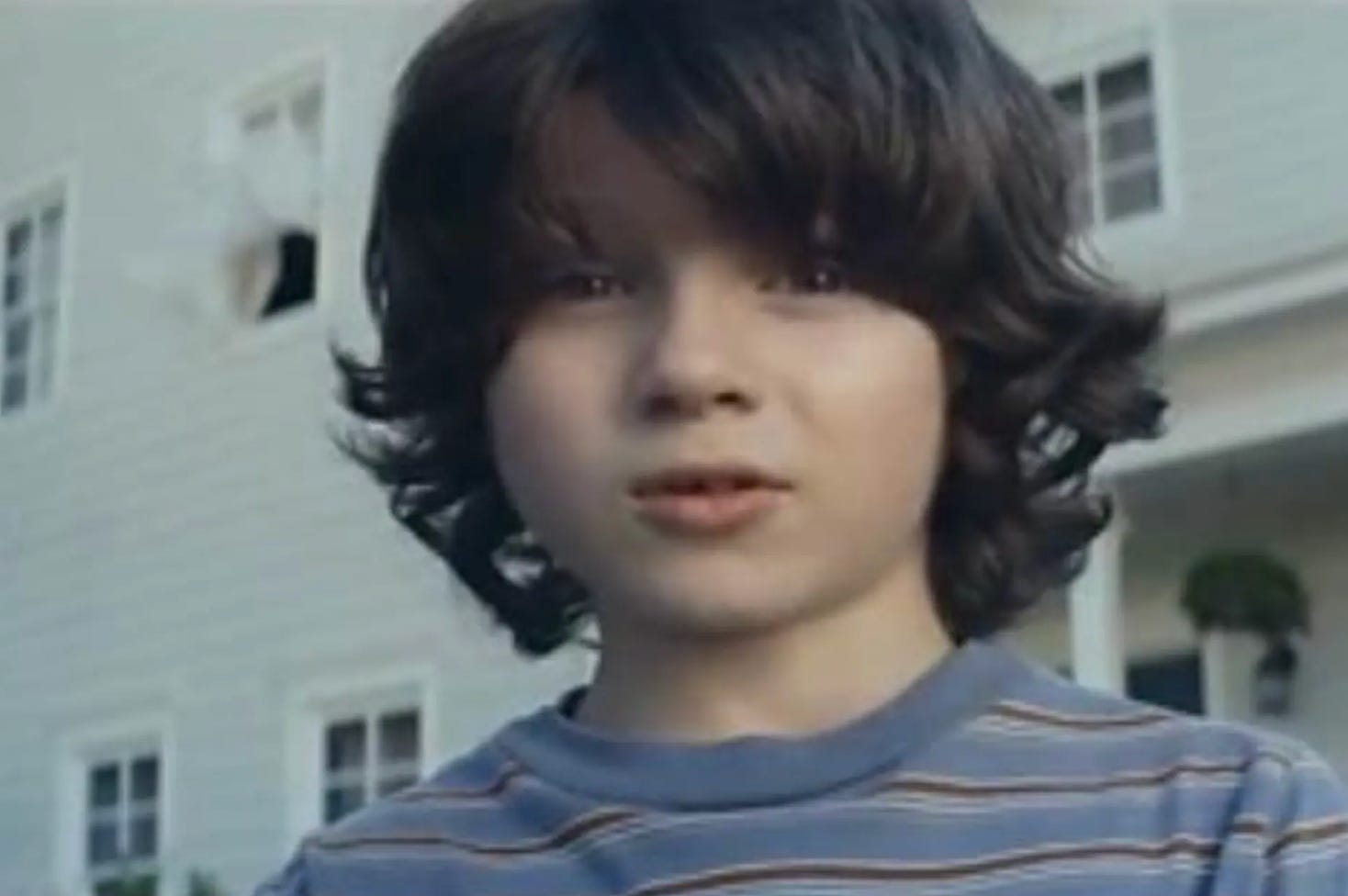
Nationwide led with the failure state too, in its 2015 Super Bowl spot about a child who died from a preventable accident.
Strategically it was the same move. Emotionally it broke the room. A Super Bowl crowd expecting entertainment rejected the dead-child frame, and the spot became one of the most criticized of the game (Time).
The rule? The failure state has to match the audience’s permission level, or urgency turns into recoil.
Questions to ask before you deploy this
If you’re a fractional CMO holding this pattern, run your client’s situation through these.
Is the problem actually invisible to the buyer? If the pain is already obvious or the product is commoditized, dramatization adds nothing and you should compete on proof or price instead.
Does the client own a piece of data that quantifies the cost of the problem? Without a Harmony Gap of their own, the emotional campaign reads as vibes and dies in the CFO’s budget review.
Is the funnel built before the creative? Name the bottom-funnel conversion action first, then build the emotion to feed it. Emotion with no destination evaporates.
And the hard one: does the brand have real standing to name this pain? A founder’s scar, a category they actually live in, a credible claim to the wound. If the answer is no, the work will read as costume.
You have clients in several different industries. Every one of them is waiting on you to tell them where their market is heading, and which move to make before their competitors make it.
That’s the job. Read the signal, name the pattern, hand them the play. Running that research by hand for every client and every trend is the slow part.
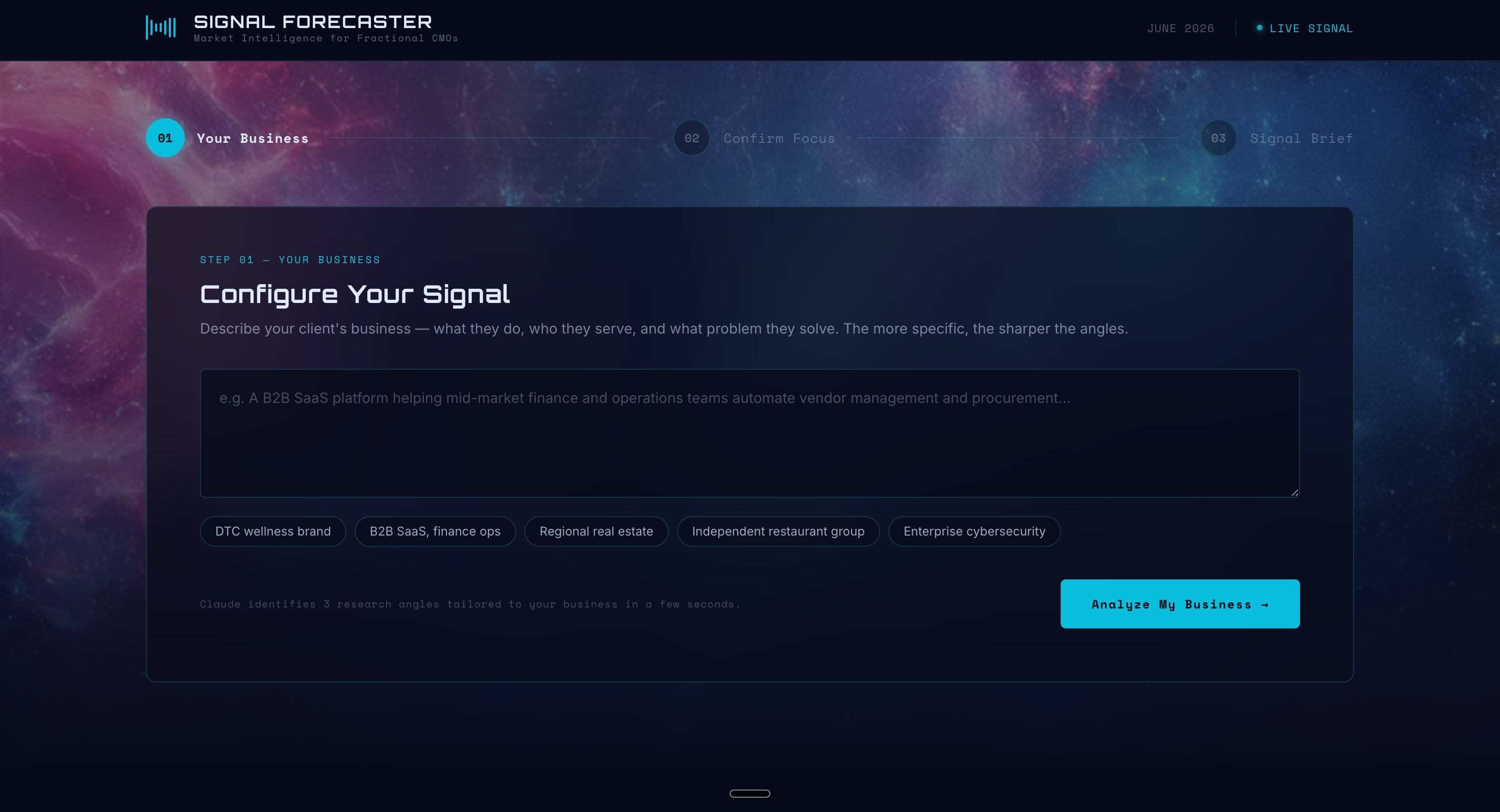
The Signal Forecaster does the research for you. Type any campaign or trend, and it searches the live web and returns a Signal Brief in about 30 seconds: the pattern name, a three-scenario Forward Hypothesis, and the recommended move. The same structure you just read, for any topic a client throws at you. You walk into the meeting already holding the answer.
I’m opening 5 pilot spots to fractional CMOs at no cost, in exchange for a 20-minute feedback call.
Matt’s take
The Rational Narrative: the campaign your competitors will copy and the pipeline they will not get
Image Capture
The Failure-State Frame is growing.
It is not emerging anymore, and it is not yet table stakes. There is roughly 12 to 24 months of runway before cinematic emotional B2B becomes the award-circuit default and stops being a differentiator.
Here is the read on the signals. Three things point the same way. The 2026 practitioner conversation on YouTube is dominated by brand-led demand and the irrational B2B buyer. LinkedIn ad budgets are climbing as a share of B2B spend. And a second enterprise brand just won in the same tier, with Anthropic’s “Keep Thinking” from agency Mother taking Best B2B Campaign at Ad Age’s 2026 Creativity Awards for dramatizing AI disruption over a feature list. That is enough to call the direction.
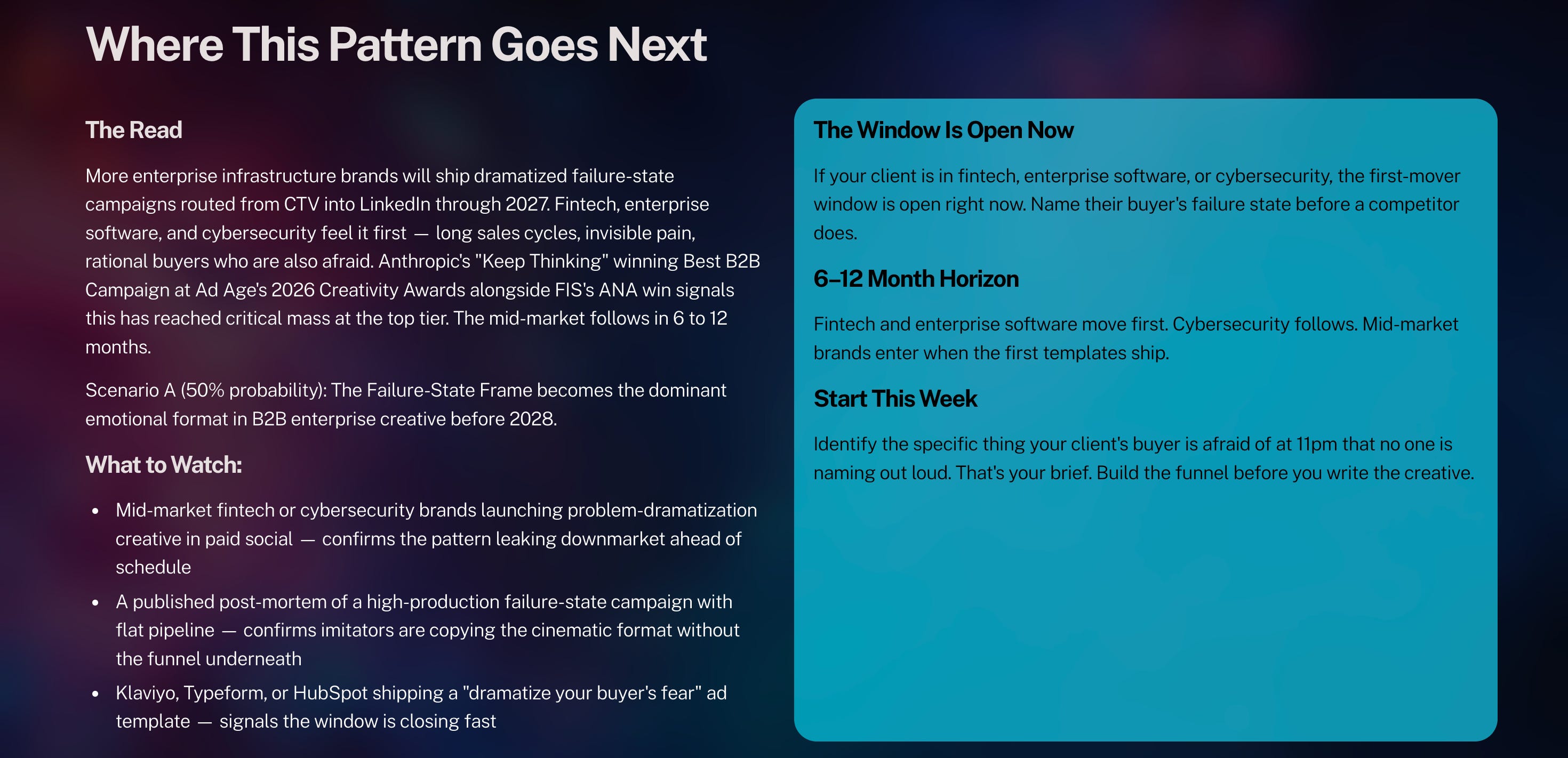
Scenario A is the most likely.
Call it 50 percent, through 2027. More enterprise infrastructure brands ship dramatized failure-state campaigns routed from connected TV into LinkedIn. Fintech, enterprise software, and cybersecurity feel it first, because the pain is invisible and the sales cycle is long.
Scenario B is the one to watch.
Call it 25 percent, inside 18 months. The campaigns launch, and the pipeline stays flat. Imitators copy the cinematic format and miss the mechanism underneath it. What confirms it within 90 days is a clean-brand copycat reporting strong awareness and weak named-account conversion.
Scenario C is the long shot.
Call it 10 percent, inside 6 months. The frame leaks downmarket and goes rational. Global Payments is already running compressed failure-state hooks in small-business paid social. What would elevate this is three or more mid-market fintech advertisers running problem-dramatization creative in paid social.
A word on the proof. The FIS numbers come from its own award entry, so treat them as a reported outcome, not an audited result. An FIS marketing leader reportedly sat on the awards jury, which is worth naming out loud. The Meta Ad Library measures paid inventory, not demand. Google Trends measures normalized search interest, not pipeline. None of that kills the case. It just sets the confidence honestly.
What would change this read. If an operator publishes a post-mortem of a high-production failure-state campaign that produced flat pipeline, Scenario B jumps.
Watch for FIS’s own reported contract value tracking the reputational news cycle ahead of the campaign launch date. That would tell you the engine was credibility all along.
The Signal: FIS won by advertising harmony while it was visibly drowning
Here’s what I didn’t expect to find.
FIS sold a campaign called harmony while the company was visibly living in disharmony. Its own rising search queries during the window were about layoffs, a securities settlement, and acquisition chaos. Rational analysis says that reputational undertow should have undercut the message. It did the opposite. It made the message credible.
The buyers at those 53 named accounts were hearing testimony. A company describing a cost it was visibly paying in public. FIS could name the chaos of broken financial systems with authority because it was bleeding from that chaos in plain sight. The wound was the campaign’s proof of standing.
There’s a precedent that should make every marketer pause. Harley-Davidson, 1983 to 1987. The brand was so close to bankruptcy that on New Year’s Eve 1985 its leadership reportedly sat in a bank with two stacks of paper, one for recapitalization and one for Chapter 11 (The Motley Fool). Everyone knew Harley was wounded. And the comeback landed precisely because it leaned into that battered, authentic heritage rather than hiding it. The audience could feel a brand that had actually been through it.
So here’s what it changes. The moat in this pattern is not the film. It’s whether the brand has standing to name the pain it dramatizes.
The Keystone: the wound is the moat, and you cannot buy it with a media budget
Everyone is about to chase the wrong thing.
The agencies will sell the cinematic film. The vendors will sell the proprietary-research spine. Both are real, and both are copyable.
The thing that’s hard to copy is experiential authority. A genuine claim to the specific failure you’re naming. FIS could sell the cost of disharmony because it was bleeding from disharmony. HP could sell the terror of the breach because it lives in security. The credibility came from the scar, and a brand with a clean record and a $6 million budget cannot purchase the scar.
This is where the minister’s instinct beats the analyst’s. A model can compute which emotion tests best. It cannot tell you whether you’ve earned the right to speak the emotion. Buyers can feel the difference between testimony and packaging the way you can feel the difference between a friend who has actually grieved and one who read a book about it.
So before your client borrows this playbook, ask the real question. Does the brand have a wound it can honestly name?
The frame is replicable. The wound is not.
Where in your client’s business is there a real, visible scar that gives them standing to name their buyer’s pain? Hit reply and tell me. I read every response.
Thanks for reading. Have a good week. See you on the flip side.
P.S. The Signal Forecaster turns any campaign or trend into a full Signal Brief in about 30 seconds, so you can run this play for any client, on demand. I have 5 free pilot spots open for fractional CMOs, in exchange for a 20-minute feedback call. Request a pilot spot →