

In this issue:
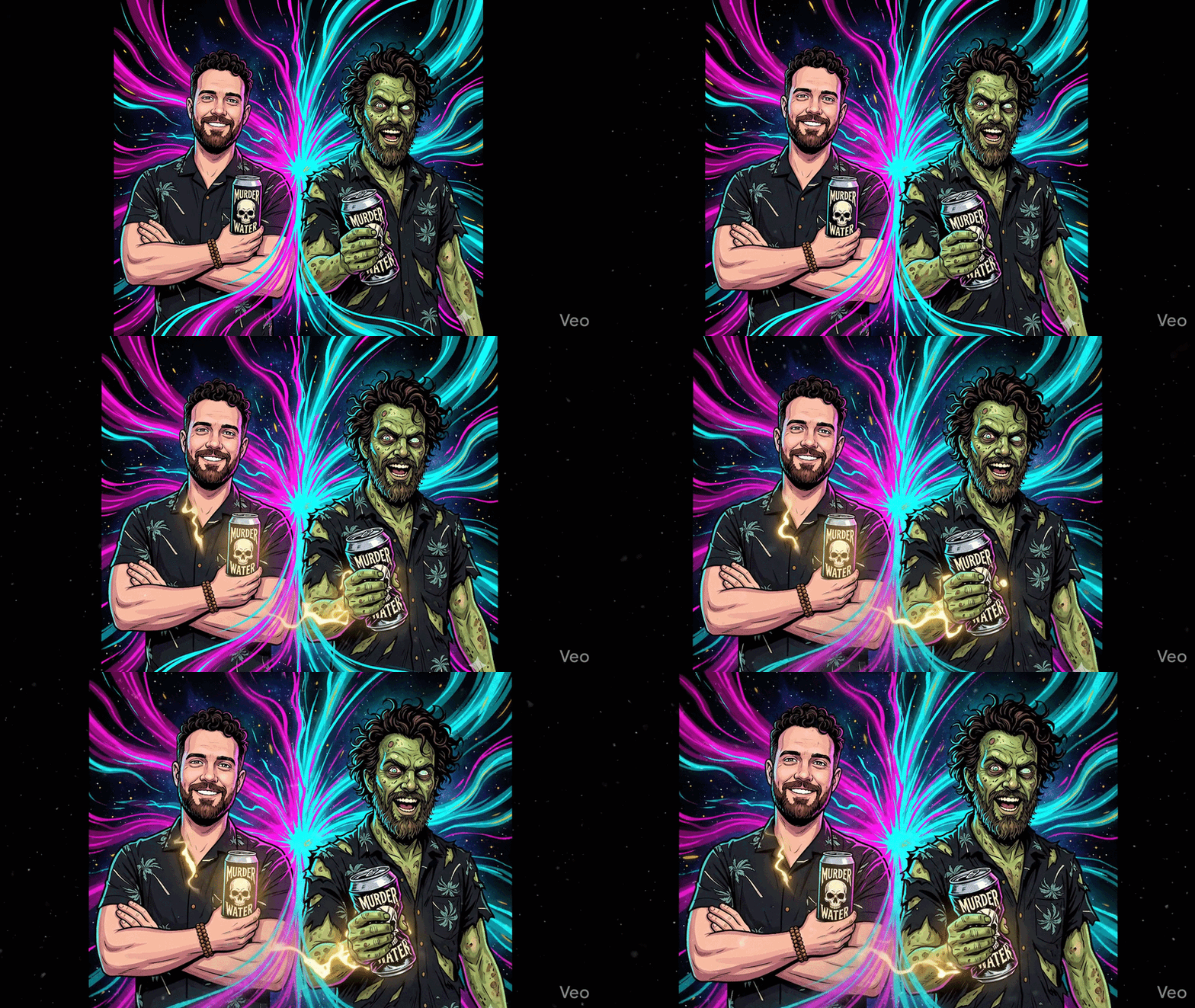
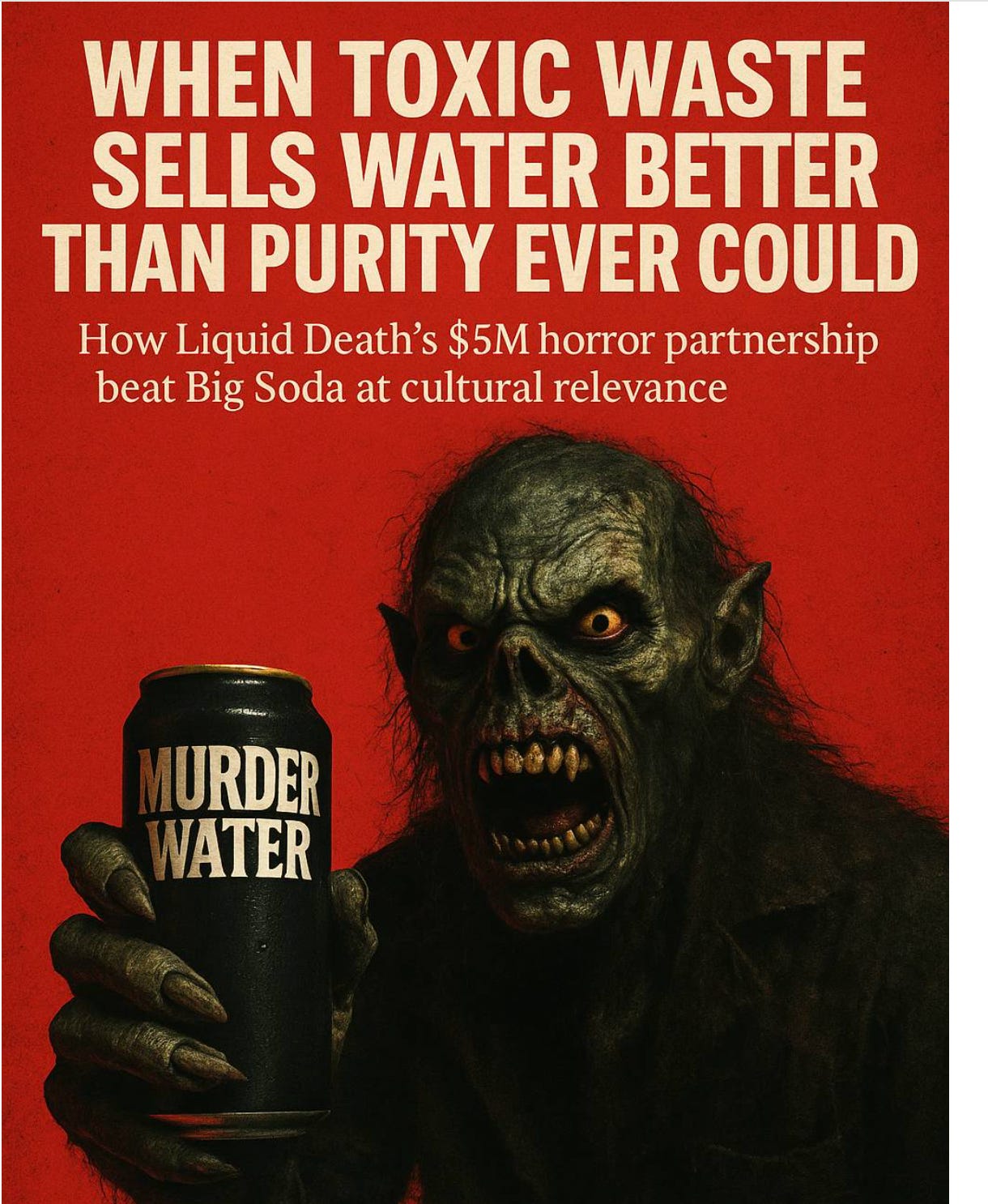
Borrowed Authenticity: the pattern behind Liquid Death’s Toxic Avenger campaign and why a gore-horror mutant selling water drove $333M in revenue
How Old Spice, Dollar Shave Club, and Poo-Pourri ran the same architecture across three different categories
Three brands that borrowed without the right to and paid for it within 24 hours
A full video breakdown on The Strategy Signal YouTube channel
A custom GPT that runs the Borrowed Authenticity diagnostics against your own brand
Intro
You ever been outspent by your category giants?
Here's how Liquid Death won anyway. Without spending what Pepsi spends on a single ad.
There’s a scene in the Liquid Death ad where Peter Dinklage, in character as “The Toxic Avenger,” rips the arm off of a teenager to demonstrate what soda does to your body.
It’s violently disgusting.
It’s shocking and hilarious.
And it somehow makes you trust the brand more.
I’ve been sitting with that since I first watched the PSA. Not necessarily the creative choice (although that’s there in spades) but the strategic one underneath it. Why does a grotesque character make a health message land harder? Why does borrowing someone else’s credibility work better than building your own from scratch?
The campaign launched August 19, 2025. Timed to the theatrical release of The Toxic Avenger on August 29. Under $5 million total budget for acquisition, distribution, and all marketing. Over $2 million in box office. Second-highest physical pre-order numbers in Cineverse history.
And $333 million in Liquid Death revenue for 2024, up 26.6% year over year.
The product hasn’t changed. It’s still water. Here’s what has.
How Liquid Death & Toxic Avenger Worked Together
Video: “The Toxic Avenger: Liquid Death Spokesperson” — watch the ad
The partnership ran four entities at once.
Liquid Death (host brand and creative team), Cineverse (film distributor, funding the promotion), Legendary Entertainment (film producer, bringing A-list talent: Dinklage, Kevin Bacon, Elijah Wood), and Troma Entertainment (original IP owners, 40-year legacy in cult horror).
Each brought something the others couldn’t generate alone.
Cineverse got direct access to Liquid Death’s 8 million social media followers: the exact demographic for a cult horror-comedy reboot. Liquid Death got a high-production-value creative asset with a recognizable actor at a fraction of what that normally costs.
And Troma’s punk-horror credibility gave the whole thing an authenticity that no agency brief could manufacture.
The creative team was entirely in-house.
VP of Creative Andy Pearson and Creative Director Will Carsola directed the PSA. Carsola personally executed the arm-ripping practical effect and got sprayed with about a liter of fake blood. This matters. The campaign earned its Troma aesthetic because the people making it actually cared about getting it right.
Distribution went digital-first.
YouTube, social, and a dedicated campaign hub at liquiddeath.com. A Times Square OOH placement layered on top for legitimacy and earned media.
The billboard turned a digital stunt into a cultural moment.
(Just a quick not here: the campaign budget has not been publicly disclosed. Specific Liquid Death campaign-level ROI and attribution methodology are also not public. Treat the revenue figures as company-level correlation, not confirmed campaign causation.)
Liquid Death achieved $333 million in revenue in 2024, up 26.6% year over year. They grew from $45 million in 2021 to $263 million in 2023. That’s a $1.4 billion valuation in March 2024.
And here’s the structural reality.
Coca-Cola and PepsiCo can’t copy this. Because their legal teams, brand safety reviews, and mass-market positioning make edgy partnerships structurally impossible.
Liquid Death built a moat out of the exact territory incumbents are forbidden to enter.
The transferable pattern: Borrowed Authenticity
Video: The Toxic Avenger official trailer (2025)
Think of cultural credibility as a finite account.
Every brand that lectures an audience about health, sustainability, or responsibility draws from the same pool of consumer trust. The account runs dry fast.
This is exactly how E.l.f. did it well. The best sunscreen ad ever made looked nothing like an ad. How to smuggle a serious message.
Liquid Death found an account that was already full.
Troma Entertainment has been building horror-comedy credibility since 1974. Their fanbase is small, devoted, and deeply suspicious of anything corporate. By partnering with the Toxic Avenger IP, Liquid Death didn’t have to spend their own credibility. They could just borrow Troma’s. And because the thematic alignment was genuine (both brands traffic in toxicity, both reject sanitized culture, both reward audiences for having a specific taste), the loan felt like a gift.
Here’s what makes this pattern transferable: it works whenever thematic alignment is real and the audience would recognize the connection without being told.
The names alone signal it.
“Liquid Death” and “The Toxic Avenger” are pointing at the same cultural territory before a single frame of the ad runs. That kind of alignment can’t be reverse-engineered. It has to be discovered.
Borrowed Authenticity defined: Partner with a niche cultural asset that already has the credibility you need. Borrow their tone, their fanbase, and their earned trust. Create content that rewards the audience for getting the joke. Content that feels like it was made for them, not at them.
Where this pattern wins
1. Old Spice “The Man Your Man Could Smell Like” (2010)
Old Spice borrowed YouTube’s emerging absurdist humor culture to shed a brand image that had calcified around grandfathers.
Isaiah Mustafa’s rapid-fire monologue felt like a viral sketch, not a television ad. Sales jumped 107% year over year.
Old Spice became the #1 men’s body wash in the U.S.
2. Dollar Shave Club launch video (2012)
$4,500 budget. Founder Michael Dubin borrowed the raw, direct-to-camera aesthetic of early YouTube creators — unpolished, profane, speaking the language of the internet rather than the language of advertising. 12,000 subscribers in 48 hours. Sold to Unilever for $1 billion four years later.
3. Poo-Pourri “Girls Don’t Poop” (2013)
Poo-Pourri borrowed the “prim, proper British spokeswoman” archetype and then subverted it completely.
They placed that character on a toilet in a glamorous setting and had her deliver shockingly frank lines with total composure. The contrast between high-class delivery and low-brow subject created something compulsively shareable.
More than 45 million views. A new product category, created through one video.
In each case, the brand found an existing cultural account with credibility to spare, made a deposit of thematic alignment, and withdrew something they couldn’t have built on their own.
Where this pattern fails
This is where most brands get hurt.
1. Pepsi Kendall Jenner protest ad (2017)
Pepsi ran a campaign featuring Kendall Jenner handing a Pepsi to a police officer at a protest, positioned as a message of unity. Pepsi pulled it within 24 hours. They tried to use social justice imagery without the cultural credibility to touch it. The entertainment was corporate. The message read as appropriation.
Swift, brutal backlash.
2. Burger King UK International Women’s Day tweet (2021)
Burger King tweeted “Women belong in the kitchen.” The follow-up tweet explained a scholarship program for female chefs. The tweet was deleted within hours. Twitter’s fast-scroll feed meant most people saw only the first tweet. The punchline never arrived. The intent was real. The format destroyed it.
3. Hyundai UK suicide-themed ad (2013)
Hyundai produced a spot showing a man surviving a suicide attempt because his hydrogen car’s emissions were only water.
The concept dramatized a real product truth. The execution trivialized a serious subject. Hyundai yanked it and issued a public apology.
The failure condition across all 3: borrowed without the right to borrow. Borrowed Authenticity requires genuine thematic alignment and earned cultural credibility. Without both, you’re not borrowing — you’re trespassing.
Want to go deeper on the failure conditions?
I walk through each of these cases and the early warning signs in my video commentary on this campaign.
Watch: Borrowed Authenticity — the deep dive (YouTube)
3 diagnostics before you run this pattern
Does your brand have authentic cultural credibility in the space you’re targeting?
Liquid Death has a flaming skull and a tagline that says “Murder Your Thirst.” That’s more than a campaign, it’s an identity. A brand without that settled foundation trying to borrow Troma’s credibility would have looked desperate. The audience reads that difference in seconds.
Can you identify a cultural asset your audience already loves, the one where the thematic alignment is obvious, not manufactured? The test: would your audience recognize the connection without being told?
If you have to explain why the partnership makes sense, it probably doesn’t.
Do you have the channels and community to amplify this organically? Liquid Death had 8 million social followers and a Times Square billboard to give the campaign legitimacy. Earned media requires something worth covering.
Something worth covering requires people who’ll actually see it first.
Apply the Borrowed Authenticity pattern to your own brand.
I built a GPT that walks you through these diagnostics against your actual business and surfaces the cultural assets your audience already trusts.
Get the Borrowed Authenticity GPT →
The infrastructure question campaign briefs rarely ask
Here’s the thing I didn’t expect when I went deep into this campaign.
The more I looked at Liquid Death, the less interested I became in the creative work itself. And the more interested I became in the infrastructure that made it possible.
Liquid Death has an in-house creative team. They shipped the Toxic Avenger PSA in weeks. Most legacy brands spend that same window in legal review. The campaign’s real competitive advantage was the organizational structure that made fast partnerships possible. I think about it like the difference between having good instincts and having trained reflexes. Both serve you in a moment of opportunity.
But only one shows up before you’ve consciously decided to act.
Not gonna lie: I had this problem in my first year of ghostwriting.
I had decent ideas and slow execution. By the time I finished drafting something, the cultural window had moved on. The work was technically fine and functionally useless.
What Liquid Death solved before the campaign existed was the version of that problem at scale.
And here’s what I’m still not certain about: whether Borrowed Authenticity is a strategy you choose, or whether it’s a behavior that falls naturally out of knowing who you are. The brands that pull this off have usually spent years being exactly one thing. The IP alignment feels inevitable because the identity was settled long before the partnership was pitched. You can’t borrow credibility you haven’t already earned the right to hold.
So the question worth sitting with: what would your brand have to genuinely believe about itself for a partnership like this to feel obvious, not strategic, obvious?
That answer tells you whether you have a brand.
Or a product with a personality attached.
One campaign per week. One strategic pattern. Read it, steal it, use it.
— Matt