

How Coors Light beat the Super Bowl by skipping it
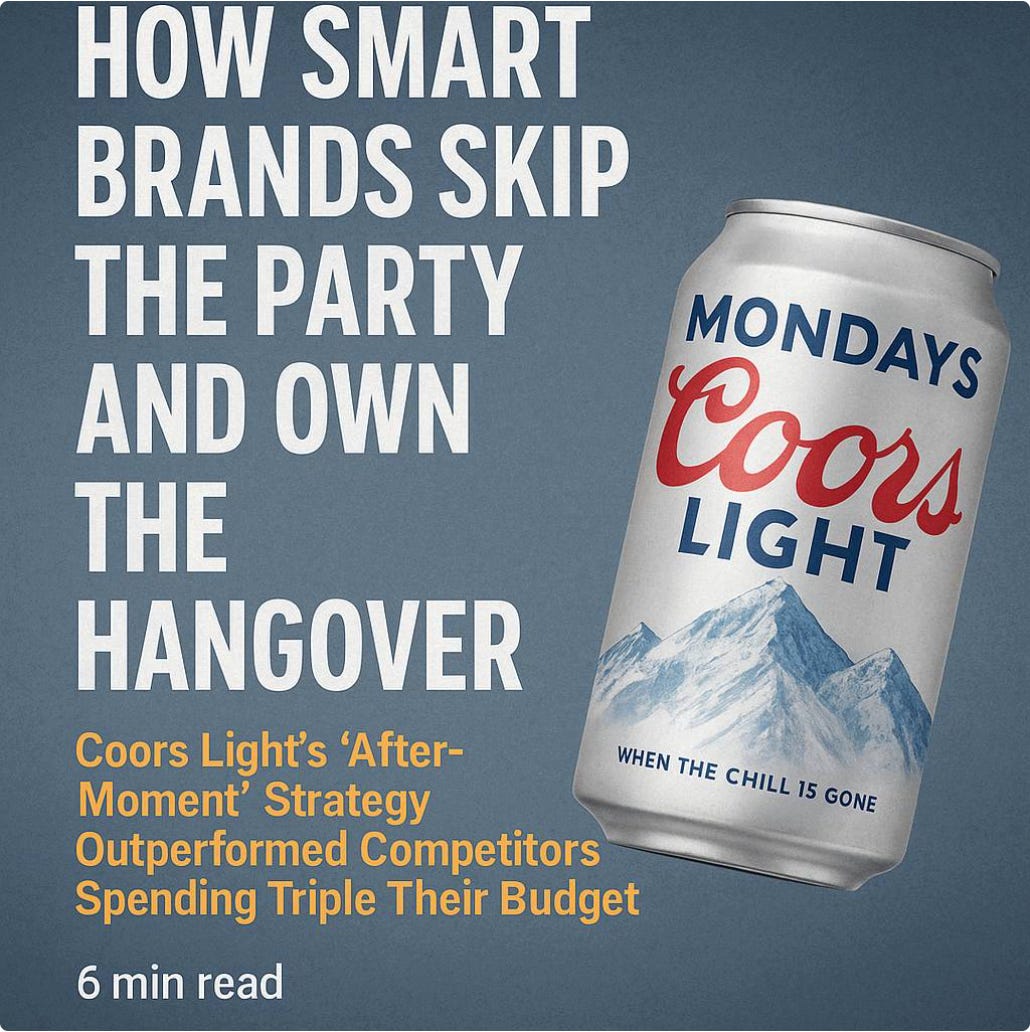
Intro
A 30-second Super Bowl ad costs $7 million.
Seven million dollars. Thirty seconds. An audience split between the game, their phones, and the guacamole.
Coors Light bought a month instead.
They generated 12.6 billion earned media impressions, sold 1.8 million limited-edition cases (complete sellout), and hit their highest search volume for “Coors Light” in 12 months, while competitors were still paying production invoices on the ads they ran during the game.
Here’s the pattern they used.
And why it’s transferable to almost any industry that has a major cultural calendar moment.
If you're a watch-it person, I broke this down on video. Same pattern, different format.
Otherwise, let's go.
The Pattern: The Cultural Aftermarket
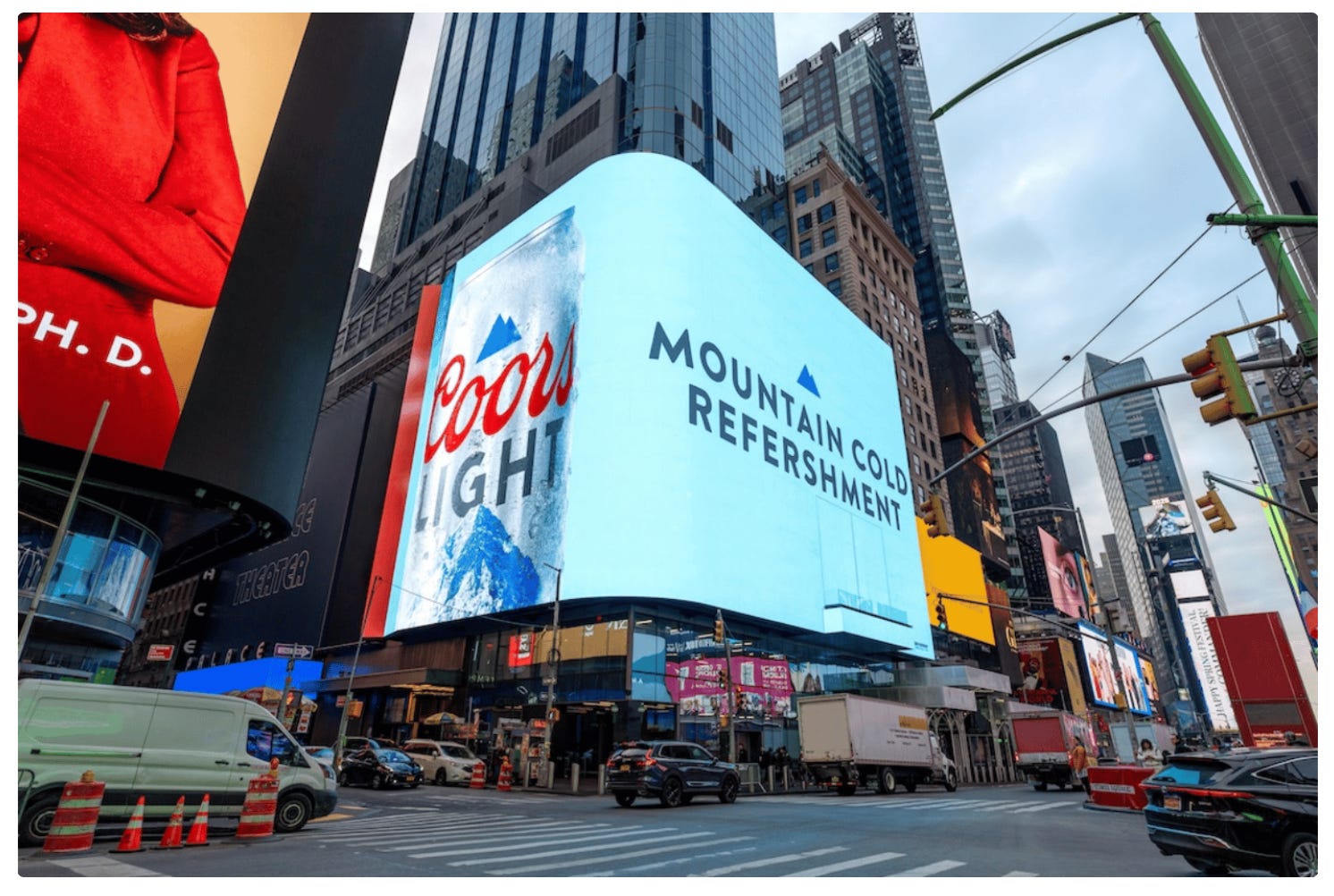
[Photo: Times Square billboard featuring strategic "refershment" typo] Strategic vulnerability in premium media placement demonstrated authentic brand connection over polished competition. Source: Campaign Analysis via Campaign US]
Major cultural events create enormous emotional energy.
Just think about it.
The Super Bowl. Black Friday. A product launch. A national election. Everyone competes for attention at the peak moment. The event itself gets saturated with too many brands, too much noise, fragmenting customer attention.
But the emotional aftermath? The morning after? The quiet Tuesday nobody planned for?
Nobody’s there.
The Cultural Aftermarket is the practice of identifying the uncontested emotional territory immediately adjacent to a major cultural moment, then building comprehensive brand ownership around it.
The aftermarket has lower competition, higher authenticity potential, and dramatically better cost efficiency.
Coors Light demonstrated all three.
The case study: Coors Light “Case of the Mondays”
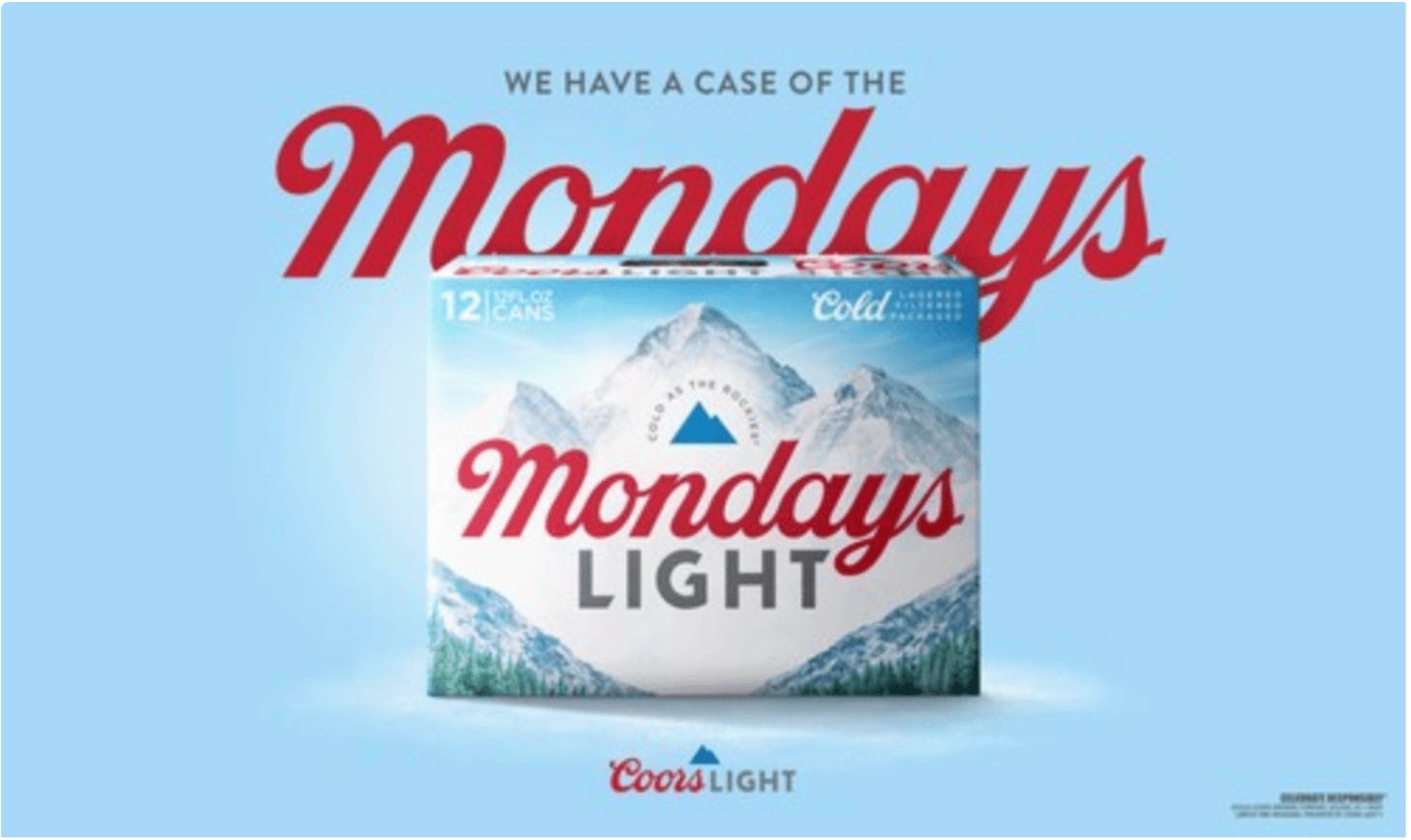
[Photo: "Mondays Light" limited-edition 12-pack packaging]Strategic timing materialized: Turning cultural moment into literal product transformation.Source: Molson Coors via PR Newswire
Super Bowl Sunday is a war zone for advertisers.
The audience is distracted, divided between the game, their phones, and whoever brought the bad chips. Competitors spend triple the budget chasing fractured attention.
Image via ASI Central
Coors Light asked a different question: what happens Monday?
Here’s what happens.
60% of Americans and Canadians wake up post-game feeling sluggish. Forty-one percent rank that Monday among the worst days of the year. People are disappointed. Their team lost. Or their team won, and now real life is back. They have to work.
And…well, the party is over.
So Coors Light ran a month-long campaign called “Case of the Mondays.”
They released 1.8 million limited-edition “Mondays Light” cases. They gave away free beer to people calling in sick. They created a Chill Face Roller. And it sold out in under ten minutes across multiple restocks.
The results:
The campaign sold 1.8 million limited-edition beer cases completely. Searches for “Coors Light” hit a 12-month high during the campaign period.
Social conversation spiked 400% on game day. Campaign achieved 8.5 billion earned media impressions across the month-long timeline.
Retail display presence grew 5% versus previous year. Coors Light became the most displayed beer brand pre-Super Bowl.The highest search volume for “Coors Light” in 12 months, with sustained momentum long after the campaign window closed.
All without buying a single Super Bowl ad
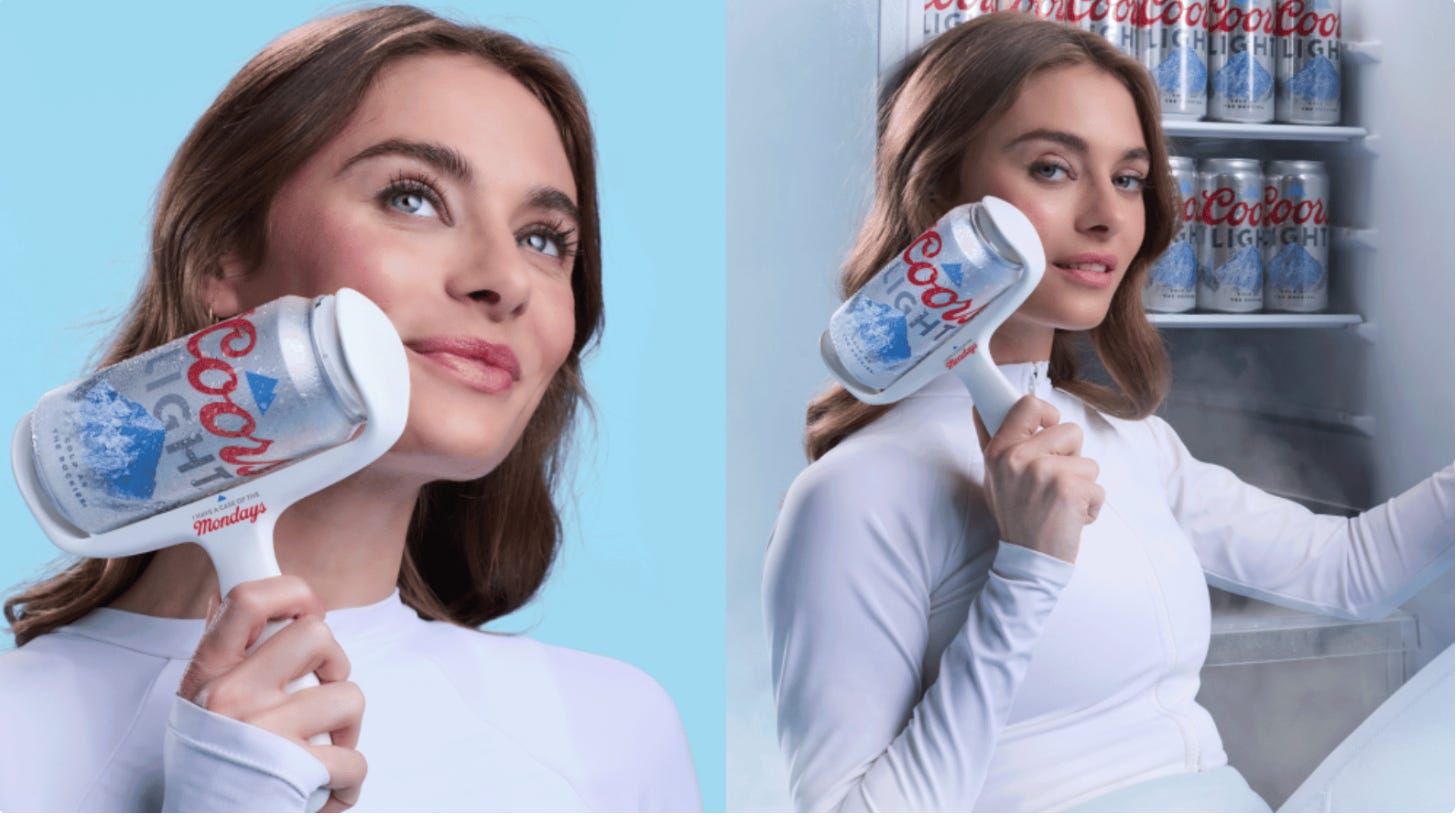
[Photo: Coors Light Chill Face Roller - viral innovation that sold out in under 10 minutes]Strategic risk validation: Cross-industry product innovation generated immediate sellout and viral social amplification.Source: Product Innovation Coverage via WWD
They owned an emotional state nobody else was touching.
Molson Coors never disclosed the campaign budget and the exact spend remains confidential. The efficiency signal is in the results.
The Monday blues are universal.
The Monday after the Super Bowl is specifically universal.
And for an entire month, when millions of people felt that low, Coors Light was already there.
Timeline Execution: How did they roll it out?
January 2025: Launch with typo strategy and social buildup
Pre-Super Bowl: Limited packaging and merchandise drops
February 9, 2025: Super Bowl LIX ad and peak activation

• Post-Super Bowl Monday: Owned cultural moment with Sloths and Peloton classes
Cross-industry proof: the same pattern, three different industries
Now, it would be one thing if that strategy pattern worked for just Coors Light, but it turns out it works for other industries, too.
Let’s unpack that.
1. The REI #OptOutside Close their Doors on Black Friday
REI ran #OptOutside on Black Friday 2015.
Every retail competitor was fighting for the high point of the consumer spending calendar.
REI closed their stores entirely and paid employees to go outside instead. They owned the anti-Black Friday sentiment, the exhaustion and spending guilt many people feel about that day. Membership applications jumped 36%. Employee approval hit 90%. The campaign became an annual brand-defining movement.
Generated 36% increase in membership applications, established recurring brand-defining movement.
More than 1.4 million people pledged to participate in first year.
Same pattern. Retail.
2. Oreo in the Dark
Oreo executed it in real time during the 2013 Super Bowl blackout. The stadium went dark. Every other advertiser was scrambling. Oreo’s team posted one tweet: “You can still dunk in the dark.” Fifteen thousand retweets in the first hour. One hundred million earned media impressions. Zero ad spend. They claimed the unplanned blackout moment while everyone else was frozen.
Achieved over 15,000 retweets and massive earned media without buying ad space
Generated approximately $525 million in media impressions.
Same pattern. CPG.
3. Airbnb We Accept Campaign
Airbnb ran “We Accept” in January 2017, timed to the post-inauguration period when immigration tensions were peaking and people were feeling specifically excluded. They showed up in that emotional space authentically. Five million YouTube views. The travel industry’s clearest positioning on inclusion.
Same pattern. Travel.
Three companies. Three industries. One mechanism: find the moment nobody else is standing in.
Why this pattern is accelerating
Three forces are converging to make The Cultural Aftermarket more powerful each year.
Super Bowl ad costs hit $8 million per 30-second slot in 2025. The ROI math gets harder every cycle. Brands spending that money need every fraction of attention available, which makes competition at the peak brutal and the value of adjacent space keeps rising.
Attention fragmentation means peak moments deliver less than they look like on paper. The Super Bowl used to be a captive audience. Now it’s a second-screen event. The quiet Monday morning often produces more focused, receptive attention than the event itself.
And consumers, especially Gen Z, have developed a fine-tuned ability to detect performative emotion. They know when a brand is forcing its way into a cultural moment for the attention grab. The Cultural Aftermarket works precisely because the emotional territory is real. The Monday blues are real. The post-inauguration anxiety was real. Showing up in those moments, honestly, without forcing a product into the peak, lands differently than any 30-second slot.
Where this pattern fails
Two well-documented failures make the failure condition clear.
Pepsi’s 2017 Kendall Jenner ad tried to own social justice emotion. Pepsi had no earned permission in that territory. The brand’s core identity (soda, pop culture, youth) gave it no authentic foothold in that space. Pepsi pulled the ad within 24 hours, and it became a case study in tone-deaf brand extension.
McDonald’s “Dead Dad” ad in 2017 tried to capture grief as emotional territory. Fast food and grief are a misaligned pairing. McDonald’s pulled the ad after public criticism.
Both cases share the same failure condition: forced emotional alignment. The brand showed up in emotional space it hadn’t earned the right to occupy.
Coors Light owns “cold beer after a rough day.” That gave them natural permission to own Monday morning recovery. Airbnb hosts people in their homes. That gave them permission to speak to belonging. REI’s identity is built around choosing the outdoors. That gave them permission to challenge the consumption ritual.
The real diagnostic question is simpler and harder: what emotional territory does your brand already have permission to enter?
Implementation questions: run these before attempting the pattern
Does your industry have a major event that creates a predictable emotional hangover? Every industry has a version of the Super Bowl — annual conferences, earnings seasons, Black Friday, back-to-school, trade show weeks. Look for the moment everyone exhaustedly returns home from.
Does your brand have natural permission to show up in the low moment? This is the brand permission test. Coors Light had it. Pepsi didn’t. Where does your brand already live in your customer’s emotional world?
Can you sustain a multi-week campaign across multiple touch points? The Cultural Aftermarket requires duration. The after-moment lasts longer than a tweet.
Are you comfortable with strategic vulnerability? This pattern often requires admitting something real. Brands that can hold that vulnerability without flinching get the reward.
I built a GPT that runs the Cultural Aftermarket diagnostic on your specific client.
You input the brand, the industry, the calendar moment. It tells you whether the pattern fits and where the permission gaps are. Free. Takes about 30 secs [Link]
Matt’s take: The low note is where loyalty forms. Almost nobody is marketing there.
There’s a story from my chaplaincy training I keep coming back to.
Paul Tournier was a Swiss physician and author, well into his eighties, frail, still receiving visitors from around the world at his home in Geneva. One afternoon, a chaplaincy professor arrived with thirty university students. All strangers to Tournier. He greeted each one individually. Asked their name, where they were from, something about their life.
Then he walked to a garden shed. Emerged with a pile of flags. And raised the flag of each student’s home country at the flagpole in his backyard.
One by one. Thirty flags. For thirty strangers.
David Benner, who witnessed it, called it “one of the most moving acts of hospitality I have ever witnessed.” What Tournier did was honor exactly where each person came from. He created space for the specific human standing in front of him. He didn’t redirect the moment or try to make thirty strangers feel like something other than what they were.
That’s the posture Coors Light took with the Monday after the Super Bowl.
Every other advertiser tried to redirect, pump it up, extend the energy, keep the celebration going. Coors Light raised the Monday flag. They said: we see you. We know where you are right now. We’re not here to fix it.
In chaplaincy, we call this soul hospitality. Meeting someone in their actual emotional state without rushing them somewhere else.
The brands that win The Cultural Aftermarket are the ones willing to honor the low moment exactly as it presents. The sloth campaign, the Chill Face Roller, the free beer for calling in sick, which none of that is trying to elevate Monday. It’s celebrating Monday for what it actually is.
Most marketing budgets are allocated toward the high note. Soul hospitality says the low note is where loyalty forms.
That’s contemplative marketing. Slowing down when the market speeds up. And it’s a category most CMOs have never once put on a planning deck.
¹ David G. Benner, Sacred Companions: The Gift of Spiritual Friendship and Direction (Downers Grove, IL: InterVarsity Press, 2002), 48–51. The Tournier story and the concept of “soul hospitality” are drawn from Benner’s account of Tournier’s practice of spiritual accompaniment. Paul Tournier (1898–1986) was a Swiss physician and author known for integrating medicine with spiritual and psychological care.
Close
Every week, The Strategy Signal breaks down one real campaign pattern, shows where it works, where it fails, and hands you the questions to run it in your own context.
If this one hit for you, the vault is building. Everything above this issue is already there.
And if you’re a fractional marketing leader thinking about how to bring this kind of thinking to a client, that’s exactly who I’m building this for.
Leave me your thoughts in the comment on the GPT or this week’s pattern.
— Matt
The Strategy Signal | Strategic pattern recognition for marketing leaders
Indeed if the brand doesn't own the emotion it's hard for it to pull off a cultural after market campaign. Will try your GPT too 😊.