

What do you do to stop chasing the 2%?
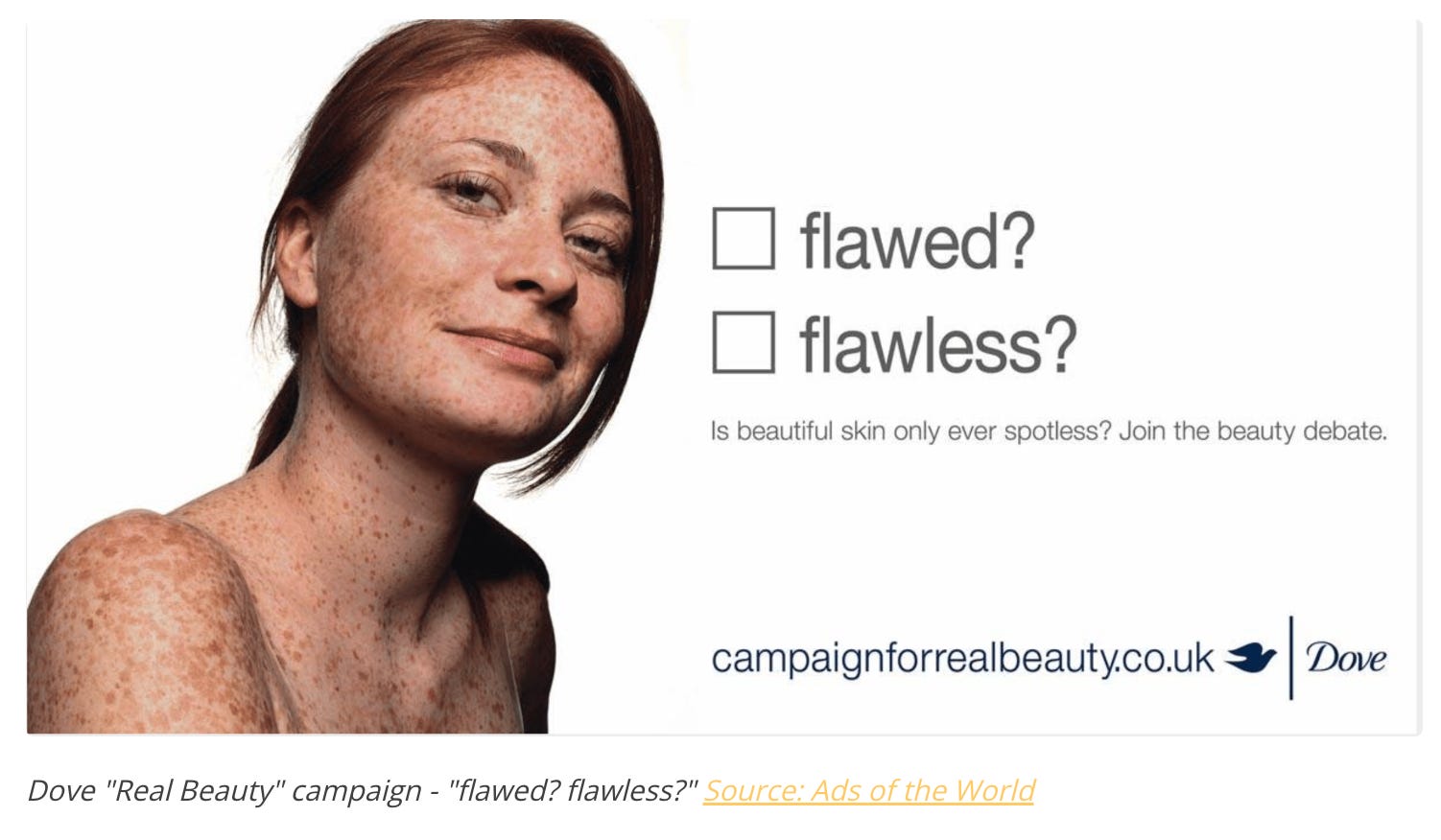
Dove weaponized the beauty industry’s own research against it and built a 20-year competitive moat in the process.
Watch the Purpose-Driven breakdown on Youtube
Same pattern, different format.
In 2004, Dove commissioned a global study with researchers from Harvard and the London School of Economics.¹
The finding was damning.
Only 2% of women worldwide described themselves as beautiful. And 68% agreed that media set unrealistic standards. And 75% said they wished the industry did a better job representing diverse ages, shapes, and sizes.
Dove’s leadership looked at that data and saw something most brands would have buried. It was the proof that their entire category had been selling to 98% of consumers while making them feel excluded.
While every competitor chased the same 2% with aspirational imagery and airbrushed perfection, Dove claimed the abandoned 98%.
The result?
Sales climbed from $2.5 billion to $4 billion over the first decade.² That’s 60% revenue growth in a category where everyone said the room for growth was spent.
The pattern: Purpose-Driven Category Inversion
Here’s what Dove actually did.
They inverted the category’s core assumption.
Every beauty brand in 2004 competed on aspiration: here’s the ideal, buy this product, reach it. The game was selling an impossible standard to people who could never achieve it, then selling them hope that the next product might close the gap.
Dove’s research proved the strategy was backfiring.
Consumers felt alienated by the very advertising designed to attract them. And no major brand was addressing that disconnect.
Purpose-Driven Category Inversion is the pattern here. Find the fundamental dishonesty your industry tells customers. Surface it with undeniable data. Then build your brand on telling the truth.
Interestingly this is also the POV of the Strategy Signal. Stay tuned for the next issue.
The pattern works because it transforms marketing from persuasion to advocacy. When you side with deeply held consumer values, people side with your cause. And competitors can’t follow you without looking like hypocrites.
But the pattern carries three non-negotiable requirements:
irrefutable consumer research that exposes the disconnect,
operational authenticity (your products must be able to deliver on the honest promise), and
platform thinking over campaign cycles.
You’re building a movement. That distinction matters.
Dove checked all three.
The case study: Real Beauty
The campaign launched in October 2004 with a series of billboards.
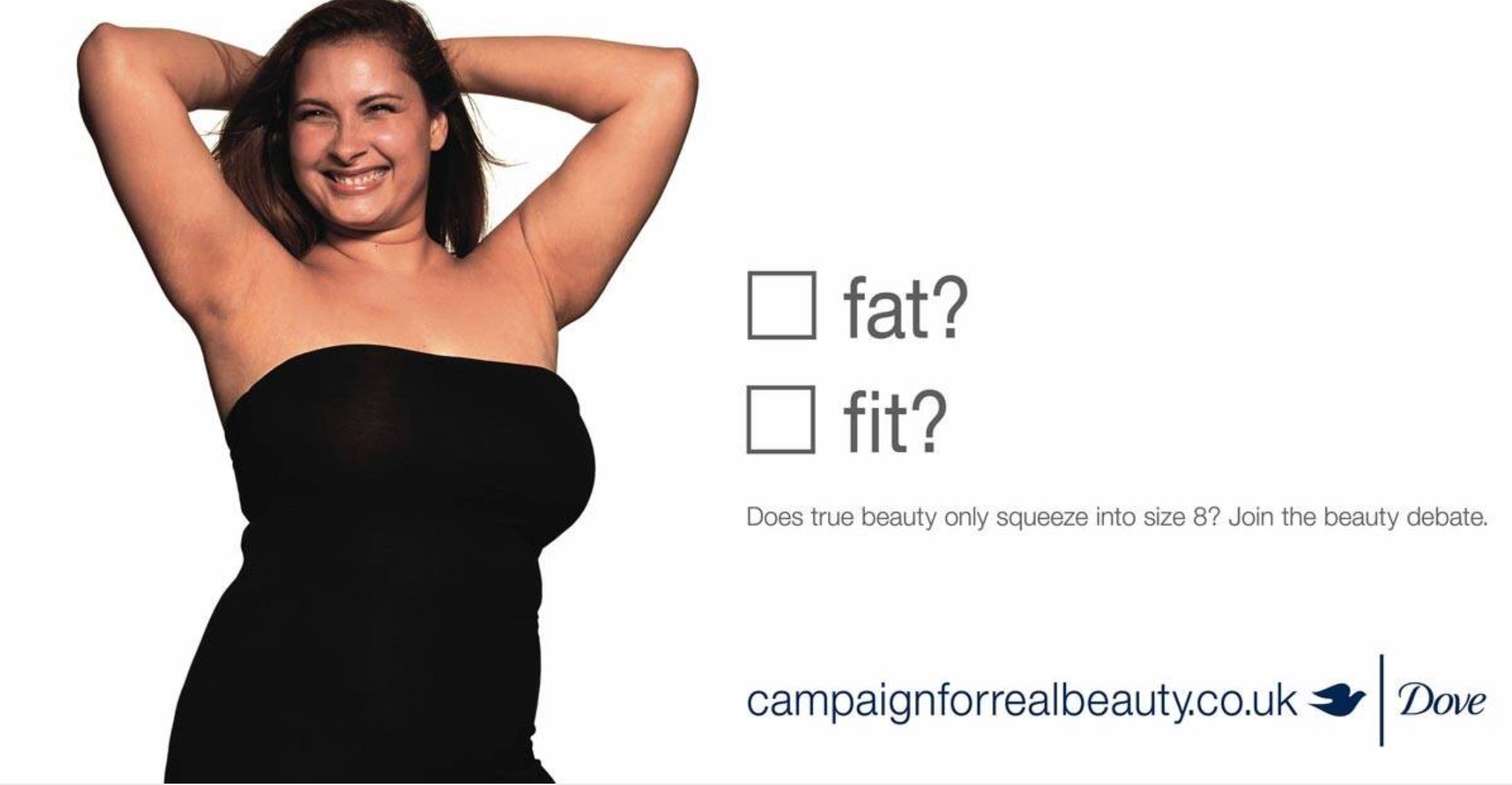
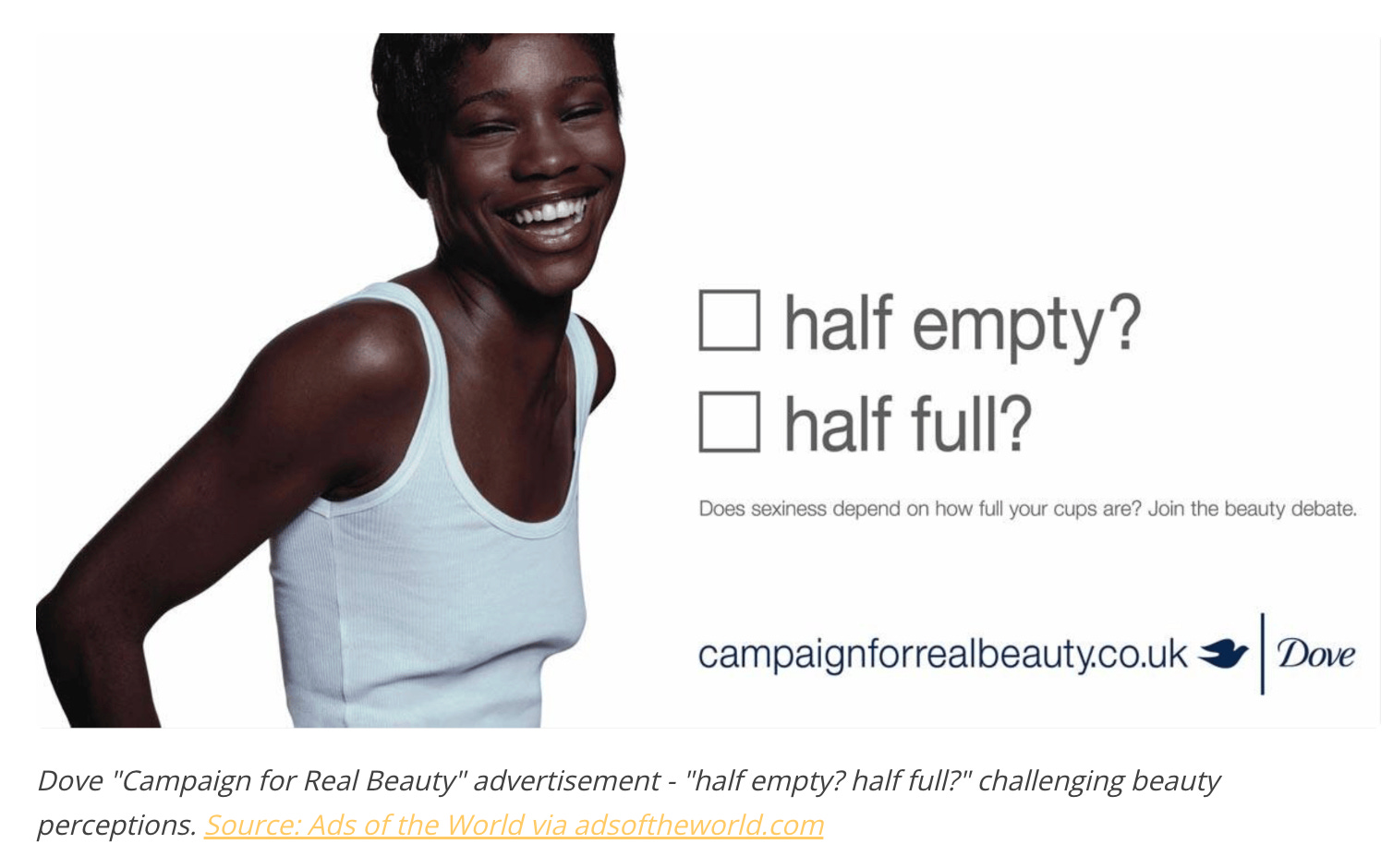
Ogilvy & Mather global brand director Sylvia Lagnado and her team hired portrait photographer Ian Rankin to shoot ordinary women, unretouched, representing ages, shapes, and ethnicities no beauty billboard had shown before.
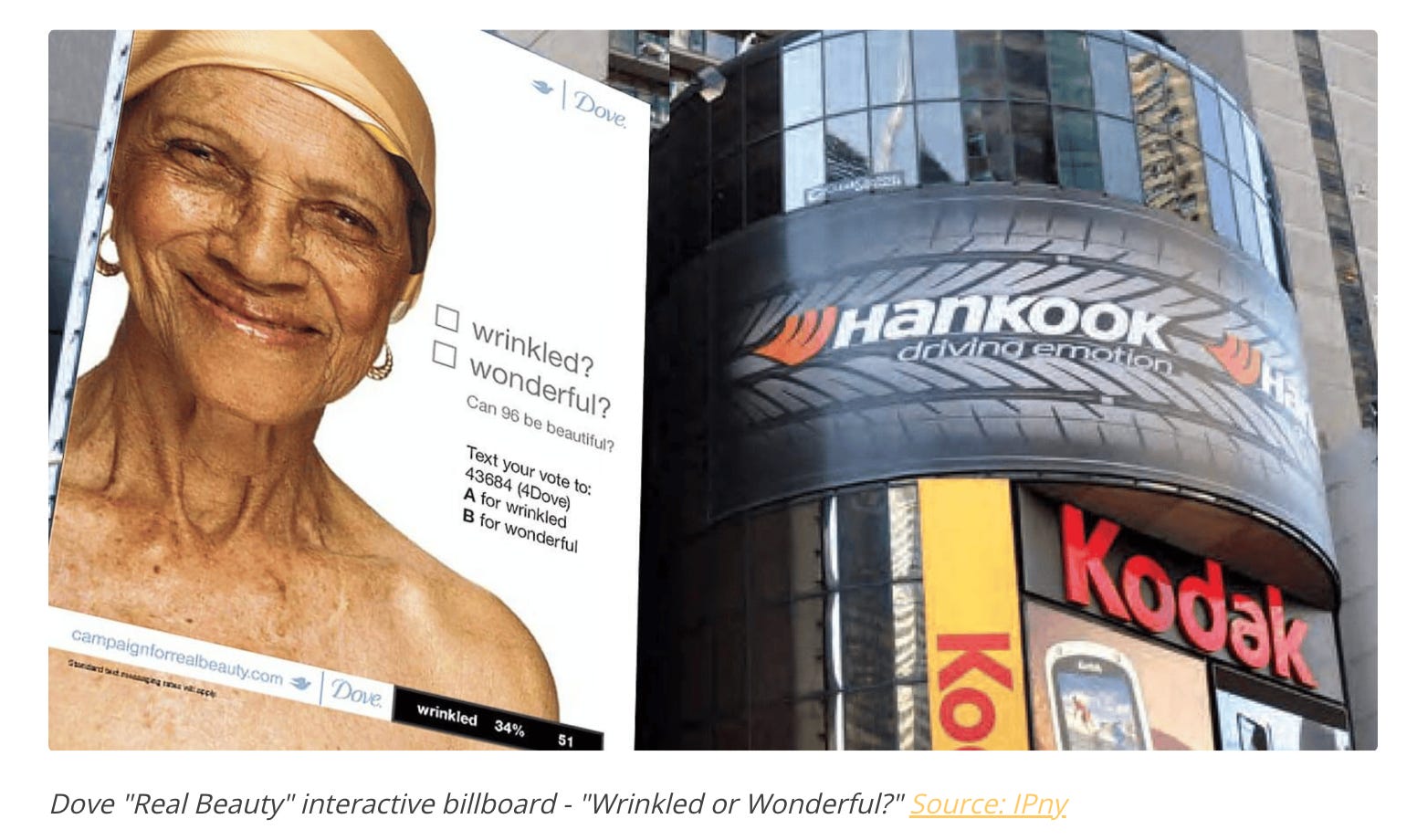
The creative intelligence was in the headline. Each billboard posed a binary question: Wrinkled or Wonderful? Fat or Fit? Grey or Gorgeous? Flawed or Flawless?
Passersby could vote via SMS. Results updated on the digital display in real-time. In Times Square, a lineup of women in their underwear celebrated curves and body diversity in front of millions of daily commuters.
Dove had turned an advertisement into a public forum. And in doing so, they’d conducted market research in public, in front of every competitor watching.
The first month told the story. Dove’s firming cream sales doubled.³ By month six, that product line had grown 700% in Europe. Market share jumped from 1% to 6% in that category alone.
In October 2006, the campaign released “Evolution,” a 75-second film directed by Tim Piper and Yael Staav on a production budget of roughly C$135,000.
The film showed a time-lapse of an ordinary woman being transformed through hair, makeup, and aggressive Photoshop retouching into a billboard model. It ended with one line: “No wonder our perception of beauty is distorted.”
The truth about how the industry manufactured the standard it sold against did the work on its own.
That C$135,000 film earned an estimated $150 million in free media coverage.⁴
In 2013, the campaign released “Real Beauty Sketches.” An FBI-trained forensic sketch artist, separated by a curtain, drew portraits of women based on their own self-descriptions, then drew a second portrait based on how a stranger described the same woman. The strangers’ portraits were consistently more accurate, more generous, more beautiful. The film closed: “You are more beautiful than you think.” It became one of the most-viewed video advertisements in history: 163 million views across 150 countries, generating 4.6 billion earned media impressions.⁵
Here’s what made the whole thing structurally different from any competitor campaign.
Dove operationalized the commitment.
In 2004, they launched the Dove Self-Esteem Project, which has since delivered body-confidence education to over 100 million young people across 150 countries.⁶ The marketing claim became an institutional program.
Competitors couldn’t copy this.
How does a brand that sells anti-wrinkle cream celebrate wrinkles? How does a brand whose business model depends on manufacturing insecurity suddenly champion self-acceptance? Any rapid pivot would have looked hypocritical. Dove claimed the authenticity high ground and made it structurally unavailable to anyone else.
By 2025, Dove and Ogilvy’s Real Beauty campaign won the Cannes Lions Grand Prix in Creative Strategy for Long-Term Brand Platform, recognizing two decades of sustained effectiveness in a single award.⁷
Cross-industry proof
The same pattern has run across at least three other industries.
Always #LikeAGirl (Procter & Gamble, 2014).
Leo Burnett commissioned research showing that more than half of girls lose confidence at puberty, the exact moment they first encounter feminine care products. The phrase “like a girl” had become a cultural insult. Always inverted it into a symbol of strength. The campaign generated over 90 million views across 150 countries and drove Always to 59.6% market share.⁸
Nike Dream Crazy (Wieden+Kennedy, 2018).
The sports apparel industry ran on strict political neutrality, an industry norm designed to avoid alienating any segment of a diverse global consumer base.
Nike inverted it.
They built the campaign around Colin Kaepernick, the NFL quarterback exiled from professional football for kneeling during the national anthem to protest racial injustice. The tagline: “Believe in something. Even if it means sacrificing everything.” The short-term backlash was real: burning shoes and boycott calls. The long-term result added an estimated $6 billion to Nike’s brand value and drove a 31% surge in direct sales.⁹
Burger King Moldy Whopper (INGO Stockholm, DAVID Miami, 2020).
Fast food’s ironclad aesthetic rule is visual perfection: tweezers, glue, and artificial coloring to make the product look impossible.
Burger King inverted it too. After quietly removing 8,500 tons of artificial preservatives from their supply chain over three years, they photographed their flagship burger decaying over 34 days and released it as their main campaign visual. The implicit message was plain: their food rots because it’s real food.
The campaign generated 8.4 billion media impressions, $40 million in earned media value, and a 14% sales increase.¹⁰
Three industries. Same pattern. Same mechanics.
Why this pattern wins right now
Three forces make Purpose-Driven Category Inversion more powerful in 2026 than when Dove launched it in 2004.
Advertising trust is near historic lows. Edelman’s Trust Barometer data tracks a sustained multi-decade decline in consumer trust across advertising, media, and corporate messaging.¹¹ When trust is scarce, the brand willing to name what the industry won’t becomes immediately credible. The truth-teller earns trust precisely because truth-telling has become rare.
Social media makes inauthenticity a liability with a short half-life. In 2004, a brand could run an aspirational campaign and the gap between that and consumer reality stayed quiet. In 2026, that gap surfaces within hours. The reverse is also true: an authentic campaign finds an audience that carries it for free. Dove’s “Evolution” earned $150 million in earned media from a C$135,000 budget in 2006, before social sharing was a mainstream behavior. The dynamics are even more favorable now.
Most categories still haven’t done this. The playbook is documented. The case studies are famous. And the majority of brands in the majority of industries are still selling aspiration to people who feel excluded by it. The abandoned majority is still out there, in nearly every market.
Where the pattern fails
1. Victoria’s Secret’s 2021 “VS Collective”
This rebrand attempted the pattern after spending three decades building the very standard it was trying to dismantle.
For most of its history, VS sold the Angels standard: a narrow, aspirational body type positioned as the pinnacle of feminine beauty. In 2021, facing falling sales and reputational damage from the Jeffrey Epstein–Wexner connection, the brand replaced its Angels with a diverse collective — Megan Rapinoe, Priyanka Chopra Jonas, transgender model Valentina Sampaio — and claimed to have changed.
The products hadn’t changed.
The business model hadn’t changed. No research foundation named the lie the brand had told for three decades. No institutional program backed the new claim. VS had spent decades profiting from the exact standard they were now denouncing, and critics immediately called it “inclusivity washing.” Sales continued to decline.
2. H&M’s Conscious Collection
H&M’s Conscious Collection ran the same failure mode in 2019. Sustainability positioning built on top of a fast-fashion business model that produced billions of garments annually. The marketing claimed authenticity the operations couldn’t deliver. Norway’s consumer watchdog flagged it publicly as greenwashing. Class action lawsuits followed.
3. Facebook “Here Together”
Facebook’s “Here Together” brand campaign in 2018 launched weeks after the Cambridge Analytica scandal broke. It positioned the platform as a safe space for human connection and promised to do better on user privacy. A business model built entirely on data collection cannot credibly position itself as a privacy champion. The FTC fined Facebook $5 billion for privacy violations the following year.
The pattern fails when the category inversion is marketing strategy without substance. Research, product alignment, and institutional commitment must all be present.
Two out of three produces backlash. One out of three produces ridicule.
The pattern fit test
Four questions to run before committing to this approach.
Question one: What does your category promise that consumers know, but haven’t said out loud, is false? The research Dove commissioned named what millions of women already knew. If you can’t point to a clear statistical gap between what your industry claims and what customers actually experience, the foundation is missing.
Question two: Can your core product deliver on an honest promise without contradiction? Dove sold cleansing and moisturizing products. Celebrating natural beauty didn’t undermine the product’s function. A brand whose primary revenue driver is anti-aging serum faces a harder alignment problem. The inversion has to work without making the product line hypocritical.
Question three: Is your organization prepared to sustain this for 10 to 20 years? Dove’s Self-Esteem Project has reached 100 million young people. Nike’s stance on social justice has outlasted multiple news cycles. The competitive moat this pattern builds is proportional to the commitment behind it. Campaign thinking and platform thinking produce completely different results.
Question four: How will your top three competitors respond? A competitor who can pivot to your position in 12 months signals a head start, and head starts expire. The structural advantage comes when competitors are architecturally locked out of matching you.
Dove earned the ground - My Personal Take
Culture assigns identity.
That’s Erich Neumann’s insight, and it holds more weight here than any marketing framework. When the beauty industry spent fifty years defining “beautiful” as a narrow physical standard, it handed people a definition of themselves. Women internalized the standard at the ego level. The cultural imposition and the self-concept fused.
Dove’s research found that 2% of women worldwide would describe themselves as beautiful. That word, themselves, is the tell. The industry’s standard had traveled all the way inward.
Robert Johnson, drawing on Jung, names a distinction worth sitting with: apprehension versus comprehension. You can know a thing completely before you have language for it. Carry it in how you move through a room. Feel it in what you skip past in a magazine. Apprehension precedes comprehension. The 98% had been apprehending the lie for decades before Dove named it. The feeling was there. The language was Dove’s to give.
Dove spent 3 years in research before they said anything publicly. That was the work of earning the right to name what already existed. They made sure they were receiving something real.
And what do you do once you’ve received it? In chaplaincy, we call this accompaniment. You sit with someone in the reality of their situation. You name what’s actually there. You stay. The naming is the work.
The brands that execute this pattern well are doing something that looks more like pastoral honesty than marketing strategy. They name something true about how people feel, at institutional scale, in public, in front of the companies that built the imposition.
The brands that fail operate at the surface level. They borrow the emotional texture of truth-telling without receiving the truth first. Pepsi rented the imagery. Dove earned the ground.
Here’s what I keep sitting with: consumers can feel the difference. They’ve been told enough false things that the truth, when it arrives, has a different weight to it.
The weight of it goes back further than any marketing framework.¹²
If your category tells a lie that consumers are carrying quietly, and you have the operational ability to tell the truth instead, you have a responsibility. The brands that act on it build 20-year competitive moats.
The ones that wait keep chasing the 2%.
If this issue gave you a useful frame, forward it to one person on your team who needs it. That’s how The Strategy Signal grows.
— Matt
P.S. The tool

If you manage client brands, the Purpose-Driven Inverter Playbook runs the fit analysis for you. Fit score, implementation roadmap, failure mode checklist, client-ready deck. Built for fractional CMOs.
Footnotes or…”in case you’re wondering where it came from!”
¹ Nancy Etcoff, Susie Orbach, Jennifer Scott, and Heidi D’Agostino, “The Real Truth About Beauty: A Global Report,” commissioned by Dove (Unilever), 2004. The study surveyed 3,200 women across ten countries. Full campaign history and study context: Dove Campaign for Real Beauty, Wikipedia.
² Unilever, “20 years on: Dove and the future of Real Beauty,” Unilever.com, 2024. Sales figures represent total Dove portfolio performance across the campaign period. Incremental attribution data and baseline comparisons have not been publicly disclosed by Unilever. For strategic planning, treat as campaign-period correlation rather than confirmed causation.
³ ARF David Ogilvy Awards, “Dove: The Campaign for Real Beauty,” American Research Foundation, 2007. Firming cream sales figures represent European market performance in the initial campaign launch phase.
⁴ “Evolution” (advertisement), Wikipedia. Production budget of C$135,000 and $150 million earned media value are the figures most widely cited from Ogilvy PR’s post-campaign analysis.
⁵ Dove and Ogilvy, “Real Beauty Sketches,” 2013. View count and earned media impression figures cited in Cannes Lions and Effie award submissions; broader campaign history covered in Ogilvy’s Real Beauty Grand Prix writeup.
⁶ Unilever, “20 years on: Dove and the future of Real Beauty,” 2024. The 100 million figure reflects the milestone reported in Unilever’s 2024 anniversary coverage, updating the 94.5 million figure from the 2023 Dove Self-Esteem Project impact report.
⁷ Ogilvy, “Dove and Ogilvy’s Decades-Long ‘Real Beauty’ Campaign Wins Creative Strategy Grand Prix,” Ogilvy.com, 2025.
⁸ CASSIES (Canadian Advertising Success Stories), “Always #LikeAGirl.” Market share figure (59.6%) sourced from US Brand Health Tracker data (July vs. June) per Leo Burnett’s campaign effectiveness documentation. View count per Campaign Live case study (2015): over 90 million views achieved within the campaign’s first two months. Confidence-at-puberty research sourced from Always Confidence & Puberty Survey, conducted by Leo Burnett and Procter & Gamble in support of the campaign. PR Grand Prix win confirmed via PR Newswire.
⁹ Nike “Dream Crazy” post-campaign analysis. $6 billion brand value addition and 31% direct sales surge per Nike’s Cannes Lions Creative Effectiveness Grand Prix submission (2021), as reported by Fortune and Contagious. Comprehensive breakdown at Globe Media Group.
¹⁰ WPP, “DAVID & INGO: Burger King Moldy Whopper,” WPP.com, 2020. Sales increase and earned media figures sourced from WPP’s published effectiveness report.
¹¹ Edelman, “2024 Trust Barometer,” Edelman.com, 2024. The 24th annual survey fielded across 28 countries with 32,000+ respondents.
¹² Neumann, Erich. The Origins and History of Consciousness. New York: Pantheon Books, 1954. Johnson, Robert A. Inner Work: Using Dreams and Active Imagination for Personal Growth. San Francisco: HarperSanFrancisco, 1986.