

What’ is the Strategy Signal? Everyone has access to the same marketing case studies. Nobody extracts the strategic pattern, proves it across industries, or tells you where it breaks. The Strategy Signal does all three. One campaign per week. Read the Pattern below.
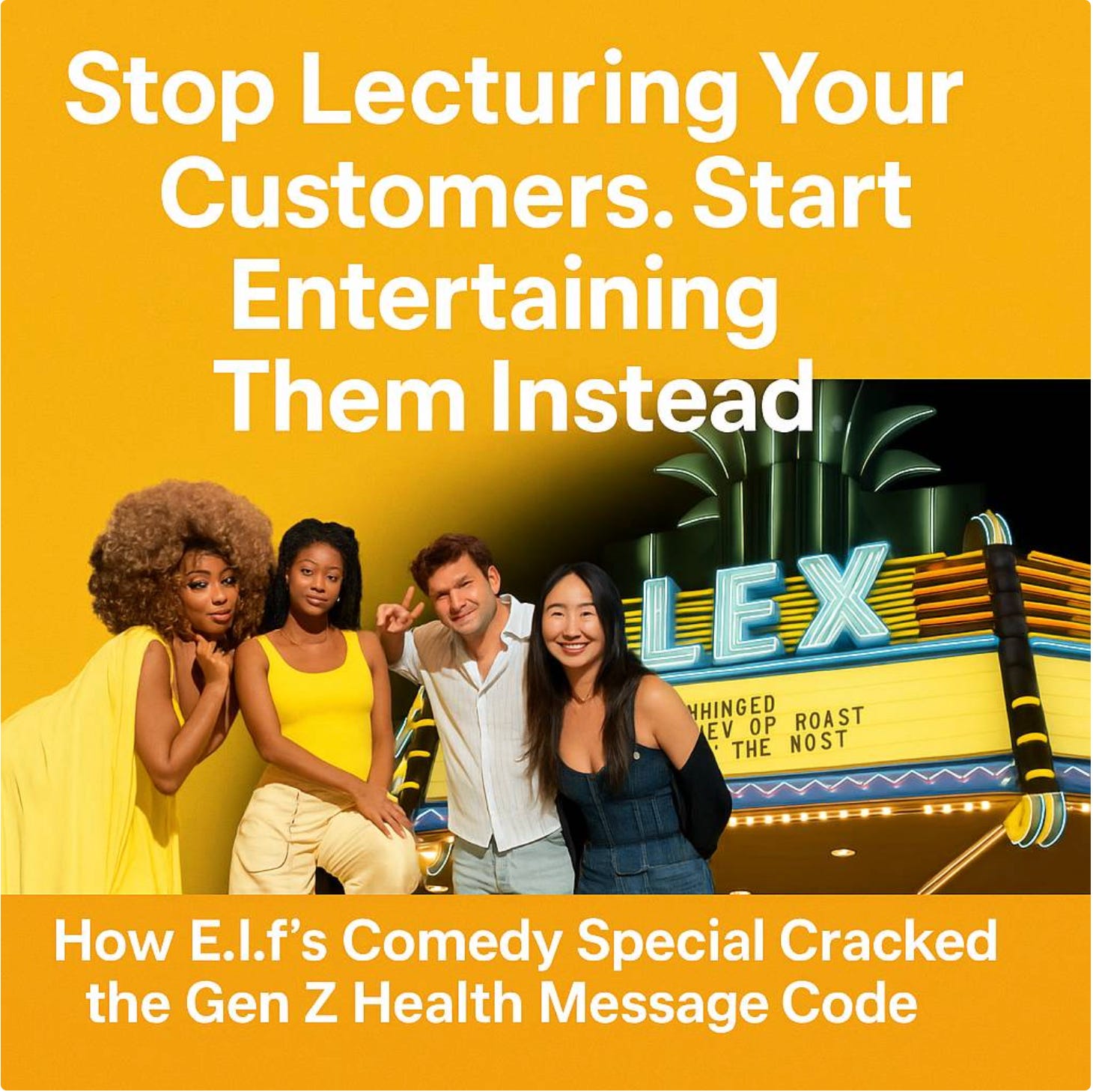
How E.l.f. Skin made a public health campaign Gen Z actually chose to watch, and what the pattern means for every brand sitting on a message its audience is tuning out.
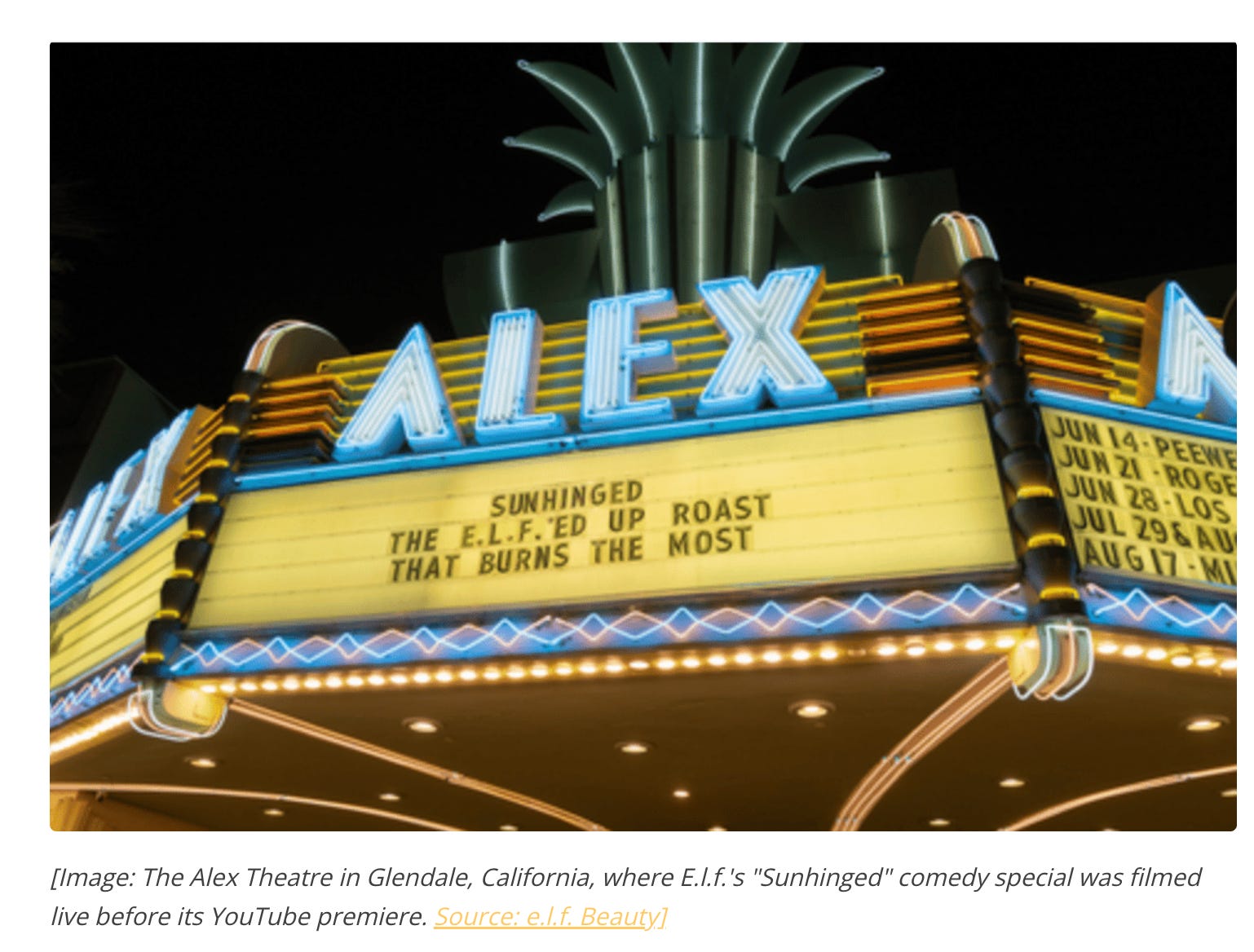
In June 2025, E.l.f. Skin released a 20-minute comedy special on YouTube.
Not a 30-second ad. Not a six-second pre-roll. A 20-minute production with professional comedians, a celebrity cast, and a Tribeca Film Festival premiere.
Approximately ten million people watched it in the first week.
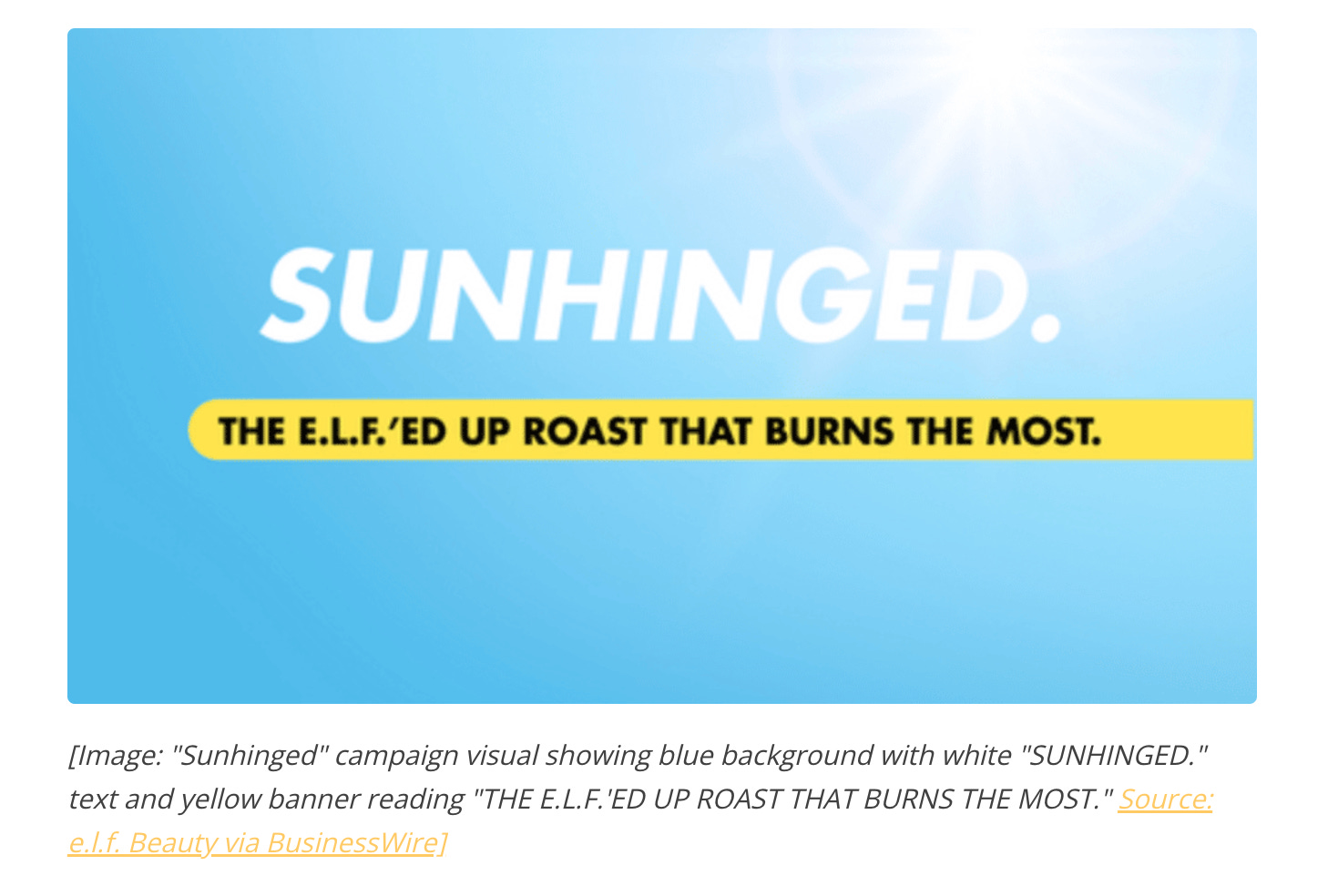
The special is called “Sunhinged.” The subject is sunscreen. The creative hook: a full stand-up comedy roast of the sun itself, cast as the “hot girl villain” of the piece. Comedian Marie Faustin hosted. Meghan Trainor appeared in her third collaboration with the brand. Heidi N’ Closet from RuPaul’s Drag Race joined the cast.
Underneath all of it ran a public health message: 64% of Gen Z regularly forgets to apply SPF.
E.l.f. made a PSA. They disguised it as entertainment people would choose to watch.
Ten million people chose.
Watch the Entertainment Trojan Horse breakdown on Youtube
Same pattern, different format.
The pattern: the entertainment trojan horse
Here’s the signal for the week.
A brand takes a message the audience would normally filter out (a health warning, a behavior change request, an inconvenient category truth) and wraps it inside high-quality entertainment.
The audience comes for the content. They absorb the message as a byproduct.
The Trojan Horse works because the psychological defense wall drops when people laugh. The Oracle Happiness Report, which surveyed over 12,000 consumers globally, found that 91% of people prefer brands that are funny, and 90% are more likely to remember humorous advertising. Among Gen Z specifically, 75% say they want brands to make them laugh — and only 20% of brands actually do it.
That gap is the opportunity.
Earned attention lands somewhere the algorithm can’t reach.
Like Inside a moment of genuine enjoyment. Here’s the youtube trailer below.
The behavioral change travels past the audience’s resistance filters while they’re busy being entertained.
Here’s the deeper principle: the frame is the product.
E.l.f. did so much more than change the sunscreen, the audience, or the underlying health message. They changed the frame from health compliance to cultural participation. That frame change was the entire campaign.
It’s the oldest trick in persuasion. E.l.f. gave it a $2.5 million production budget and a Tribeca premiere.
Primary case study: “Sunhinged,” E.l.f. Skin, June 14, 2025
The rational narrative
Every major brand in the sun care category ran the same playbook. La Roche-Posay built clinical authority campaigns around dermatologist partnerships. Neutrogena invested in UV-tracking wearables and weather-activated advertising. The American Academy of Dermatology pushed statistics through professional medical channels. The assumption underneath all of it: if people understood the danger clearly enough, they’d change their behavior.
That assumption failed.
According to the American Academy of Dermatology, 64% of Gen Z regularly skips sunscreen. Only 34% cite skin cancer prevention as a primary reason to use SPF. Half the demographic gets severely sunburned every summer. The demographic that follows dermatologists on TikTok and knows the active ingredients in their serums was still ignoring the rational answer, delivered through every rational channel the industry had.
If logic were enough, someone would have found it by now.
The signal underneath
The real driver was psychological resistance to being lectured.
Health messaging, however accurate, triggers the same defensive response as any unsolicited advice: the audience knows what’s coming before the first word lands, and the wall goes up. The rational sotry had been addressing what Gen Z knew. E.l.f. looked for what Gen Z actually felt.
And they found it.
It was the defense wall that drops when people laugh. Humor bypasses the resistance that logic runs directly into. The behavior problem was wearing the costume of a knowledge problem.
Underneath, it was a psychological one with a psychological solution.
The creative decision
The answer was a comedy roast of the sun.
Marie Faustin, a working stand-up comedian with legitimate club credentials, hosted. Meghan Trainor brought her fanbase and her third brand collaboration to the production. Heidi N’ Closet brought the RuPaul’s Drag Race audience and the LGBTQ+ beauty community into the tent.
Watch the full 20 minute Comedy Special just below.
The production partner was Above Average, the Emmy-winning comedy company launched through Lorne Michaels’ Broadway Video. That choice carried a specific signal before a single joke aired. Audiences recognize the difference between corporate entertainment trying to be funny and production infrastructure with SNL DNA.
Above Average provided borrowed credibility the brand couldn’t have built internally.
The trailer premiered at the Tribeca Film Festival on June 6, running in front of 450+ screenings over ten days before the full special launched on YouTube on June 14. Tribeca credentials signal filmmaking. E.l.f. arrived at that event as a content creator, and the cultural positioning followed accordingly.
The business result
Approximately ten million YouTube views in the first week.
Combined reach across celebrity talent social networks, including Meghan Trainor’s audience, reportedly exceeded 100 million followers across campaign partners.
E.l.f. Beauty reported their 26th consecutive quarter of net sales growth in Q1 2026, with net sales reaching $353.7 million (up 9% year-over-year). Company leadership cited “very significant, strong ROI” from entertainment-driven marketing during that period. E.l.f. is the only brand among nearly 1,000 cosmetics brands tracked by Nielsen to gain market share for 26 consecutive quarters.
The Suntouchable SPF line the campaign supported sells at $8 to $18.29, cruelty-free and vegan, no white cast, lightweight wear. Price points aligned with E.l.f.’s foundational brand promise: accessible quality. The campaign made the product feel like participation in a cultural moment.
Cross-industry proof: the same pattern in three other categories
1. Metro Trains Melbourne: “Dumb Ways to Die” (public safety, 2012)
Railway safety campaigns had a long tradition of graphic imagery and grim consequence statistics.
Metro Trains Melbourne went the opposite direction: a darkly humorous animated music video featuring cheerful characters dying in increasingly absurd ways, three of them wandering into train-related danger at the end.
The song became the most shared video on the internet in 2012. The campaign accumulated over 325 million YouTube views and became the most awarded campaign in Cannes Lions history: 28 Lions, including 5 Grand Prix. Near-miss incidents at train stations fell 20 to 21% in the year following the campaign’s release.
The rational narrative was safety statistics and consequences.
The signal underneath was that no one voluntarily consumes fear. The PSA reached people because it gave them something they wanted to share.
The safety message traveled inside the entertainment.
2. Blendtec: “Will It Blend?” (consumer appliances, 2006–2009)
Blendtec had a genuine product story: their commercial blenders were extraordinarily powerful. The standard product demo approach existed. Nothing broke through.
CEO Tom Dickson’s answer: blend an iPhone on camera.
The series ran for years. Dickson in a lab coat, destroying progressively more absurd objects (golf balls, rake handles, garden hoses) while asking “Will it blend?” The absurdity was the point. But the entertainment carried a real product claim: this blender handles things professionals need to destroy.
Online sales climbed approximately 700% over the three-year run of the series.
3. Chipotle: “Farmed and Dangerous” (food service, 2014)
Chipotle produced a four-episode satirical miniseries for Hulu mocking industrial agriculture through a fictional narrative about a corrupt farming corporation. The brand’s name showed up in the credits.
Nowhere else in the story.
An independent study found the series more effective at changing consumer attitudes than 98% of social-issue documentary films. Chipotle’s “Food with Integrity” positioning traveled inside the story itself.
In a category where direct brand assertions get processed as marketing noise, that decision mattered.
Why it works now: 3 converging forces
Post-pandemic purpose fatigue.
Years of serious brand messaging around health, safety, and social responsibility trained audiences to tune out earnest content at scale.
Cannes Lions 2024 showed approximately 75% of winning campaigns used humor, up from 52% in 2023. Levity reads as credibility now because seriousness became table stakes.
The humor gap is a strategic arbitrage opportunity before the market corrects.
The entertainment-advertising gap stays wide.
Ninety-one percent of consumers prefer funny brands. Twenty percent of brands use humor. When that supply-demand imbalance stays severe, brands that cross to the entertainment side find enormous uncrowded space.
The ones that get there first lock in positioning before the gold rush starts.
Platform behavior has shifted toward long-form.
Gen Z watches long-form content on YouTube the way older generations watched network television. A 20-minute branded special arrives as the content itself. Gen Z watches it by choice, the same way they’d choose any show.
Brands that build for that platform behavior generate the engagement numbers that media-buy reporting can’t produce.
Failure analysis: 2 ways the Trojan Horse collapses
The pattern fails in two distinct ways. Both are worth studying before you build anything with it.
Failure 1: The vehicle breaks the audience’s trust
E.l.f. — “e.l.f.ino & schmarnes,” 2025
Following the success of Sunhinged, E.l.f. launched a satirical legal drama under the same playbook. Heidi N’ Closet returned. Comedian Matt Rife joined the cast.
The backlash arrived within days.
Rife had recently released a Netflix special that opened with a domestic violence joke. A significant portion of E.l.f.’s community had loved Sunhinged precisely for its inclusive, warmhearted energy. They read the Rife casting as a betrayal. E.l.f. issued a public statement acknowledging they had “missed the mark with people we care about in our e.l.f. Community.” The brand left the campaign running.
The failure condition: Sunhinged worked because every element (the talent, the tone, Above Average’s production credibility, the Tribeca premiere) signaled safety to the audience before the first joke landed. The Rife casting introduced a variable that was culturally corrosive to the brand’s core community. The container broke. The message broke with it.
The marketing error was an error of omission. E.l.f. left out the question of what the Rife casting would signal to the community they’d just built real trust with through Sunhinged.Failure 2: The horse is a costume
Gillette — “We Believe: The Best Men Can Be,” January 2019
In January 2019, Gillette released a short film built around the cultural conversation following #MeToo.
The brand’s thirty-year tagline, “The Best a Man Can Get,” had always been about product performance. “We Believe” attempted to reframe it: what does it mean for men to be their best selves while a culture reckons with toxic masculinity?
The cultural frame was real and the emotional territory was genuinely charged. The film generated millions of dislikes in its first days on YouTube and a trending boycott hashtag. Gillette kept the campaign running. The audience’s verdict was clear.
The brand was performing conviction rather than possessing it.
The Failure? The film existed only as advertising.
Remove the Gillette logo and what remains is an unbranded montage of men behaving badly and then slightly better. No story, no comedy, no performance value that earns an audience’s voluntary time. Sunhinged works as a comedy special before it works as a marketing vehicle. The Gillette film only works as an ad. The Trojan Horse was built from the outside in: cultural frame first, brand repositioning second, entertainment never.
Both failure modes end in audience rejection, through opposite routes. In the E.l.f. case, the vehicle was real but the talent selection destroyed trust in it. In the Gillette case, the vehicle itself was never real. The entertainment was built to carry the brand message. It had no value independent of the brand.
The test before you build: can this content earn an audience if the brand logo is removed?
If yes, the horse is real. If the answer requires the brand present to make sense of what you’ve made, you’ve built a costume.
How to bring the Entertainment Trojan Horse to life in your business?
Before taking this pattern into a client brief, work through these.
What’s the rational narrative in your category?
Name the conventional playbook your competitors are running, the logical plan, the settled industry wisdom. Then ask: is it actually working? If the rational answer has been available for years and the behavior hasn’t changed, the invitation is to look underneath the logic for the human drive the logic was never designed to detect.
What’s the psychological resistance your audience carries into the category?
Name it honestly. Not the stated reason they give you in surveys — the actual felt experience: the boredom, the judgment-avoidance, the defense wall that goes up when they see a certain type of message coming. That’s the signal. The Trojan Horse vehicle has to address the felt experience, not the stated reason.
What entertainment format has your audience’s genuine, voluntary attention right now?
The vehicle has to exist inside a format they already love and choose on their own time. Sunhinged worked because 20-minute YouTube comedy is a format Gen Z seeks. The Dumb Ways to Die song worked because earworm music videos are a format people share.
Can this content earn an audience if the brand logo is removed?
This is the test that separates a real Trojan Horse from a costume. If the answer is yes, build it.
If the content only makes sense with the brand present, go back to the brief.
Now Your Free GPT - The Entertainment Trojan Horse Playbook
If you want to try this out on your brand The Entertainment Trojan Horse Playbook runs the fit analysis for you. Fit score, implementation roadmap, failure mode checklist, client-ready deck. Built for fractional CMOs. Start here →
Matt’s take
I spent years in palliative care chaplaincy accompanying people through the last weeks of their lives.
One thing I learned there: people cannot receive serious information until you’ve first established that you understand their world. Walk into a room with a clipboard and a checklist and the conversation closes before it opens. Sit down, look around, ask about the photograph on the windowsill. The true exchange happens. The serious things get said. But they get said on the person’s terms.
Marketing operates on the same human architecture.
E.l.f. chose comedy because Gen Z has been oversaturated with messages arriving ahead of relationship. The health warning, the PSA, the dermatologist endorsement each communicate the same thing before a word is spoken: we know better, and you should listen. Comedy communicates differently. The format signals: we’re here in your world. We see what you see.
Here’s what I keep turning over about the Trojan Horse name. It sounds like manipulation. You’re concealing something inside something else. But watch how the best executions actually work. Dumb Ways to Die is genuinely funny. Will It Blend is genuinely entertaining. Sunhinged is a 20-minute comedy special that holds up on its own merits.
The brands that succeeded made something worth consuming and attached their message to it honestly. The humor was the condition of honest encounter. The entertainment had to work on its own terms, and the message attached to something real.
The Gillette case is the cautionary version of that principle. They read the cultural frame correctly. The #MeToo conversation was real, the question of masculinity was live in the culture, and they attached a vehicle that existed only as advertising to it. The signal was real. The build wasn’t.
My take for the fractional CMOs and even new marketers reading this: most of your clients believe their category is too serious for entertainment. Financial services. Healthcare. Legal. B2B. That belief is worth challenging, and the data behind Sunhinged is one counter-argument to bring into the room.
But the more important question comes before the creative brief, before the talent conversation, before the production partner decision:
What format does your audience actually want to spend time in? And are you willing to meet them there?
That question is only answerable to the degree you’ve already spent time in your audience’s world before trying to build inside it. The marketer who treats the audience as a demographic to optimize answers it differently than the one who’s genuinely paying attention. The form follows the relationship. It always has.
Close
The Strategy Signal breaks down one marketing campaign every two weeks. Each issue names the pattern, shows it across industries, pairs the wins with the failures, and gives you implementation questions for your own work.
If this one landed, forward it to a client who’s been insisting their category is too serious for this kind of approach.
They might be right. Or they might be sitting on their own Sunhinged.
See you next issue, Matt
Great read. It reminded me that understanding your audience and a way to connect with them is so important.
"It was the defense wall that drops when people laugh. Humor bypasses the resistance that logic runs directly into. The behavior problem was wearing the costume of a knowledge problem."
Oh humor is definitely the best converter. I think of the Harmon Brothers ads, like Squatty Potty and Pooperie as massive visual and viral successes because they took the time to craft zany characters, wild plotlines, and anchor it to very funny hooks.