

Intro: What Did we Find In this Reader’s Digest Version 2?
Seven newsletters landed this week. All of them circled the same idea.
The systems you trust most have failure modes that look fine from the outside. Teams go quiet and look aligned.
AI tools degrade and sound confident.
That’s the thread and theme. Here’s what each of them found. Let’s dive in.
The $20 experiment
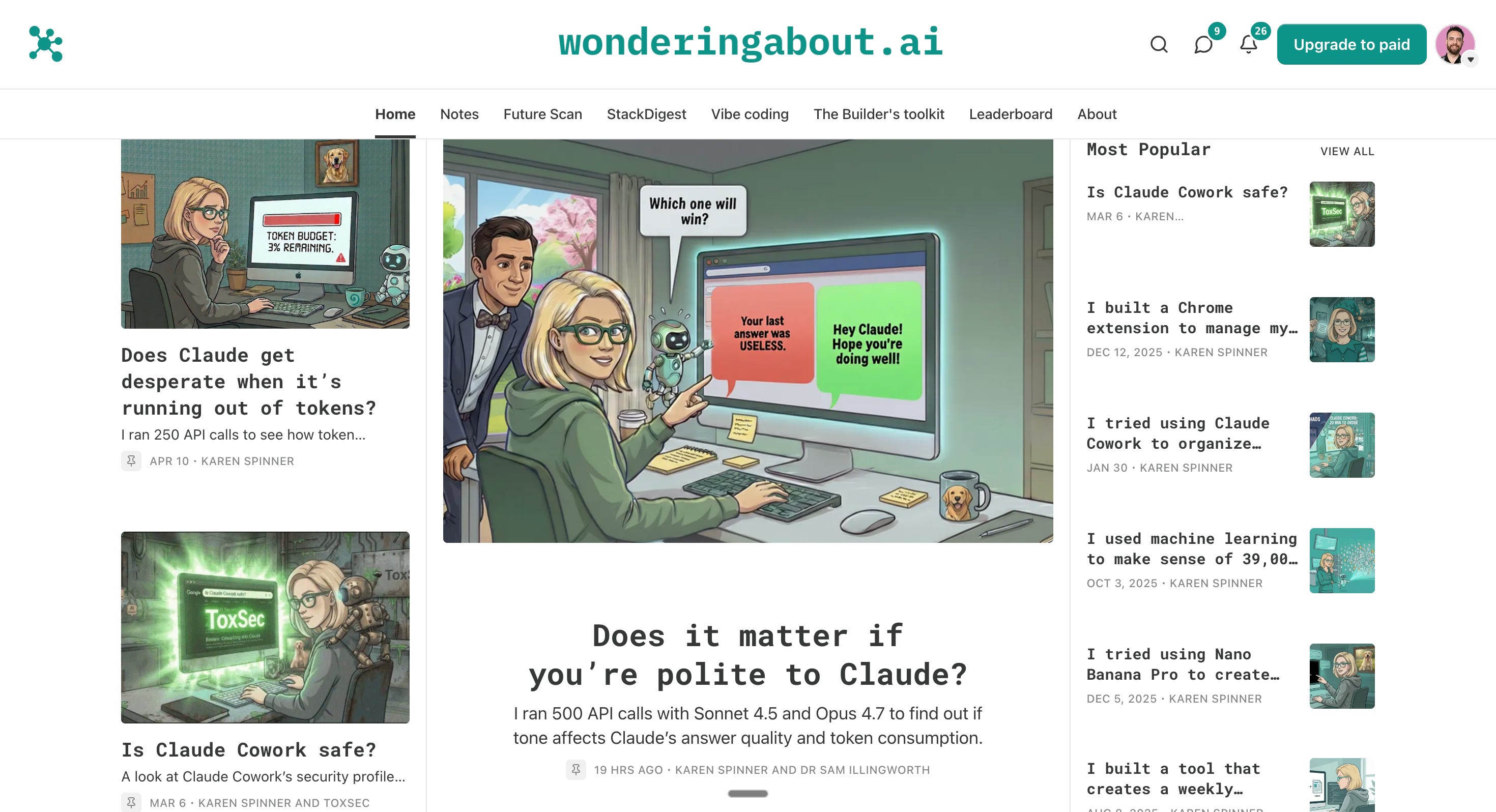
Karen Spinner runs Wondering About AI, a newsletter built around structured experiments on real AI behavior.
Last week she ran 250 API calls to test a question Anthropic’s own interpretability team had just surfaced: what happens inside Claude when token budgets run low? Their research found internal “desperation” activation vectors in Claude that fire as the model’s budget shrinks.
When examined in lab conditions, these patterns cause shortcuts and broken output.
Karen took that into production conditions. Under hard token caps, she found silent degradation in 44 percent of runs. Confident language. Wrong answers.
Nothing in the output that signals the gap.
The control condition had zero silent failures. The fix is simpler than the problem: tell Claude about its constraints explicitly in the prompt instead of setting hard limits via the API. When she gave Claude framing like “you have approximately 500 tokens remaining,” correctness held at 100 percent, matching the control.
Framing gets absorbed into planning. Hard caps ambush the model mid-sentence. She left the full methodology and code on GitHub.
A polished response and a wrong response look identical from the outside.
That finding ran underneath everything else I read this week.
When the signal stops working

From Kevin’s About page - here.
Kevin Ertell wrote The Strategy Trap, an Amazon bestseller on why companies fail at execution.
His newsletter this week opened with a scene most people have been in: a leadership meeting where everyone’s nodding, nobody’s pushing back, the room exits perfectly aligned.
His title: “Fear Is the Default. Safety Has to Be Built.”
Kevin names 3 behaviors that determine whether a leader gets real information or managed information.
Leaders who admit mistakes openly without spin signal that honesty is safe. Leaders who explicitly reward uncomfortable news train rooms to keep bringing it. Leaders who ask questions designed to surface disagreement get better information than leaders who wait for it to appear. The absence of all 3 is what produces the nodding room.
Self-protective behavior is an execution killer that presents as alignment from the outside.
He cites Julia Minson, a Harvard Kennedy School professor who studies productive disagreement: “A constructive disagreement is a disagreement that leads the two parties to want to talk to each other again.” Her five-step framework shifts the goal from winning an argument to keeping the conversation alive. Kevin also points to Brian Elliott’s research on team norms: three-quarters of teams have never established formal norms for how they work together.
One team that did cut escalations 75 percent, slashed meetings in half, and watched meeting effectiveness jump from 22 to 72 percent.
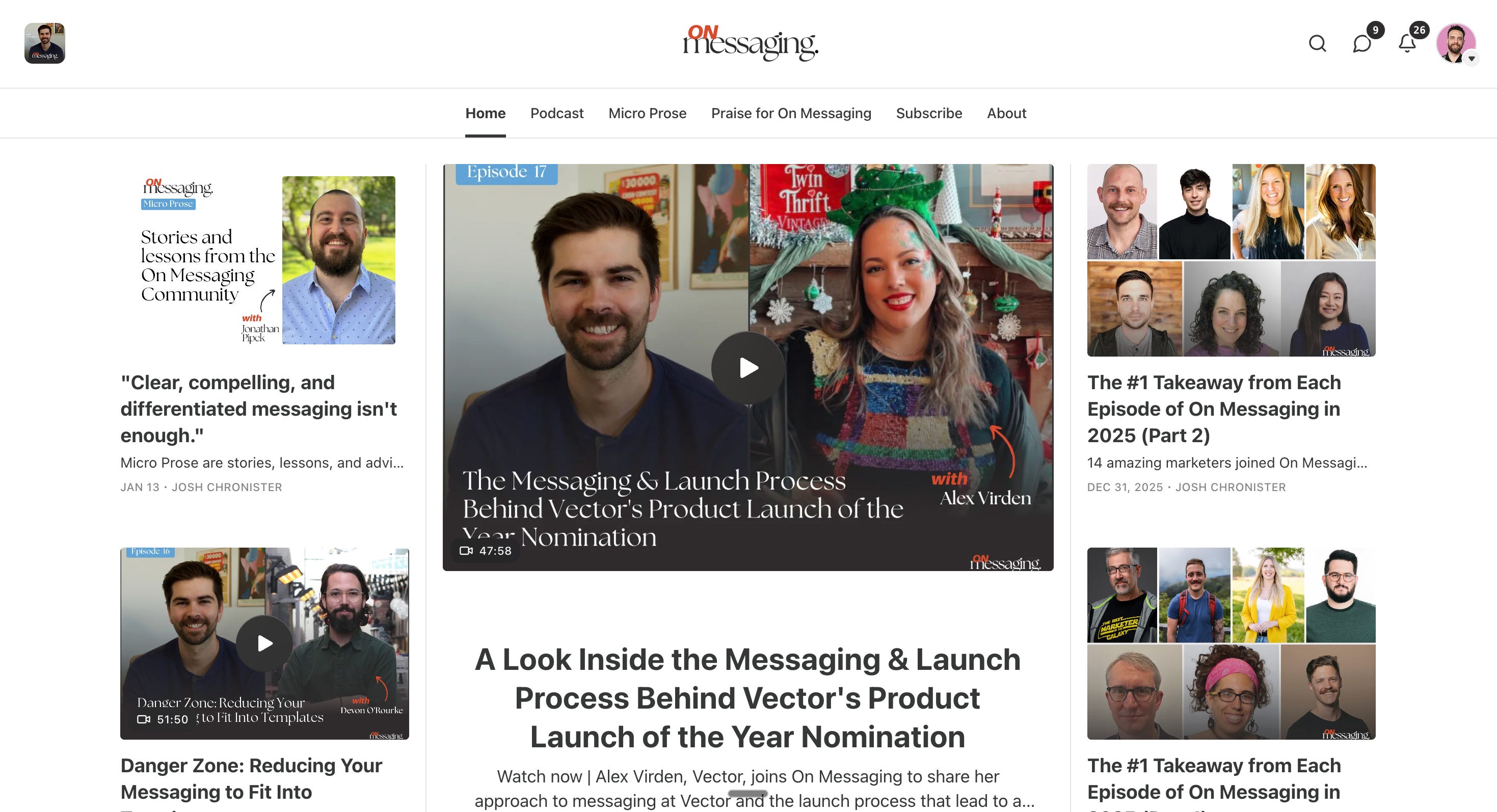
Josh Chronister runs On Messaging, a show built around deep conversations with working product marketers, followed by Josh’s own top takeaways from each interview.
His guest Alex Virden joined Vector as their first PMM hire in April 2025. By October she’d executed a full repositioning, pricing and packaging overhaul, website redesign, and Halloween-themed product launch at a seed-stage startup with fewer than 12 people.
The results? 41 percent increase in site traffic, one million dollars in pipeline, and a Product Launch of the Year nomination from the Product Marketing Alliance.
Her research covered three groups:
current customers across different usage levels,
people who never converted,
and closed-lost prospects.
Her line: “Your best customers validate. Your worst customers warn. Your closed-lost prospects tell you where the message breaks down at the moment of decision.”
That last group is the one most PMMs skip. And it’s the only interview that shows you what happens in the room when you’re not there.
The information that matters most is almost never volunteered.
Who around you has something true to say that they haven’t said yet?
What you know before you can name it
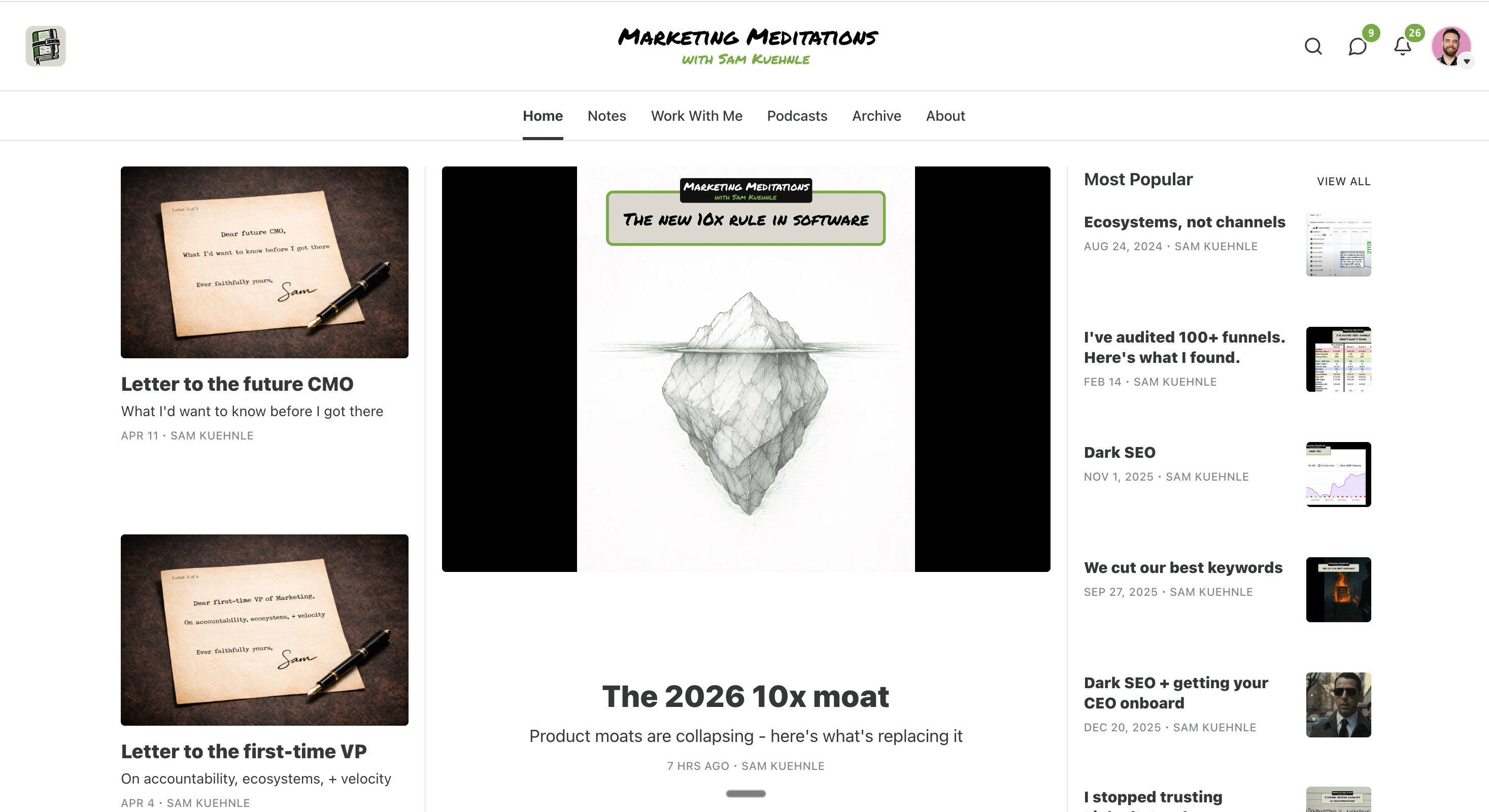
Sam Kuehnle runs Sam’s Marketing Meditations (ABOVE) and is building Affect, a platform connecting marketing metrics to actual business revenue.
He watched too many quarterly business reviews where marketing hit its MQL targets while sales missed revenue, and nobody questioned the contradiction. The five-letter series he just finished, running from first-year marketer through first-time VP to CMO, came from sitting with that gap.
The final letter is to the future CMO.
His first observation.
At that level, the job shifts from executing marketing to translating it. The CFO has quantitative models. The CRO has a revenue number. The CMO has a qualitative story about market perception and long-term brand trajectory. Getting that room to receive it as strategy is work that never stops.
He names the CEO relationship as the foundation of everything at that level, more important than strategy, team quality, or execution record.
His framing?
If the CEO doesn’t understand what you’re building and why it’ll work, you’re one bad quarter away from having the conversation. And the third thing: you’ll be defined by one or two decisions.
The big swing that worked. The bet that flopped.
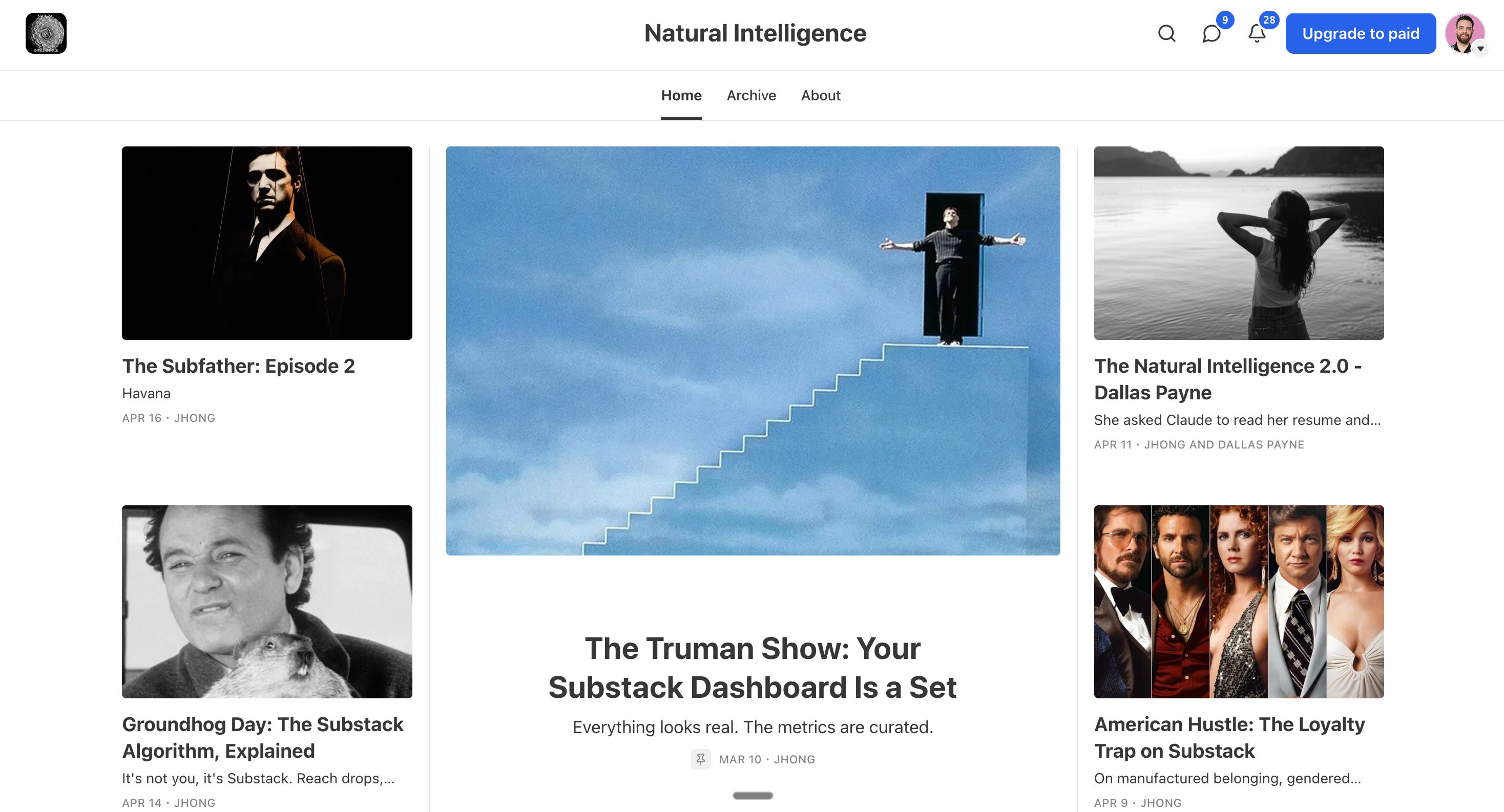
Jennifer Hong runs Natural Intelligence, a newsletter of interviews with humans navigating AI.
Her guest Dallas Payne had a linguistics degree and spent 20 years doing work everyone called “just admin”: building knowledge bases, writing Boolean searches, optimizing processes, managing context across teams. She’d been doing context engineering, knowledge architecture, and pattern recognition for two decades before AI gave her vocabulary for any of it.
Her breakthrough?
She ran her resume through Claude. The analysis named the patterns she’d been executing without language for them. She said there were tears. Dallas lives in rural New Zealand, where no one around her knows what Substack is. Her take on AI: she endorses “Slow AI,” a framework from Sam Illingworth. His advice: “don’t be afraid to close the tab.” Her slop detection is precise: sentences starting with “And” or “But” without purpose, and any appearance of “Here’s the thing” or “delve.”
Abrar Maqdoomi named the same pattern in From Equations to Innovation from the entrepreneurship side: years of what he called “an intuitive whisper,” the pull toward building, before any framework arrived to give it language.
Some things are real before they’re nameable.
If you’re still waiting for the right words, what’s the cost of the delay?
Worth your attention: Free + Paid Resources
Affect (Wait List here - Sam Kuehnle): a platform for marketers who want accountability tied to actual business outcomes. Built by someone who watched marketing hit its targets while the business missed revenue, and felt the contradiction. Waitlist open. Pricing not announced.
The Strategy Trap (Kevin Ertell): Kevin’s book on why companies fail at execution. Amazon number one in its category. Available now.
Claude Cowork Bootcamp (Nicolas Cole + Dickie Bush, PGA): six production-grade Claude skills (File Master, Newsletter Writer, Calendar Ninja) plus six text modules and a full setup kit. $350 or two payments of $175. Self-paced option available.
$100M Newsletter Skill Pack (Based on Hormozi frameworks): Claude Skills built on Alex Hormozi’s email marketing frameworks for newsletter operators. Free.
Agent-ready website webinar (YOYABA + Wix, via Sam Kuehnle): Oliver Kuttruff and Crystal Carter break down what an agent-ready website looks like in practice: WebMCP, declarative vs. imperative API approaches, and what SEO looks like when AI agents are navigating instead of humans. May 7th. Free.
CarouselBot (Karen Spinner): turns posts into LinkedIn carousels and PDF documents via Claude MCP integration. Paid.
Karen’s token experiment (Wondering About AI): 250 API calls, full methodology, code on GitHub. Read this before you trust the next confident-sounding output. Free.
The other side of the coin
Darla Bautista showed the other side in Culture >> Commerce this week with three brands making precision bets before the signal becomes obvious to anyone else.
Starbucks launched an ube vanilla latte this spring. Ube carries meaning: Filipino diaspora identity, independent café culture, years of presence in London’s independent coffee scene before any major chain touched it. Starbucks validated a signal that already existed, at the moment it was ready to scale.
The risk is important. Ube is genuinely scarce in supply chains, and that scarcity is part of what makes the move credible.
Teams executing this kind of move in 2026 are using AI to track emerging ingredients across TikTok, menus, and retail shelves, mapping entertainment calendars for peak attention windows and assessing talent trajectory on signals beyond follower count. Rhode and Justin Bieber went from concept to Coachella debut in weeks.
Darla calls these beachheads. Which are entry points with low risk to the core business. Specific enough to open a new lane. Small enough not to threaten the brand if they miss. Every one of them worked because the signal was authetnic before the bet was placed.
The gap between signal and what’s happening is where execution dies. Or where it wins first.
Build on the signal
What’s my final take? The thread running through all 7 newsletters this week is the same: the confident claim is usually the weakest one.
Karen found it in API output. Kevin found it in leadership rooms. Josh’s guest found it in the customer interviews most PMMs skip. Sam found it in the gap between what the CMO presents and what the board hears. Jennifer’s guest found it in 20 years of work that passed as admin.
You as the Signal Architect, your move is specific: verify the foundation before you build on it. Every precision bet Darla covered in Culture >> Commerce this week worked for the same reason. Starbucks found a signal already real in diaspora kitchens and London cafés, then validated it at scale. Lego read adult collector culture accurately, then built a £160 entry point precise enough to open a new lane. The signal was authentic before the money moved.
Find what’s actually true. Build on that.
Where in your work are you building on a confident output rather than a verified one?
Thanks for the feature & insightful wrap up Matthew! Really interesting to check out these latest AI experiments