

In 2021, Under Armour had a new shoe ready, the Flow Velociti Wind.
They had a marketing budget. They had a choice: run ads or build something different.
They built a running challenge. Thirty miles in thirty days. Log every run through the MapMyRun app. Three winners get a dream running trip for two.
54,000 people completed the challenge. 127 million views on Instagram. Footwear revenue grew 35% that year. Overall company revenue hit $5.7 billion. A record.
Four years later, Under Armour reported a 9% revenue decline in FY2025. Company leadership began publicly asking how to “reignite brand relevance.”
That’s a Memory Equity problem.
If you’re a watch-it person, I broke this down on video.
Watch the Memory Equity breakdown on Youtube
Same pattern, different format.
Memory Equity: what is and how it works
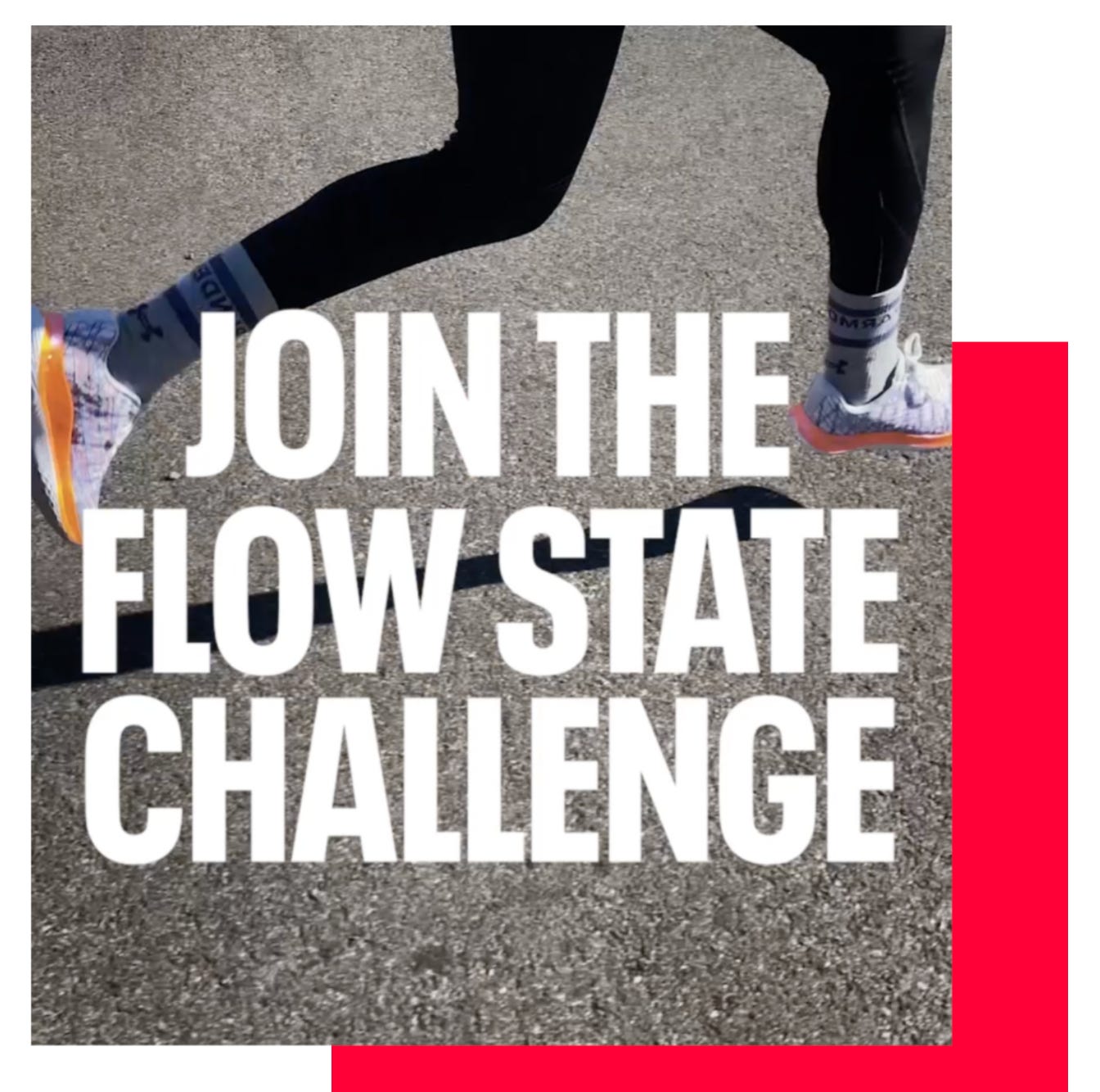
As sourced from https://wearesocial.com/ca-en/case-study/under-armour-flow-state-challenge/ along with the campaign Brief.
Memory Equity is the collection of shared experiences your audience carries about your brand.
Brand equity lives in the market. Memory equity lives in the body. It’s the difference between someone who recognizes your logo and someone who remembers finishing something hard while wearing your product.
The mechanism: a brand uses an owned digital platform to host a time-limited, goal-oriented challenge tied to its core performance promise. Participants document progress.
That content brings in new participants.
The cycle builds.
The pattern produces four things at once:
owned behavioral data,
user-generated content that handles distribution,
emotional loyalty, and
premium brand positioning through community belonging.
Loyalty members spent roughly 50% more per transaction than average customers.
Shared achievement builds a different kind of customer than a discount does.
How Under Armour built it
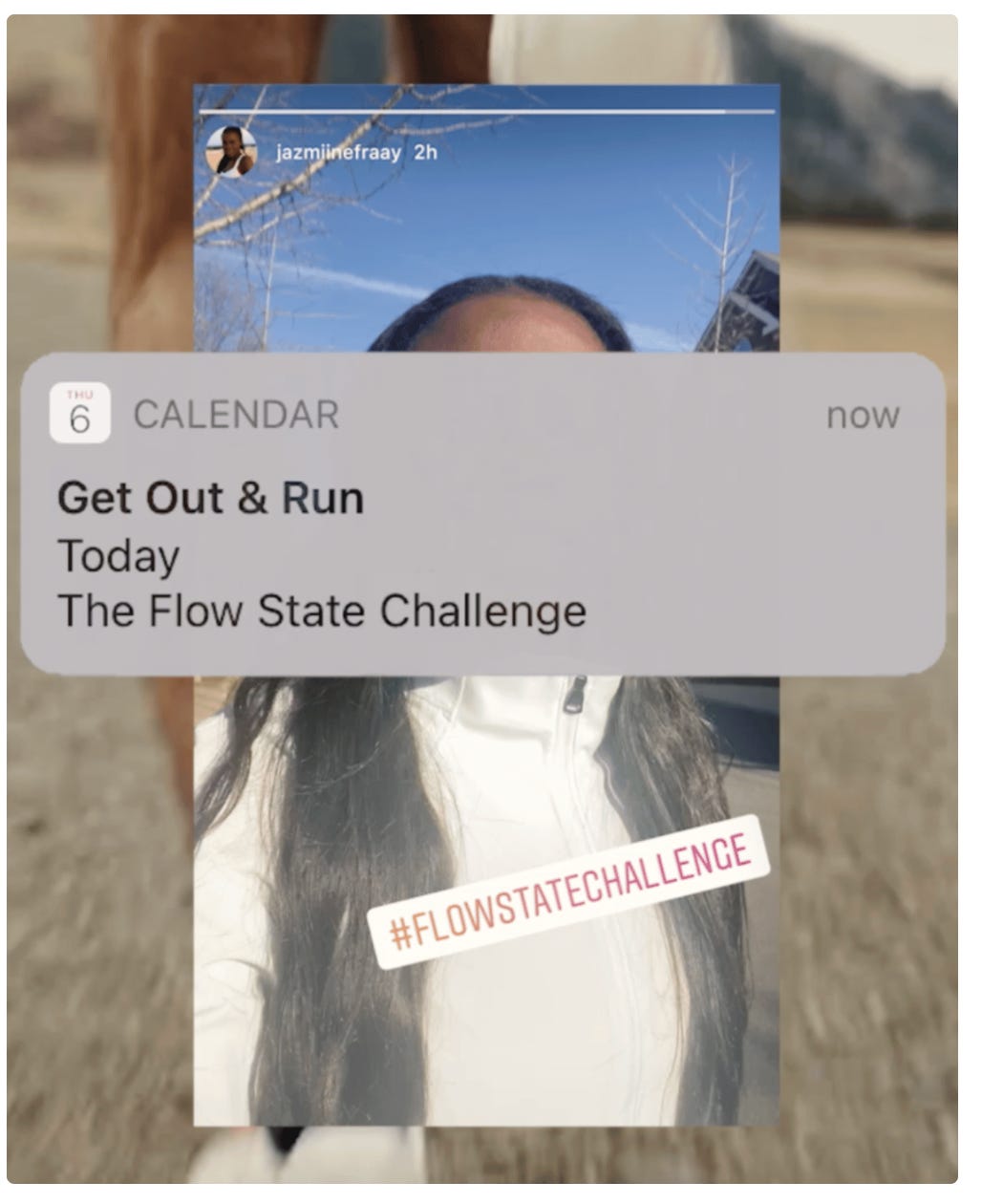
Calendar notification demonstrates how Under Armour turned routine running into anticipated community events. The #FLOWSTATECHALLENGE hashtag shows how memory equity campaigns create lasting digital engagement beyond their original timeline. Source: Under Armour Via We Are Social Canada Case Study
The setup mattered as much as the mechanics.
By early 2021, MapMyRun had grown 51% in active workout users during the pandemic. 47% more workouts logged that year. Under Armour had an existing, engaged community of runners who’d been training alone for twelve months, with no races to train toward, no group runs, none of the social infrastructure that gives solo training its meaning. They were fit. They were disconnected. The conditions for something like this had never been better.
Three things were missing from their lives:
a goal worth chasing,
people to chase it with, and
something aspirational to look forward to once travel restrictions lifted.
Under Armour built the challenge architecture around all three.
The Flow State Challenge addressed all three at once.
The challenge structure gave runners a clear, achievable goal (30 miles in 30 days) with a defined finish line. The MapMyRun platform gave them community, 54,000 people logging miles, watching each other’s progress, moving toward the same thing. The prize, a dream running trip for two, destination selected by Under Armour, redeemable once travel opened, hit something deeper than a gift card ever could.
The psychological concept anchoring it all was flow state. The research came from Mihaly Csikszentmihalyi, the actual science of peak performance, the state where effort feels effortless and focus becomes total. Under Armour built an entire visual identity around making that invisible mental state visible: a custom AR Instagram filter that let runners overlay 3D rings trailing their run path after finishing. A badge you could share. Every element of the experience designed to make the invisible visible: proof the moment happened, proof it was yours.
An invisible experience, made tangible and shareable.
The launch video earned its 127 million views because the athletes in it looked exactly like the runners watching it. Shot by twelve elite athletes across four continents during pandemic restrictions, raw footage, no production crew, no director telling them where to look. Sweat and effort visible on every face.
The runners watching it say more than a campaign.
They saw themselves.
Timeline execution
March 3, 2021: Challenge launches on MapMyRun.
March 3–April 2: 54,000 runners log miles, share progress, and generate UGC across 30 days.
April 2: Challenge closes. Three winners announced. The AR filter content keeps circulating for weeks.
Why Memory Equity works right now
Three converging forces are making this pattern more valuable every year.
First, the owned data problem.
iOS changes and cookie deprecation have made paid audience targeting more expensive and less precise every year since 2021. The brand that owns its community owns its data. Every one of those 54,000 MapMyRun challenge participants gave Under Armour behavioral insight (athletic habits, geographic spread, run frequency, shoe preferences) at near-zero acquisition cost.
Paid targeting builds none of that.
Second, peer signal beats brand signal.
The average consumer sees somewhere between 4,000 and 10,000 brand messages per day. Most don’t register. When 54,000 people publicly complete something hard together, that’s a different kind of signal. People trust peer behavior over brand messages at roughly a 4:1 ratio.
Memory Equity converts your marketing budget from broadcasting into proof.
Third, the premium positioning ceiling.
Brands competing on product features run into commodity pricing eventually. The challenge architecture builds identity attachment that product specs can’t replicate.
The shoe becomes the tool that helped you finish something worth finishing.
Cross-industry proof: the same pattern, three industries
Memory Equity works in sports apparel. The architecture runs across categories, and the results scale regardless of audience size.
1. Nike Run Club
Nike runs this continuously through the Nike Run Club app.
Weekly challenges, monthly distance goals, digital achievement badges. The incentive is social status and community belonging, the same things race day used to provide before the app replaced it. Every challenge completed feeds an owned behavioral dataset while reinforcing Nike’s performance identity in ways no ad buy can replicate.
Millions of active athletes logging challenges across a global owned platform. The data stays with Nike.
The loyalty stays with the app.
Same pattern. Sports technology.
2. HP #HPRadicalReuse
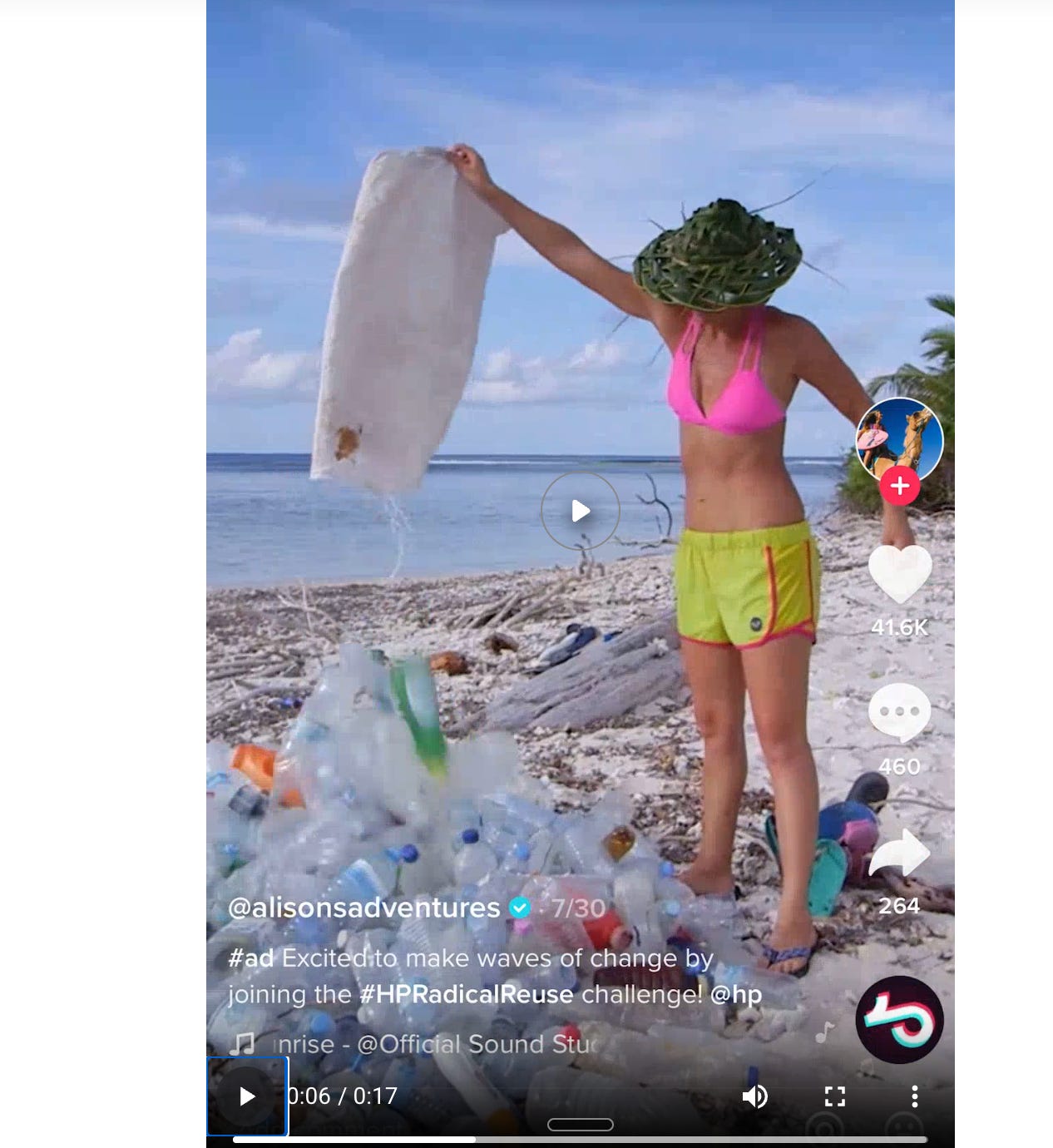
HP challenged TikTok creators to show how they reuse materials in everyday life, tied to their use of ocean-collected plastics and corporate sustainability commitment. The incentive was social recognition on a platform built around transformation content.
A sustainability message that would have died as a press release became a cultural conversation because the mechanic turned spectators into participants.
1.4 billion views. 1.2 million user-created videos. 5.9% lift in ad recall. 1.9% lift in brand favorability.
Same pattern. Consumer technology.
3. LEGO Ideas

LEGO made the challenge permanent. Submit an original set design, build community support up to 10,000 votes, get reviewed for official production. Winners see their creation manufactured and sold worldwide, plus a royalty percentage.
LEGO turned their most passionate customers into their product development pipeline, not just once, but as the standing architecture of how new products get built.
Fan-submitted designs with 10,000 votes advance to production review. LEGO’s most engaged customers now shape what gets built next.
Same pattern but for consumer goods.
Three companies. Three industries.
One mechanism: build a platform where participation produces something worth keeping.
The architecture doesn’t care what product you make.
Where it breaks: three campaigns with the receipts
Memory Equity breaks in predictable ways. Three campaigns left the receipts.
1. McDonald’s #McDStories (2012)
McDonald’s invited customers to share warm memories on Twitter. No owned platform, just a public square. Within an hour, replies documented food poisoning and worse.
72,788 negative tweets in under an hour. Campaign cancelled the day it launched.
Same break. No owned platform.
2. The Pepsi Refresh Project (2010)
Pepsi redirected $20 million into a community voting platform for grassroots social causes. The engagement was genuine. Memory Equity requires the shared experience to run through the brand’s actual promise, and the experience of drinking Pepsi was never part of it.
80 million votes. 18 million unique visitors. Pepsi sales declined 6%. Campaign discontinued after two years.
Same break. Challenge disconnected from the brand’s promise.
YouTube positioned their annual Rewind as a community reflection. Creators immediately recognized a corporate production filtering out everything genuinely popular. The community had no real voice in it.
Over 20 million dislikes before YouTube removed the counter. Format discontinued after 2019.
Same break. Community voice under management.
The failure condition is always structural. The diagnostic question before you build this: which of these three vulnerabilities does your client face? And the harder lesson from Under Armour’s FY2025: a single activation builds a campaign. Continuous activation builds Memory Equity. Memory Equity erodes when you stop earning it.
Four questions before you build it
Before recommending this pattern to any client, I run four diagnostics.
Does the brand have an owned platform (app, loyalty program, or engaged community hub) where the challenge can live? No platform, no architecture.
Does the challenge connect authentically to the brand’s actual performance promise? A hollow challenge disconnected from brand identity reads as a marketing stunt.
Is the prize aspirational to this specific audience? You need to know what the audience’s life could look like, the thing they’d actually work toward and feel proud of finishing.
Does the brand have the infrastructure to run this continuously? One activation builds buzz. Continuous activation builds Memory Equity.
If the answer to any of these is no, the conditions need work before the pattern can run.
What the body remembers
Here’s what I keep coming back to with this campaign.
People carry what they did together. That’s the memory.
54,000 runners did more than buy a shoe after the Flow State Challenge. They finished something hard, side by side with 53,999 strangers, and they had the data to prove it. The run log. The badge. The AR rings trailing behind them in the Instagram post. Memory with a body.
Those 54,000 runners had been training alone for twelve months without a race date, without a group, without anyone counting on them to show up. Research on social isolation is consistent: people chronically underestimate how much they need connection until they’re back in it.
In one study, commuters asked to choose between sitting alone or talking to a stranger almost universally preferred solitude, then reported a significantly more enjoyable commute when assigned to connect. (Levitin, The Organized Mind, p. 126; Epley, Mindwise, pp. 58–59) Under Armour built the challenge directly into that gap.
There’s a second layer the challenge brief didn’t account for. Coordinated movement toward a shared goal triggers oxytocin alongside the endorphins. It’s the bonding chemical the brain typically reserves for its closest relationships. Research shows it measurably increases trust toward others even in brief social encounters. (Levitin, The Organized Mind, p. 142) The body registers finishing together as social evidence: proof that this person can be counted on. Twelve months of solo miles had produced the endorphins.
The oxytocin requires a witness.
The neuroscience here is worth sitting with. The psychologist Robin Dunbar found that synchronized physical activity, moving together toward a shared goal, releases endorphins and deepens social bonds faster than almost any other human activity. Rowers who trained in synchrony showed significantly elevated pain thresholds compared to those rowing alone, a physiological marker of social bonding. (Dunbar et al., Biology Letters, 2010) It’s why finishing a race with strangers feels like more than finishing a race alone.
Memory Equity borrows that mechanic and builds it into brand architecture.
What Under Armour assembled in March 2021 was, in the language of depth psychology, a container: a bounded space where transformation becomes possible. Thirty days. A defined distance. A community tracking the same finish line. Every element of that structure is ancient. Pilgrimage works the same way. A shared ordeal with a defined end works the same way. The brands that understand this are designing something closer to a rite than a campaign.
Under Armour, in 2021, earned belonging. That’s the thing most brands are still trying to buy.
The question worth asking for your clients: which of them has an owned platform, a real performance promise, and a community already forming around something meaningful?
Because the conditions for building Memory Equity might be sitting there unused, waiting for someone to see that the pieces are already in place.
Sources
Levitin, Daniel J. The Organized Mind: Thinking Straight in the Age of Information Overload. Dutton, 2014. pp. 126, 142.
Epley, Nicholas. Mindwise: How We Understand What Others Think, Believe, Feel, and Want. Alfred A. Knopf, 2014. pp. 58–59.
Cohen, E., Ejsmond-Frey, R., Knight, N., & Dunbar, R.I.M. (2010). Rowers’ high: Behavioural synchrony is correlated with elevated pain thresholds. Biology Letters, 6, 106–108.
Run your client through the Memory Equity Analyzer

I built a GPT that applies this pattern to your client situations.
Paste in what you know about their owned platform, their core performance promise, and the community forming around their product.
It runs the four diagnostics and tells you whether the conditions are there, what’s missing, and what to fix first.
[[Memory Equity Analyzer GPT →]] Click here for the Free GPT.
If this pattern surfaces in a client conversation this week, I’d love to hear what you’re seeing. Hit reply.
See you next issue.
Matt