

Intro
Universal sold out a year early.
41 rooms on earth can project IMAX 70mm.
Seats for opening weekend went on sale on July 17, 2025, exactly twelve months before release, and sold out within minutes. One insider put it at 95% of seats gone, the bulk inside the first hour.
Comscore’s Paul Dergarabedian, in the same story…
“It’s bold, it’s brilliant and it’s audacious. But only someone of Nolan’s stature could pull this off. He’s a brand unto himself.”
He’s right, and that’s the part most people stop at. Nolan can do this and you can’t, so move along.
Here’s who I’d rather talk about: the people who never got a seat.
Prefer to watch? The full breakdown of the Proof-of-Scarcity Ladder is on YouTube.
The pattern: the Proof-of-Scarcity Ladder
Here’s the play.
Build progressively scarcer levels of access where each scarcer level delivers genuinely greater value.
Then…. let the resulting demand become the evidence for your positioning.
Ordinary artificial scarcity says buy because there aren’t many.
The Proof-of-Scarcity Ladder says there aren’t many because this version is hard to reproduce, and the demand for it proves people believe the difference matters.
Universal’s ladder had six rungs:
The film
The film in a theater
The film in IMAX
The film in IMAX 70mm (41 venues worldwide)
Opening-weekend IMAX 70mm
Specific seats at the most desirable venues
Every rung reduced availability and increased actual experiential difference. That second half is the whole game. That’s what separates this from a countdown timer on a landing page.
Universal moved the burden of proof from the message to the mechanism. Every event film’s advertising claims the film is an event. Universal built a distribution system where the market’s own behavior made the claim, then reported that behavior back as the campaign.
Sellouts became press. Presales became press. Resale listings became press.
The transaction itself became the communications asset.
The case study: 409 days of engineered restriction

The sequencing is the transferable part, and most brands run it backwards.
Universal ran scarcity first and mass reach second.
July 1–2, 2025. The teaser was placed in theaters only, attached to Jurassic World Rebirth. A competing Universal release became the gateway to first footage. Worth noting it leaked online almost immediately, so the exclusivity held in intent more than in fact.
July 17, 2025. IMAX 70mm opening-weekend seats went on sale exactly one year early, across 26 locations. Gone in minutes.
December 12, 2025. A nearly six-minute prologue, exclusively on IMAX 70mm screens, attached to 70mm re-releases of Sinners and One Battle After Another. The scarcest tier got privileged content.
December 22, 2025. First full digital trailer. 121.4 million views in 24 hours, per WaveMetrix. Oppenheimer did 50 million.
July 2026. $28.9 million in US national TV through July 26, per iSpot, second only to The Super Mario Galaxy Movie at $29.8 million. That figure includes NBCU in-house media value, not purely cash.
See the order?
The 121 million trailer views weren’t the opening move. They WERE the payoff of 173 days of engineered restriction landing on a market that already believed.
Most brands buy awareness first and bolt urgency on at the end. Universal built the proof-generating mechanism first, so the media budget landed on prepared ground. It never had to manufacture belief from zero.
And this was on purpose. Universal CMO Michael Moses told The Ankler in February 2026, months before release: “We have a whole generation that’s very adept at never seeing advertising, and so the methods have become more challenging.” The same piece frames premium formats as a generational badge of honor and notes that directors like Nolan may now be bigger brands than most movie stars. He wasn’t describing The Odyssey specifically. He was describing the playbook.

Now a discipline note, because this is where campaign analysis usually goes soft.
A $250 million Nolan epic with this cast opens huge under any release strategy. There’s no counterfactual, so nobody gets to say scarcity earned the billion.
What the strategy does isolate is concentration and stamina.
IMAX took $52 million of the roughly $264 million global opening, about 20% of it. The forty-one true 70mm rooms did $6.3 million of that in three days, which is $153,000 per screen. The second IMAX weekend was $48 million, the best in IMAX history, down only 8%. By August 10 the film had done $289 million in IMAX alone, the highest-grossing IMAX release ever, passing Avatar’s $271 million, with the 70mm rooms at $37.5 million and roughly $40 million still sitting in forward presales while the movie played down the street.
Concentration and stamina.
Those two you can defend. Total gross you just simply can’t.
And the constraint is a real factor, which is the load-bearing fact.
IMAX CEO Rich Gelfond laid out the economics on the July 2026 earnings call: the projector “costs $50,000 a piece to put in your theater,” you need “logistics like a forklift to lift them, so you need a very big projection booth,” and “there are a finite number of locations that really can support the economics of it.” He added the part people skip: “It’s finite; you just can’t say, ‘Why don’t you build hundreds of them?’ because there aren’t hundreds of places where it would work.”
They haven’t manufactured new IMAX film projectors in about fifty years.
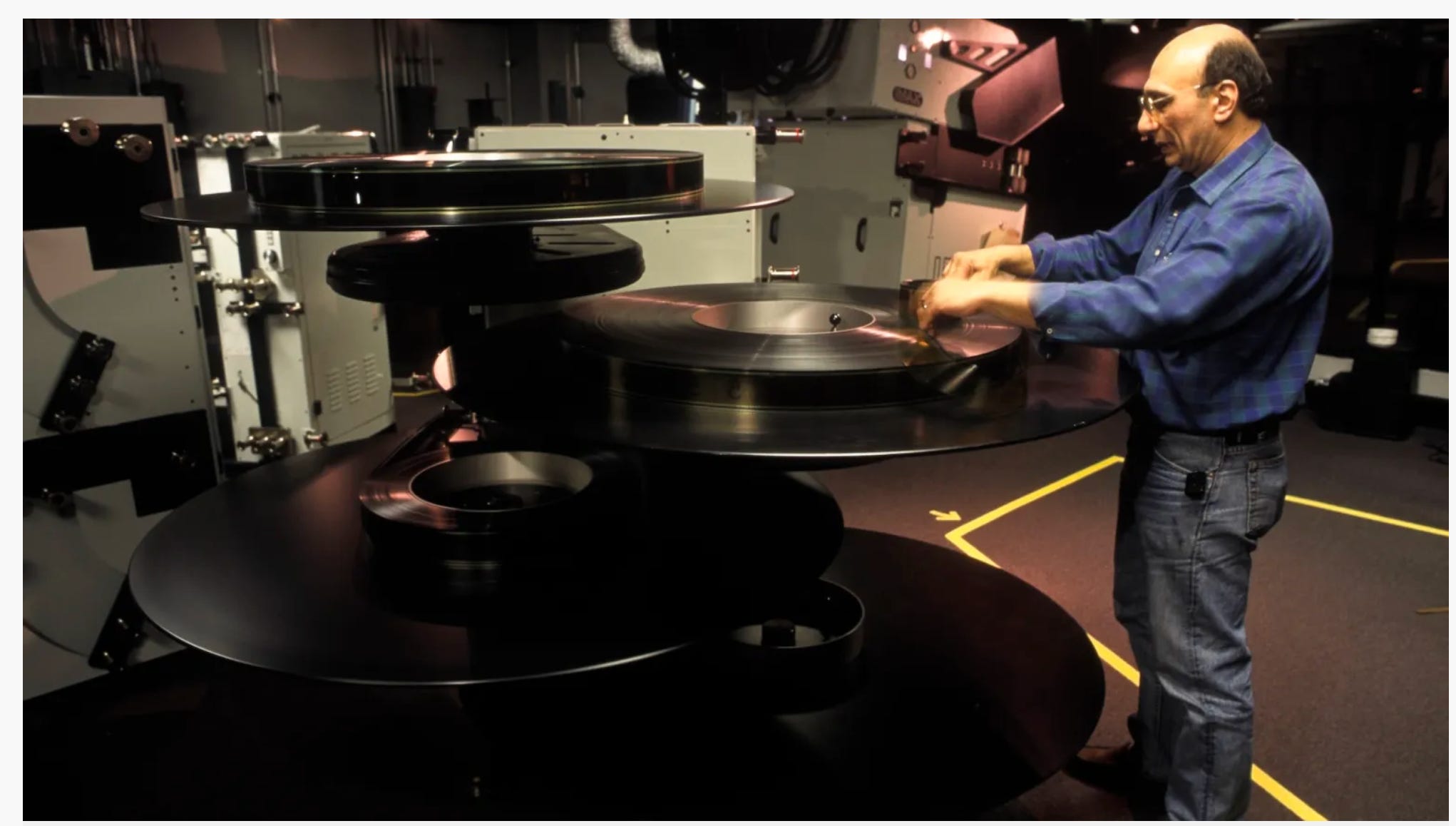
So the audience knew the scarcity was a real thing.
Nobody accused Universal of faking it.
Tickets hit eBay at $400, $500, upward of $3,000, with one pair of New York seats going for $2,000 against a $25 to $35 face. In London, the BFI IMAX simply refused to allow it. Their published policy: “Tickets cannot be resold for higher than 20% of the original purchase price.”

It repeats everywhere
Taco Bell built a hotel.
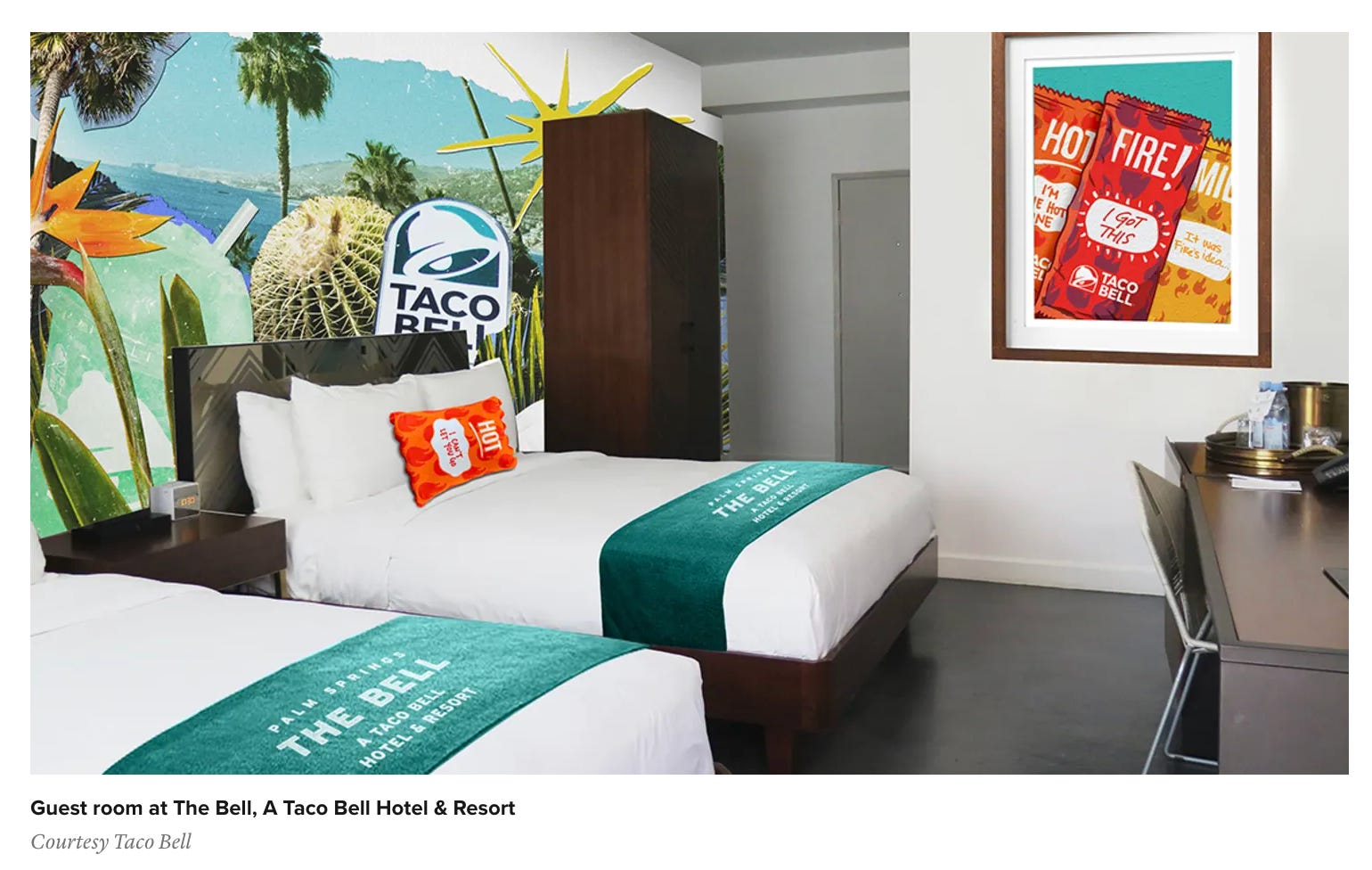
The Bell, 2019. Reservations opened June 27 and roughly seventy rooms sold out in about two minutes; the property operated August 8 through 12. Taco Bell’s agency claims zero paid media and 4.4 billion earned impressions, though that comes from its own awards submission rather than an audited disclosure.
A physical experience built for hundreds, engineered so the story of not getting in reached millions.
Dior and Jordan Brand.
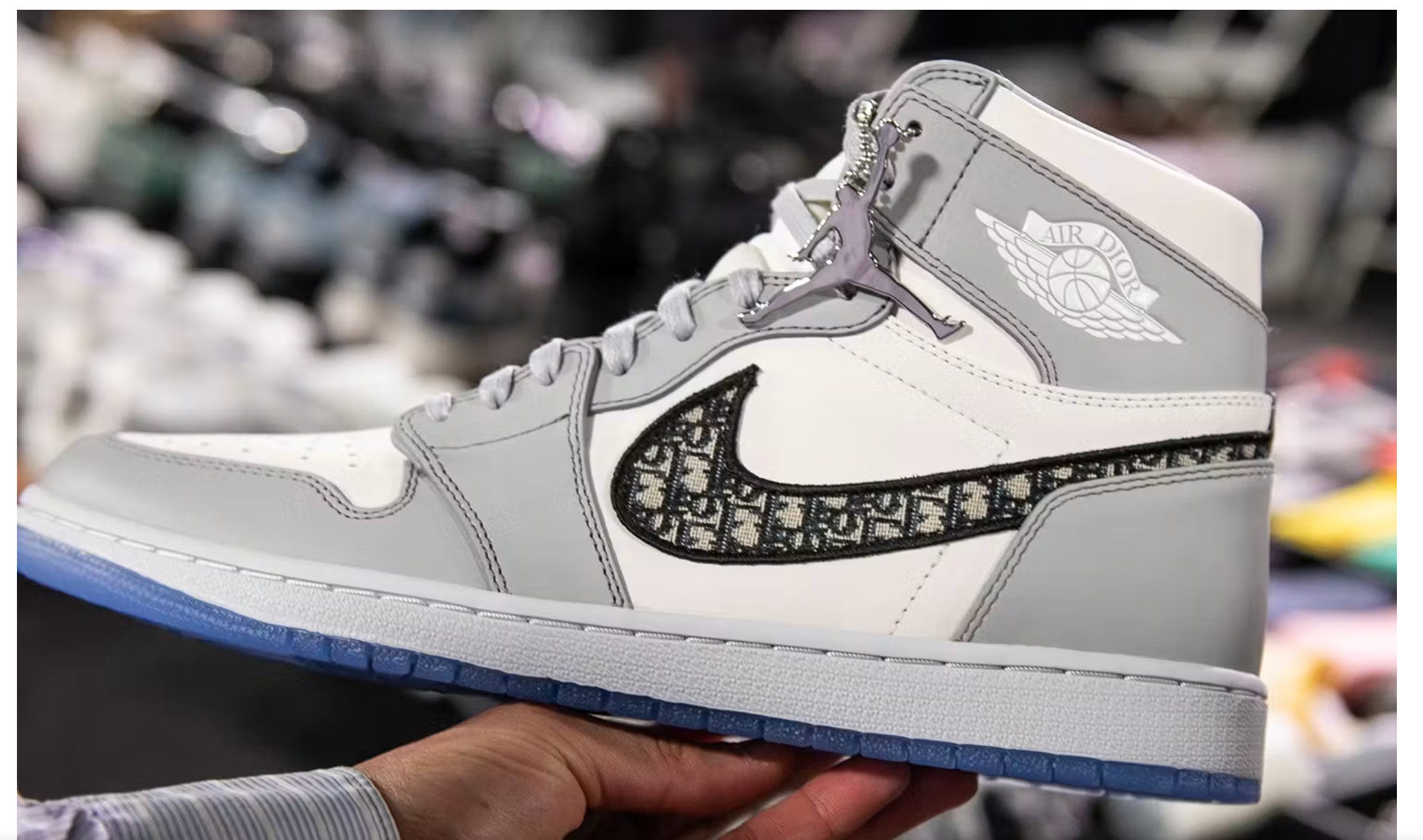
Air Dior, June 2020.
Registration opened June 25 and drew roughly five million registrations against about 8,000 pairs released to the public, high-tops at $2,200. The right to purchase became the scarce good, and the excess-demand number became part of the product’s meaning.
Tesla Model 3.
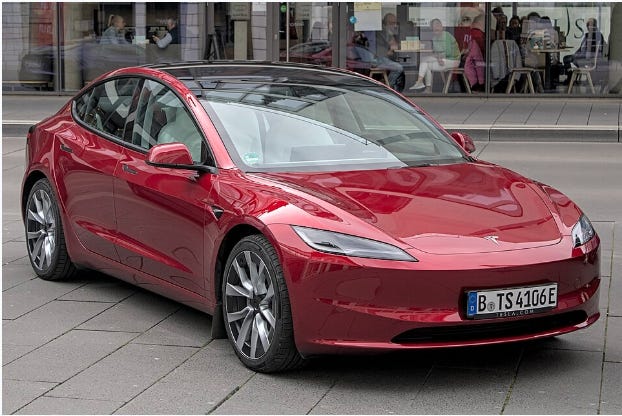
March 2016.
Tesla’s own SEC filing states it plainly: “We unveiled Model 3 in the first quarter of 2016 and received more than 325,000 reservations for this vehicle within one week of its introduction.” The reservation agreement is equally plain that a reservation “does not constitute the purchase or order of a vehicle.”
Good discipline. Steal it.
Here’s the older precedent, and it’s the one I keep thinking about.
Remembering my older theological background, medieval shrines never sold the miracle.
They sold cheap cast-lead badges so pilgrims could prove they’d walked to Canterbury.
The British Museum has them: hollow-cast lead alloy, mass-produced from stone moulds, worn pinned to a hat.

At the biggest sites they moved six figures a year.
Universal sells no equivalent. Somebody will.
One marketing pattern per week. Each issue breaks down what worked, why it spread, and what it means for the next 12 months. Free.

Subscribe to The Strategy Signal →
Why it works now
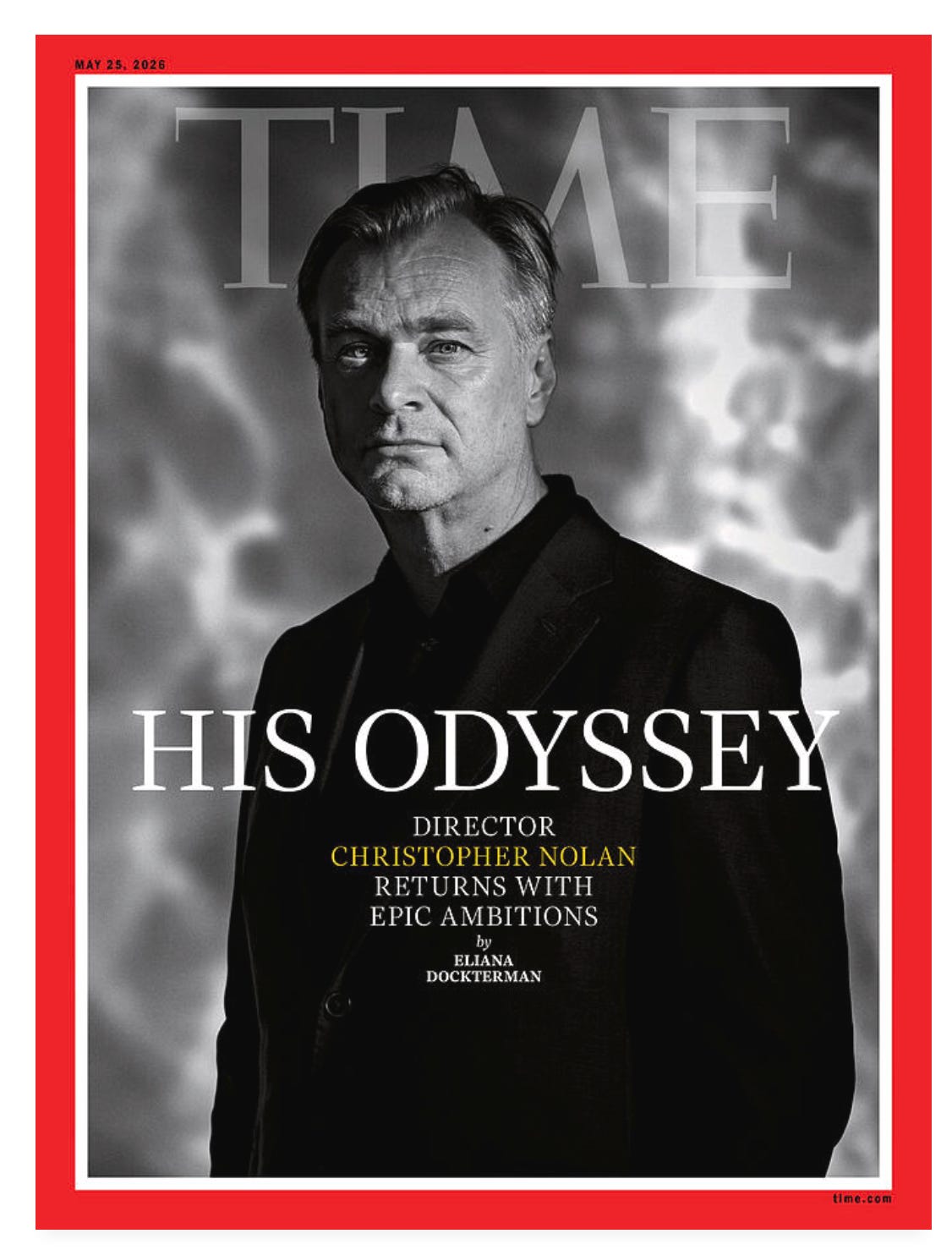
3 forces converged.
The economics flipped.
Reuters reported on August 5, 2026 that theaters sold 470.9 million tickets through the first 30 weeks of 2026 against 747.3 million in the same stretch of 2019. A
verage adult ticket, $13.46. IMAX premium, $18.22. And IMAX’s own 10-K reports a record 5.2% of domestic box office on roughly 1% of domestic screens. Fewer people, paying more, for a better room.
Digital abundance made physical constraint legible.
Generative AI floods the market with infinite copies of everything, and audiences have grown immune to digital scarcity. Software waitlists. Limited digital drops. “Only 500 spots.” Nobody believes it, because everyone can see the marginal cost is zero.
Walter Benjamin saw the mechanism in 1935. In The Work of Art in the Age of Mechanical Reproduction, he argued that even a perfect copy lacks one thing: “its presence in time and space, its unique existence at the place where it happens to be.”
He called what’s missing the aura, and said reproduction makes it wither.
Benjamin thought that was mostly a good thing, though not for the reason people usually cite. He wasn’t celebrating wider access. He argued that stripping the aura freed art from ritual and handed it to politics, and he was explicit that the same machinery could serve fascism just as easily.
Ninety years later, the reproduction is what everybody can get.
The aura is what sold out through week 8.
And the format got genuinely better.
The Odyssey is the first commercial feature shot entirely with IMAX film cameras. The premium tier was the native format. Everything below it was the compromise.
That last condition is the one most brands skip.
Superior plus scarce equals privilege. Ordinary plus scarce = frustration.
Where it breaks
Scarcity hid the real size of the market.
Snap Spectacles, launched November 2016 through traveling vending machines at surprise locations. Lines, resale premiums, enormous press. Then Snap widened distribution and the demand signal evaporated. Its Q3 2017 SEC filing records $39.9 million in Spectacles charges: $19.5 million in excess inventory reserves, $17.9 million in cancelled purchase commitments, $2.5 million in asset impairments.
That’s the mirror image of Odyssey.
Universal’s scarce tier kept generating forward demand while the film played everywhere.
Snap’s demand was an artifact of the constraint.
There was no structural reason for the limit.
McDonald’s Szechuan Sauce, October 7, 2017. One day, nearly 1,000 restaurants, while supplies lasted.
Demand vastly exceeded supply and customers read bad planning.
McDonald’s conceded it two days later: “our super-limited batch, though well-intentioned, clearly wasn’t near enough to meet that demand. ‘Not cool.’ We agree. So, we’re gonna make this right.” The original corporate page for that statement is no longer live; Snopes preserved the full text.

Forty-one irreplaceable projectors versus a company that can make more dipping sauce.
That may be the whoooooole difference.
Gatekeeping created stigma.
Google Glass Explorer Program, 2013. Invite-only for insiders who still paid $1,500. It produced the word “Glassholes,” which Google eventually adopted in its own etiquette guide.
Scarcity can make your customers look bad to everyone else, and my read is that’s what foreclosed the mass market.
Questions to run against your own business
Is your constraint structurally real, or could you make more tomorrow if you wanted to? Your customers will figure out which one it is.
Is your scarce tier genuinely superior, or just harder to get?
Do you have a frictionless mass-market fallback? Universal never made the film hard to see. It made the best version hard to see.
What happens if the scarce tier doesn’t sell out? Scarcity reveals demand, and revelation cuts both ways. Had those forty-one rooms sat half-empty, the story becomes “Nolan can’t fill forty-one cinemas.”
Are you capturing the list of people who tried and failed to buy? Almost nobody is.
You have clients in multiple different industries. Every one of them is waiting on you to tell them where their market is heading, and which move to make before their competitors make it.
That’s the job. Read the signal, name the pattern, hand them the play. Running that research by hand for every client and every trend is the slow part.
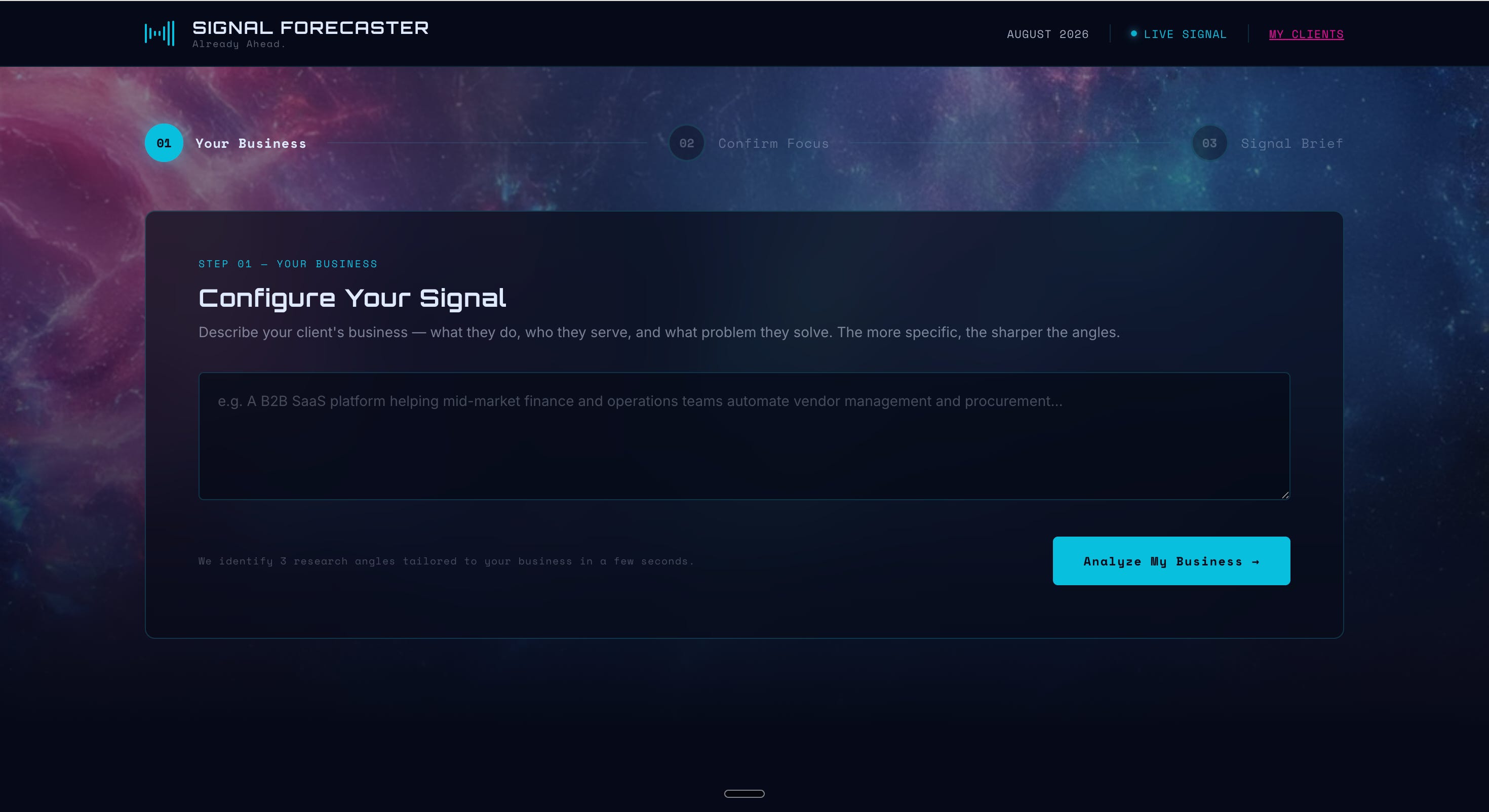
The Signal Forecaster does the research for you. Type any campaign or trend, and it searches the live web and returns a Signal Brief in about 30 seconds: the pattern name, a three-scenario Forward Hypothesis, and the recommended move. The same structure you just read, for any topic a client throws at you. You walk into the meeting already holding the answer.
I’m opening 5 pilot spots to fractional CMOs at no cost, in exchange for a 20-minute feedback call.
Matt’s take
The rational narrative: I said nobody had built the second wave. It had been public for 16 days.
I want to open with a correction, because it is more useful than anything else I could put here.
My signal research said no official second wave existed.
No extended run, no announced additional inventory, nobody serving the audience that got shut out.
I wrote that in mid-August.
Universal extended the 70mm run from August 19 to September 16 on July 30 (paywalled). Forbes and CNBC both covered it the same afternoon. It had been public for sixteen days when I called it a gap. I did not look.
Here is the corrected read, and the correction changes it substantially.
The pattern looks good and is Growing.
The supply runway is long because IMAX cannot manufacture new 70mm projectors.
Scenario A, now 45%, down from 60%.
I had this as exclusion becoming the product, metered and never resolved, with rising prices on the admitted tier.
The evidence points the other way. Gelfond scoured the world for projectors, added them in 42 theaters, added screenings between midnight and 3 a.m., and extended the run. On variable seat pricing he said, “I don’t generally like it.” The constraint-holder tried to serve the excluded audience up to the physical limit.
That is a materially different forecast from the one I published.
Scenario B, now 30%.
Venue revival. Glendale’s Alex Theatre had not screened a first-run film since Terminator 2 in 1991. It spent about $500,000 on a 70mm install and became the highest-grossing 70mm venue in the country, then booked Dune: Part Three and Gerwig’s Narnia.
Scenario C, now 25%, up from 15%. The relic market. Nobody is selling proof of attendance, and the historical precedent for that gap is eight centuries deep.
On sources: this forecast now rests only on claims with working primary links. The previous version rested partly on a Gelfond quote about raising prices that does not exist in any publication.
What would change this: whether the next constrained release adds capacity like IMAX did, or meters it.
The signal: nobody waited for the product, so a guy in San Francisco shipped it himself
Here is what I did not expect to find.
The rational read is that the excluded audience is unmet demand sitting in a queue, waiting for somebody to sell them a better place in line.
They didn’t wait.
Andrew Baker, in San Francisco, built imaxxing.io, which is a tool that watches 70mm seat maps and alerts you the moment a cancellation opens. More than 1,300 people were using it inside a week. He isn’t selling tickets. He built infrastructure for strangers trying to get into a room he also can’t reliably get into.
That is not often associated with queue behavior. Most queues wait.
And listen to how the ones who got turned away actually talk.
When Denver’s 70mm projector failed on opening weekend, a customer offered a digital screening or his $35 back described it this way: “Complete rug pull after driving 2 hours for this experience.”
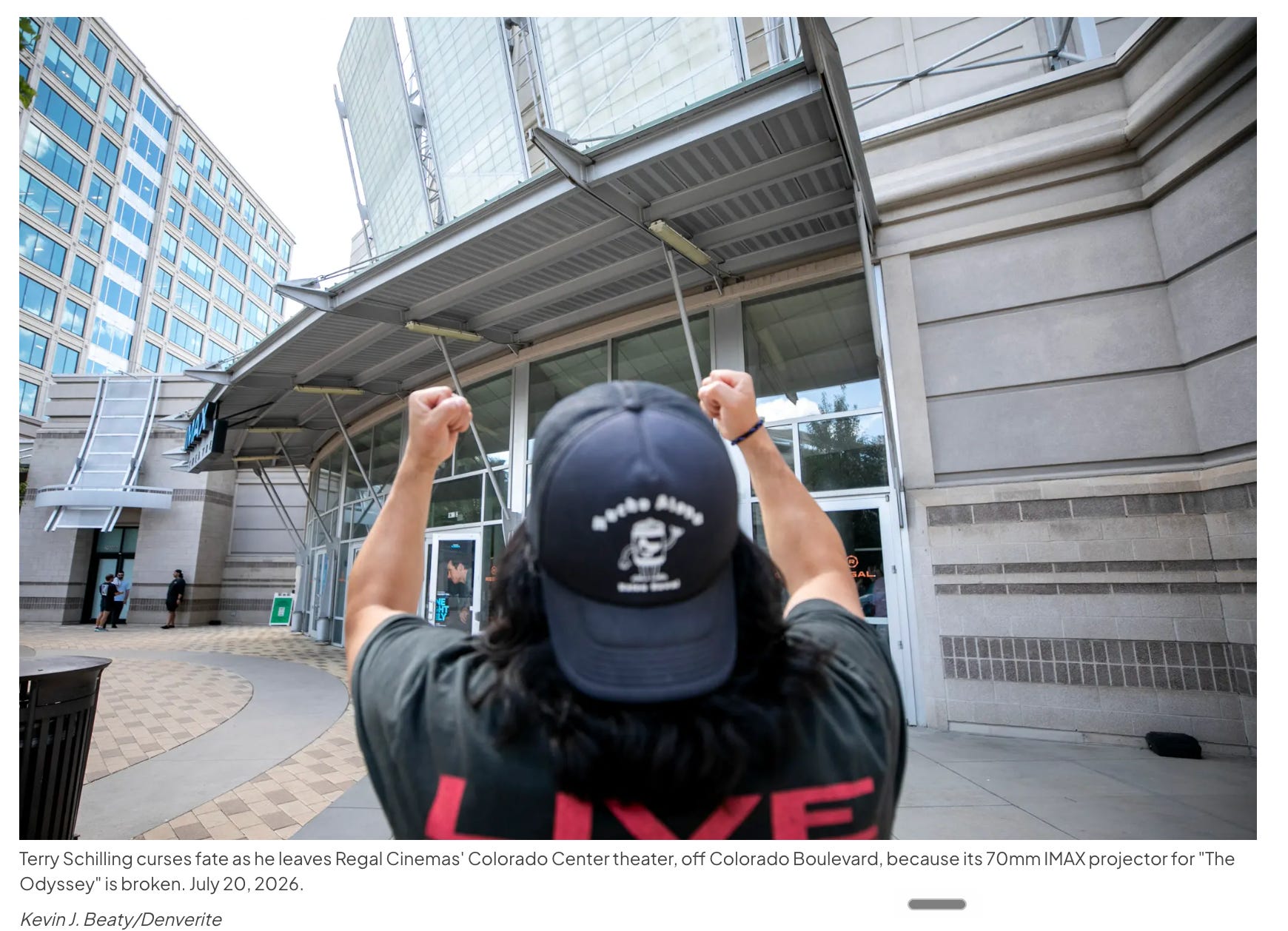
He was offered his money. The money was not the injury.
Buffalo Trace learned this with bourbon.
Pappy Van Winkle stayed unobtainable, and they refused to expand supply, refused to price to market, refused to bless resale. Then they built Weller, which shares the mashbill and sells on the strength of Pappy being impossible to find. That business exists because the flagship can’t be had.
This complicates my own forecast, and I want to be honest about that.
It suggests the money is in adjacency, and that the access product may be the trap.
The keystone: Universal is standing at a fork it doesn’t know it’s standing at
The Proof-of-Scarcity Ladder works because each sold-out rung proves the value of the rung above it. Any competent analyst catches that.
Here’s what the analysis misses. The people on the bottom rung are getting something.
Which means Universal has 2 doors.
Sell those people a better place in line, and you prove the tickets were always for sale. Ticketmaster ran that experiment with Verified Fan, and inside one cycle the public argument moved from “scalpers are ruining this” to “Ticketmaster is the scalper.” It ended in congressional hearings.
Or…
sell them proof they showed up. Pilgrim badges. Film cells. The door keeps its meaning and you still get paid.
A queue wants in. A congregation wants the door to mean something.
Most companies can’t tell which one they have until they’ve already destroyed it.
Close
Somewhere in your business there’s a list nobody is keeping.
The people who tried to buy and couldn’t. The ones who showed up late, got sold out, hit the waitlist, and left.
Standard practice says fix that. Widen the funnel, clear the queue, let everybody in.
Sit with the other possibility for a minute before you do.
See you next week, Matt
P.S. The Signal Forecaster turns any campaign or trend into a full Signal Brief in about 30 seconds, so you can run this play for any client, on demand. I have 5 free pilot spots open for fractional CMOs, in exchange for a 20-minute feedback call. Request a pilot spot →
The strongest part for me is the distinction between scarcity as a claim and scarcity as evidence.
A countdown timer asks the buyer to believe demand exists.
A genuinely constrained experience lets other buyers’ behavior demonstrate that the difference matters.
But the “superior + scarce” condition is what makes the whole thing work. If the scarcer tier isn’t meaningfully better, scarcity creates pressure. If it is better, scarcity can create identity, anticipation, and proof at the same time.
That’s very close to what I obsess over at QUASAR Signal: the moment marketing stops telling the buyer what something means and designs enough evidence for the buyer to reach that meaning themselves.
And the queue vs congregation distinction at the end is excellent. One wants access. The other wants the access to keep meaning something.
This reminds me of a book ‘oversubscribed’.