

Image showing visual contrast between content noise and a clear signal beam, representing Signal Architecture framework, May 4th, 2026
Hey! It’s Matt. May the 4th be with you - for all my SW fans out there!
In April 2017, Pepsi released what they believed was the year’s most culturally resonant ad.
You’ve probably seen it. Kendall Jenner peels off a blonde wig, steps out of a photo shoot, and joins a crowd of protesters. She walks to the front. Hands a Pepsi to a police officer. Everyone exhales. Everyone smiles.
The ad was pulled within 24 hours. Here it is below for your “cringy watching pleasure.”
Wrong messenger, wrong cultural frame, wrong moment in history.
Pepsi apologized publicly.
Bernice King (Martin Luther King Jr.’s daughter) posted a response that cut clean.
“If only Daddy had known about the power of Pepsi.”
But every autopsy I read on this dead campaign missed the structural problem.
Pepsi performed authenticity.
They borrowed the visual grammar of a cultural moment. The protest imagery, the racial tension, the police encounter. Then inserted a product into it. The problem ran deeper than execution. The brand possessed none of what the imagery required, and audiences decoded that at a gut level before they could articulate why it felt wrong.
This pattern (performing something you don’t possess) sits underneath nearly every campaign failure I’ve studied.
And it has a visible tell, once you know where to look.
So why do so many brands keep doing it? More on that below.
Why I see it
I spent 16 years as a hospital chaplain and 20 years in ministry before I ran a marketing campaign.
In healthcare, I learned fast that presence is either authentic or it’s theater.
A family in a waiting room at hour three of not knowing whether their father will survive surgery. They know when someone walks in who is presently with them. The body language looks similar from across the hallway.
But what that presence does inside that room is a different thing entirely.
What fake presence gives you is sentimentality.
The surface feeling of compassion without the substance of it. Every human being has felt what genuine presence does to a room. It changes the atmosphere in a way you notice before you have words for it.
I spent years in that work before I understood it had anything to do with marketing.
When I started studying campaigns, the pattern showed up immediately. The brands that broke through possessed something true. A genuine tension, a real enemy, a costly stake that was theirs to claim. The brands that crashed performed having it. The structural problem was identical. The industry was different.
That chasm between performing something and possessing (or even owning) it, is the thing I built this entire newsletter to teach you how to see.
The system most marketing operates inside
Before I show you the method, we need to understand what the method is up against.
The belief system running most marketing operations has a name.
Image taken from Mark Schaefer’s original 2014 blog post.
In 2014, Mark Schaefer coined the term Content Shock to describe the mathematical ceiling this approach was building toward. Content supply doubling every nine to twenty-four months. Human attention remaining fixed.
The economics of attention inevitably inverting.
The warning was published. The industry ignored it.
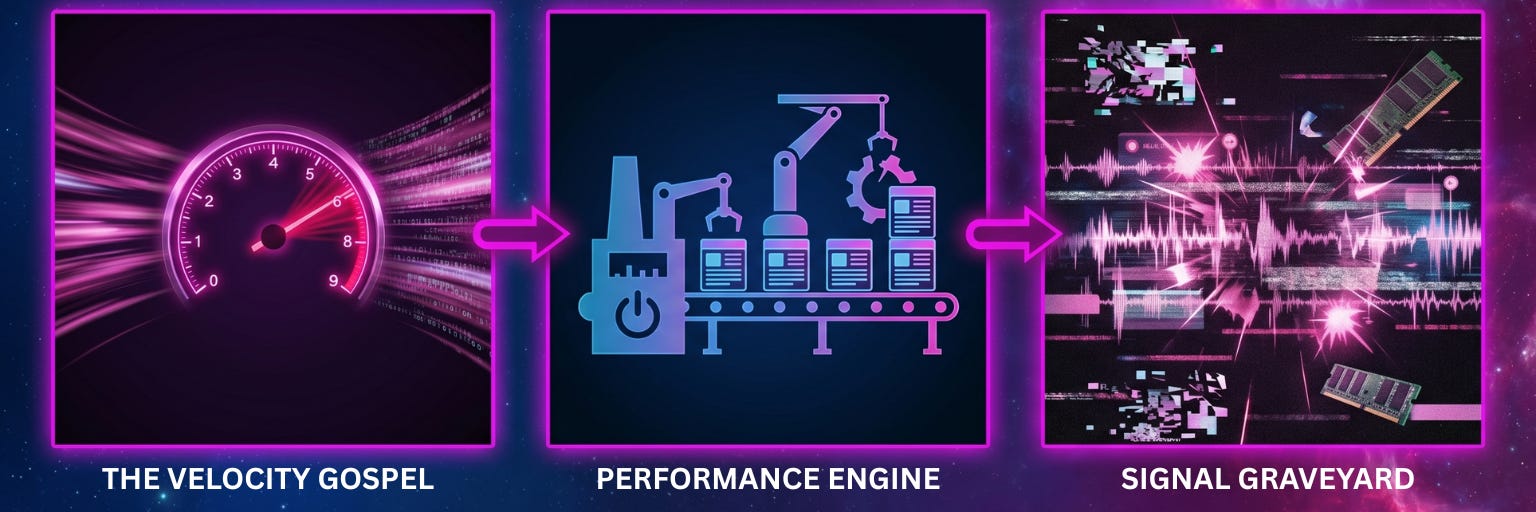
I call the belief system underneath this phenomenon, the Velocity Gospel. Faster content equals more reach equals better outcomes. Volume is strategy. Frequency is progress. Quiet is falling behind.
When a brand runs the Velocity Gospel through its content operation, it becomes a Performance Engine.
More posts, more formats, more channels. The calendar fills up. Metrics get tracked. Everything looks productive from the inside. The engine produces content the way a factory produces goods.
Efficiently. Consistently.
Without asking whether any of it carries a signal.
Let’s talk examples.
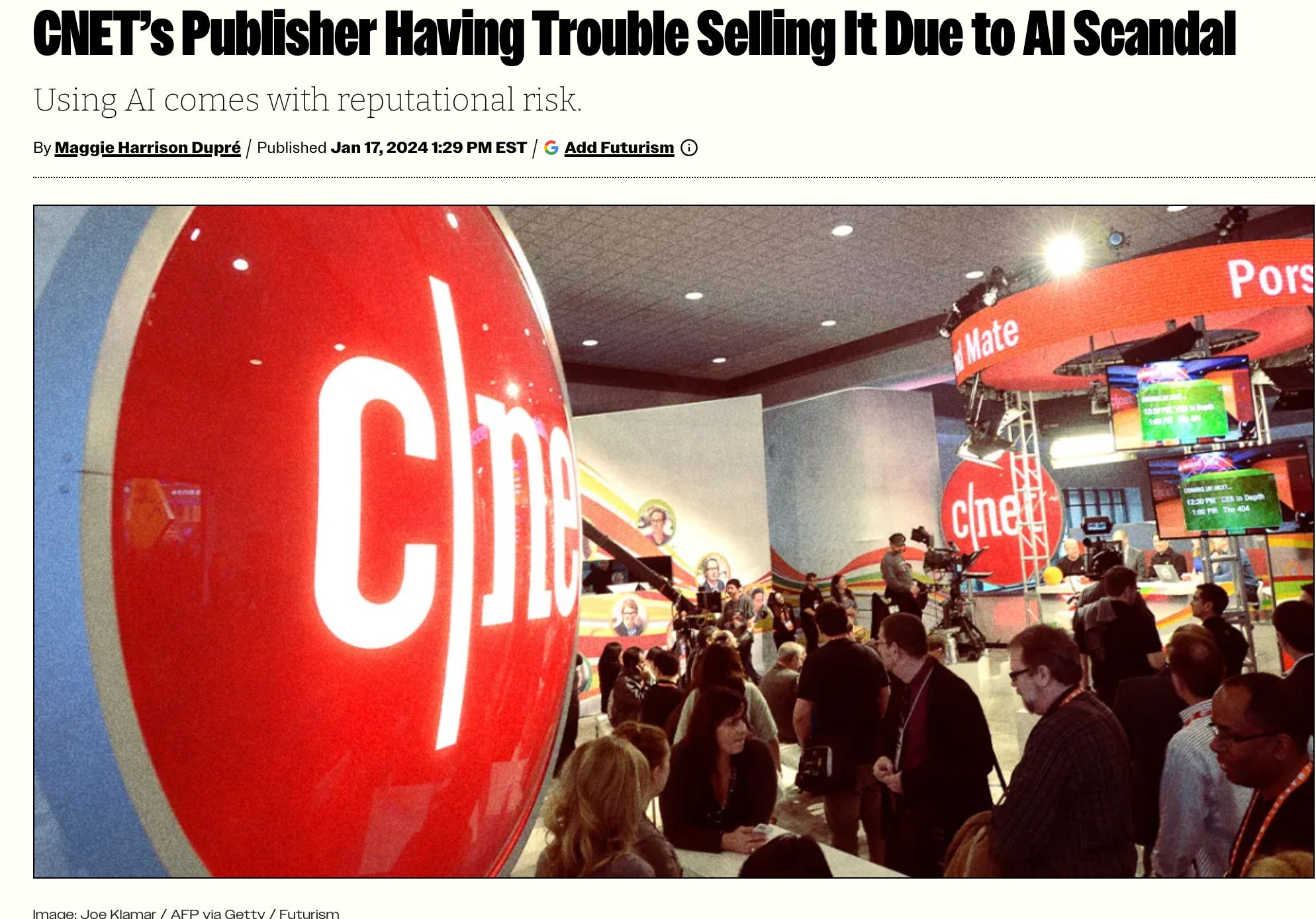
CNET ran this engine at scale.
The publication built brand equity over decades, reaching a $2 billion acquisition valuation in 2008. Then, under pressure to produce at volume, it used AI to publish 247 pages in seven days. When the factual errors surfaced, so did the cost.
By 2025, potential buyers were citing the AI content scandal as an active valuation liability.
In other words, by 2025, potential buyers were walking away or lowering their offers because of it.
Decades of trust, destroyed by a production decision.
When every brand in a category runs the same engine at the same speed, the whole category becomes a Signal Graveyard.
Every brand publishes three LinkedIn posts a week, a monthly newsletter, a quarterly “State of Industry” report.
The audience stops reading any of it.
Here’s another example.
Between 2024 and 2026, the ten largest technology publications lost 65 million combined monthly visits.
A 58% decline from peak. The Nieman Lab documented the collapse.
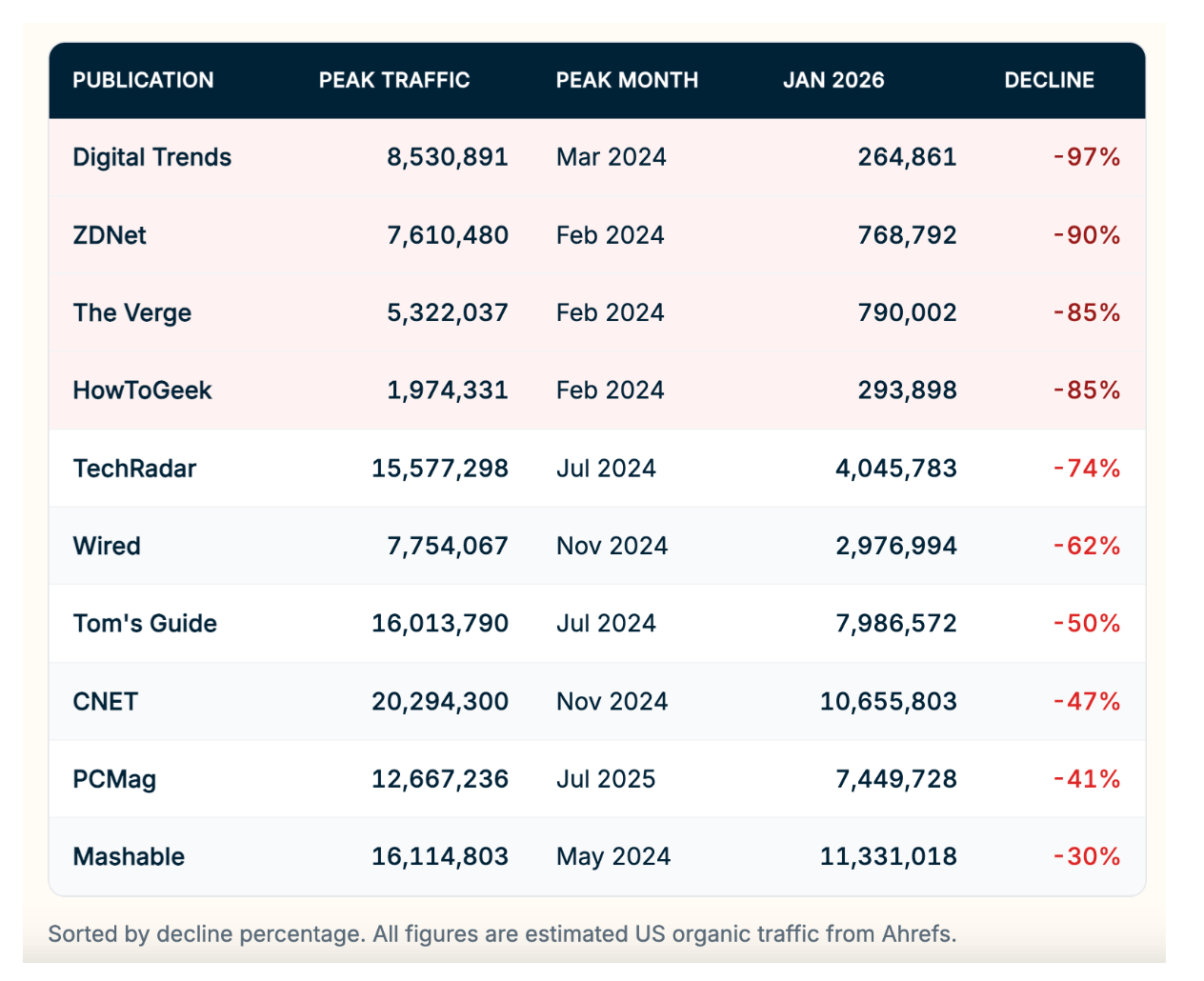
Image screenshot from Neiman Lab here showing Traffic to top tech publications has plummeted since 2024, new analysis shows.
An entire category that mistook activity for signal.
The Velocity Gospel creates the Performance Engine.
The Performance Engine, scaled across an industry, becomes the Signal Graveyard.
One belief. Three consequences.
If every brand is running the same engine at the same speed, what exactly is the strategy?
The campaigns that break through almost always break one of the Velocity Gospel’s rules.
They publish less and mean more.
They signal what they actually OWN.
They build upon what I call the Architect’s Keystone.
The Signal Architecture method
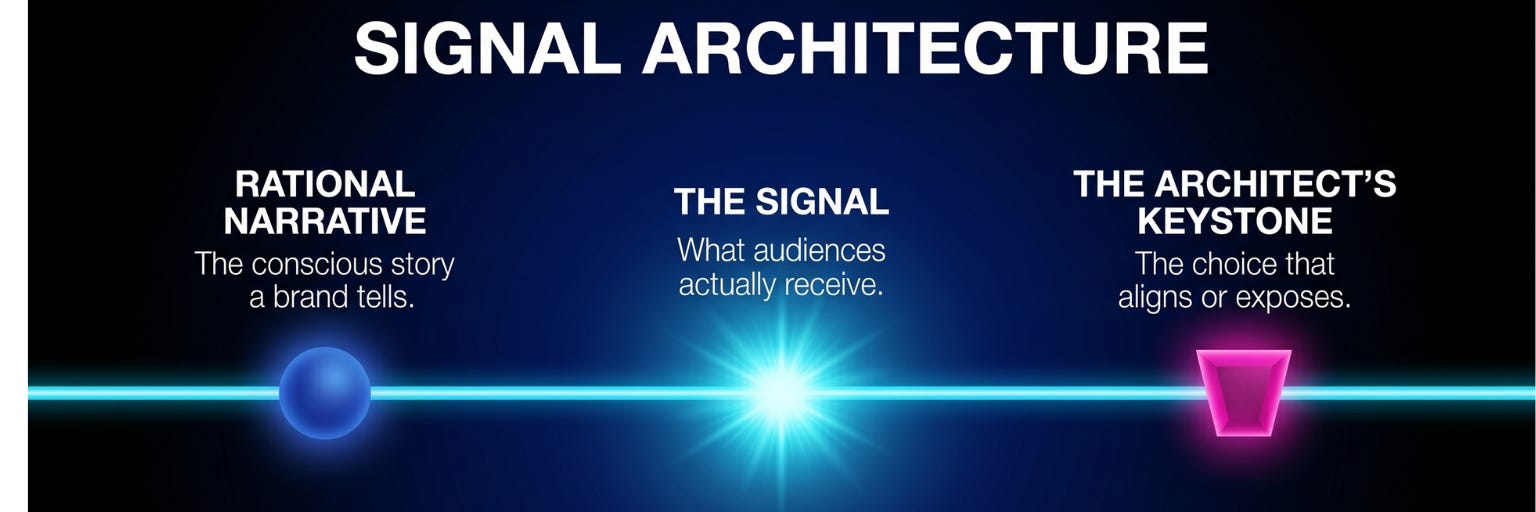
After 3 years of studying campaigns this way (12 in depth campaigns, 36 other instances where that strategy worked, over 15 different industries, and 30+ failed attempts), I developed a three-step framework for reading them below the surface.
I call it Signal Architecture.
Step 1. The Rational Narrative. Every campaign tells a conscious story about itself. “We’re the affordable option.” “We’re the secure choice.” “We stand for X.” This is what the brand or the market intends to communicate and think the customer wants.
Step 2. The Signal. Underneath the Rational Narrative is a Signal. Not the logical extension of what the brand intends. I't’s the intuitive, pre-rational truth the audience already carries. Gut-level. Sometimes illogical and always based in the human condition.
Often the thing the category has trained itself not to say out loud.
The Signal doesn’t confirm the Rational Narrative. It operates outside it or against it. It’s the opening to a new world the brand can claim, if it actually possesses what the Signal requires.
What it reveals is whether that possession is real or performed.
Pepsi’s Rational Narrative in 2017 was straightforward. Unity is possible. A Pepsi can help get us there.
But audiences decoded a different Signal entirely. You don’t understand what this conflict actually is ….and you just sold a soft drink with it.
The decoded Signal always wins.
Not because brands intend it to. Because it’s what people feel before they have words for it.
Step 3. The Keystone. In architecture, the keystone is the wedge at the top of an arch. That’s the last stone placed, the one that locks every other stone in position. Remove it and the arch collapses. In a campaign, the Keystone is the single design decision that deploys the Signal.
Not the brand’s Rational Narrative but the thing audiences already feel.
The campaigns that break through almost always make a Keystone decision that runs against the category’s conventional logic.
The category says lecture with authority. The Keystone entertains without credentials. The category says defend your reputation. The Keystone names the fear. The category says compete on price.
The Keystone exposes who raised it.
Pepsi ran the opposite error. They built the Keystone to deliver the Rational Narrative and never asked what Signal their audience was already carrying.
Audiences already knew: social justice requires real stakes, real confrontation, real sacrifice. It doesn’t resolve because a celebrity steps out of a luxury photo shoot and hands a soft drink to a cop. That decoded Signal was present in the audience before a single frame ran.
The Keystone did more than create the misalignment. It just made it impossible to unsee.
Watch the framework explained. Deep Dive
The full Signal Architecture breakdown — Rational Narrative, The Signal, The Keystone — with the Pepsi failure analysis walked through in real time.
Two campaigns that prove it
Here’s the first example “What’s App - Message Privately.”
WhatsApp ran what I call an Inoculation Play.
A campaign built around the brand’s most dangerous liability.
WhatsApp is owned by Meta. That single fact had been breaking the brand since 2021, when updated terms of service triggered a mass migration to Signal and Telegram. Elon Musk told 170 million followers directly: “Don’t trust WhatsApp.”
The Rational Narrative was genuine, which was an end-to-end encryption built into every message since 2016. But the Signal audiences were carrying said something else entirely: Meta monetizes attention.
Why would this platform be different?
The Keystone was three words: “Not even WhatsApp.” A global campaign built around the admission that the platform itself cannot read your messages. Intimate texts, late-night voice notes, hospital call, which rendered as scrambled, unreadable code on screen.
The tagline demonstrated the technology.
Ad awareness climbed 11.5 percentage points in a single month. The largest campaign in WhatsApp’s history ran on the one line most brand teams would have sent straight to legal.
Read the full breakdown. WhatsApp’s Inoculation Play →
Chili’s ran a Category Crasher.
Running a humorous predatory paid laon service BELOW their business category.
Why? Because the category below them had broken its own defining promise.
Fast food’s Rational Narrative had always been simple: the cheapest meal available.
By 2025, a McDonald’s combo that once cost $5 had crept to $12 to $15. The identity stayed intact in the branding. The pricing told a different story. The Signal Chili’s recognized was the one fast food customers were already carrying: the sense that the deal they’d trusted for decades had been quietly stolen.
A sit-down Chili’s meal at $10.99 was now genuinely cheaper than the drive-thru. Nobody in the industry had said it out loud yet.
The Keystone was a fake payday loan office set up directly next to a Manhattan McDonald’s, with signs reading “Finance Your Fast Food Today.”
Chili’s didn’t argue that fast food had become predatory. The format made the argument. 6 billion earned media impressions. 31.6% same-store sales growth the following quarter.
Read the full breakdown. Chili’s Category Crasher →
Both campaigns worked because the Keystone aligned the Signal with something the brand authentically carried.
Copying the structure without the underlying possession would have produced another Pepsi ad.
Which leads me to the next question (and hopefully yours as well), what am I building towards here on the Strategy Signal?
What this newsletter builds
The Strategy Signal publishes every week.
Each issue is one campaign breakdown using Signal Architecture. 1 named pattern, the mechanics and human conditioning psychology behind it, the Keystone that made it work, and the failure conditions that kill it when brands try to copy it without the underlying possession.
The campaign library below is the foundation.
Each pattern has a primary breakdown and a deeper application issue. Start anywhere. They build on each other, but none requires reading in order.
If you’re working inside the Performance Engine, producing content that technically functions but generates no real signal, the exit is learning to read what you actually possess and building the campaign from that.
My take: possession is the strategy. Everything else is execution.
That’s the work. That’s what this newsletter teaches.
Before you read the library. Try out my AI prompt below.
Run your own brand through The Architect’s Diagnostic first — a 10-minute AI interview that surfaces which enemy you’re inside, your current Signal Architecture, and 5 conversation questions for your next strategy session.
Get The Architect’s Diagnostic →
The campaign library
6 patterns. Each one a different Architect’s Build and Keystone. Start wherever the brand challenge fits yours.
The Entertainment Trojan Horse. E.l.f. Skin Sunhinged
The Inoculation Play. WhatsApp
WhatsApp said the thing most CMOs are afraid to say (Video)→
Your brand’s biggest fear might be its best campaign brief →
The Purpose-Driven Inverter. Dove Real Beauty
The Category Crasher. Chili’s
Chili’s Set Up a Fake Payday Loan Office Next to a McDonald’s (Video)→
Stop Fighting Your Real Competitors. Fight Someone Else’s Instead. →
Memory Equity. Under Armour
They Beat Nike Without Fresh Creative — Then Stopped (Video)→
Under Armour got this right in 2021. By 2025, they’d forgotten why. →
The Cultural Aftermarket. Coors Light
Also in the library
What your confident-looking systems aren’t telling you → (Signal Reader’s Digest. April 2026)
You can’t direct what you haven’t named → (Signal Reader’s Digest. March 2026)
7 Hours of Research. 6 Minutes in Your Inbox. Every Week. (Video)→ (How this newsletter is built)
New issue every week.
See you next one.
Matt
wow so in depth! definitely feels like most campaigns don’t fail because the creative is bad, they flop because the brand is pretending to be something it’s not. The ones that hit (and have staying power!) are just honest about what they really are and tap into something people already feel. also, not trying to be everything to everyone