Intro
Hey Folks!
It’s been a fun week. I’m trying out some new Substack Live videos with John Hoad who has been ramping up the conversations. There’s some fascinating people here on Substack and I highly recommend them.
Keep an eye out on them. The first one comes out in the next few days!
Now why you came here!
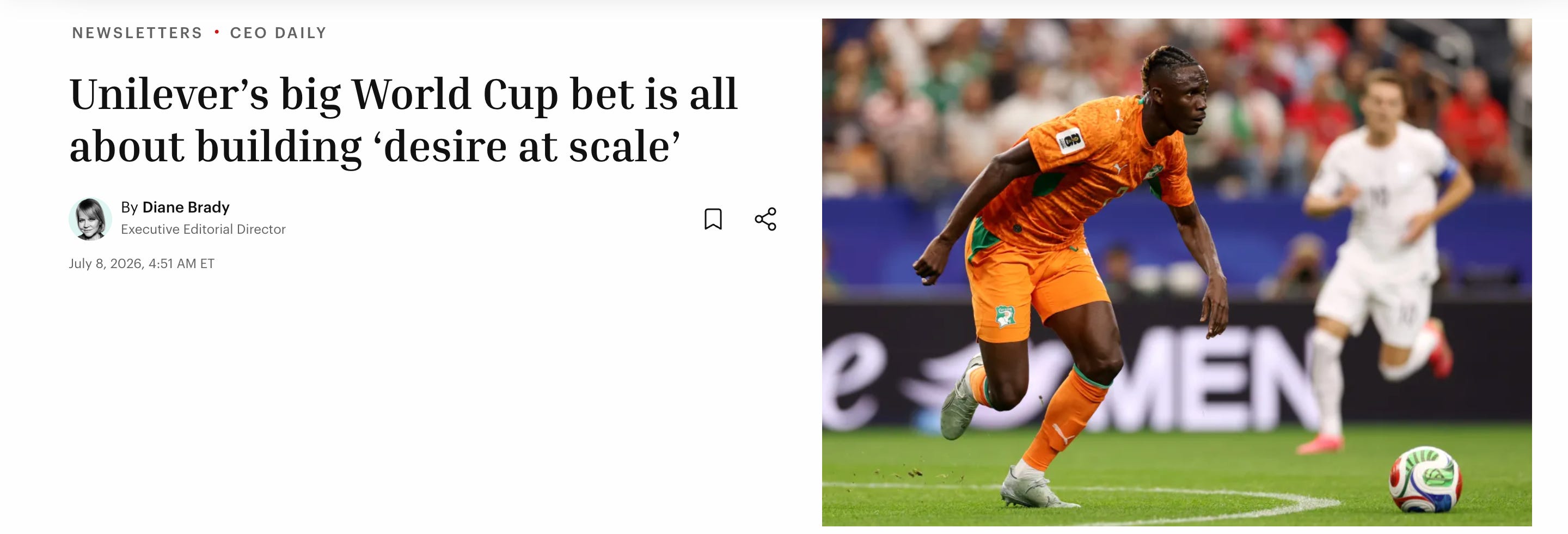
Unilever made a documentary about buying the World Cup.
It has 275 views.
The company activated 35+ brands across 120+ markets as Official Personal Care Sponsor, shipped more than 180 limited-edition products, and put 50,000 creators to work across 39 days and 104 matches. Their own behind-the-scenes explainer of all of it sits at 275 views on their own channel
Nike’s World Cup film has 80 million.
So the obvious read is that Unilever spent a fortune and nobody noticed.
I believed that for about 4 days. Then I found the number that changed my mind, and the campaign turned into something considerably more interesting than a failure.
Here’s what they actually built.
Prefer to watch? The full breakdown of The Portfolio Prism is on YouTube.
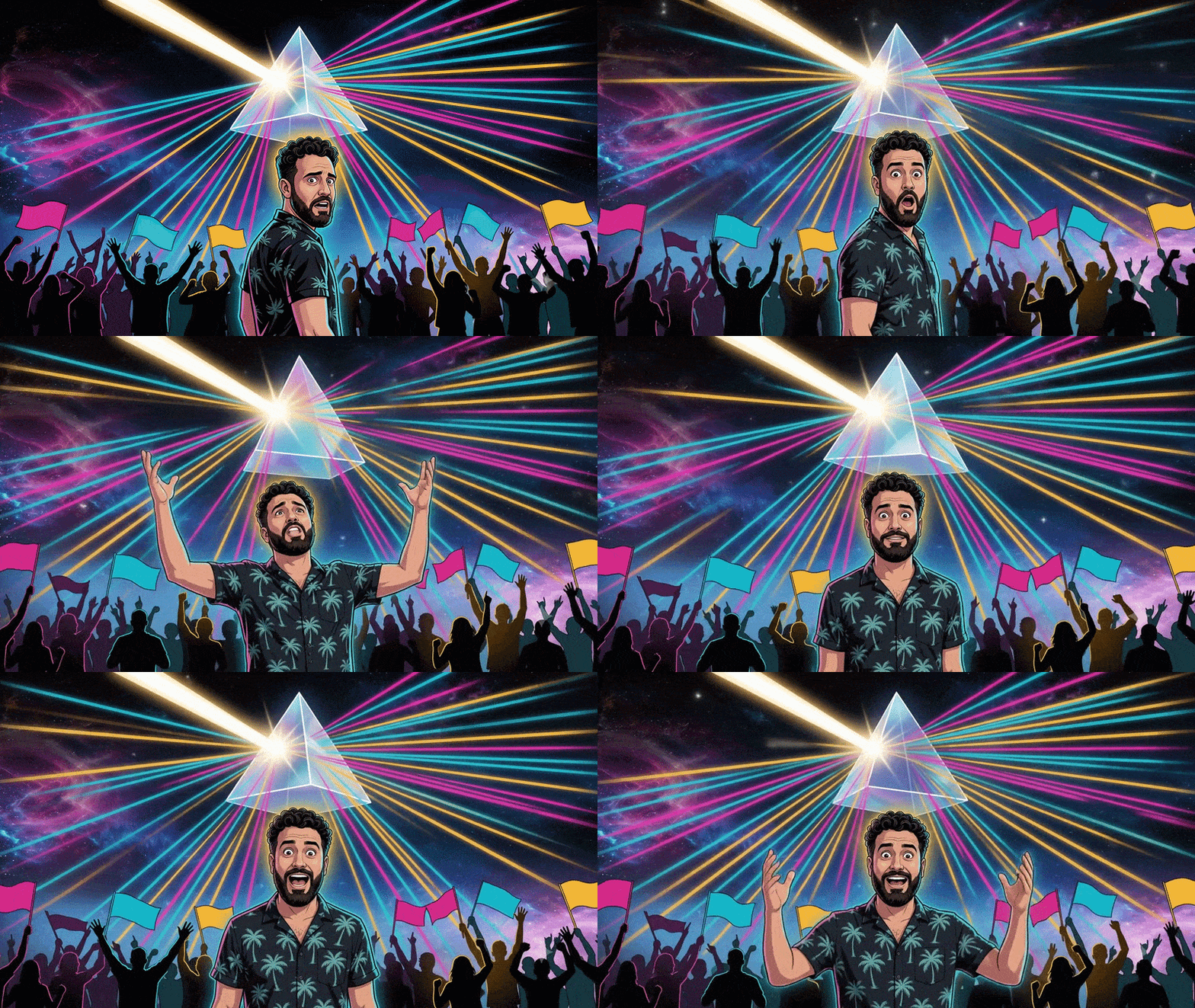
The pattern: the Portfolio Prism
Sponsorship strategy usually concentrates.
Buy the cultural moment, point everything at it, make one film big enough that people still say your name in August.
Nike did exactly that and got 80 million views for it.
Budweiser did it and got 40 million.
The playbook works, and it has worked since the 1980s.
Unilever built a prism.
They centralized the expensive, invisible layer: production, rights, creator infrastructure, retail attribution.
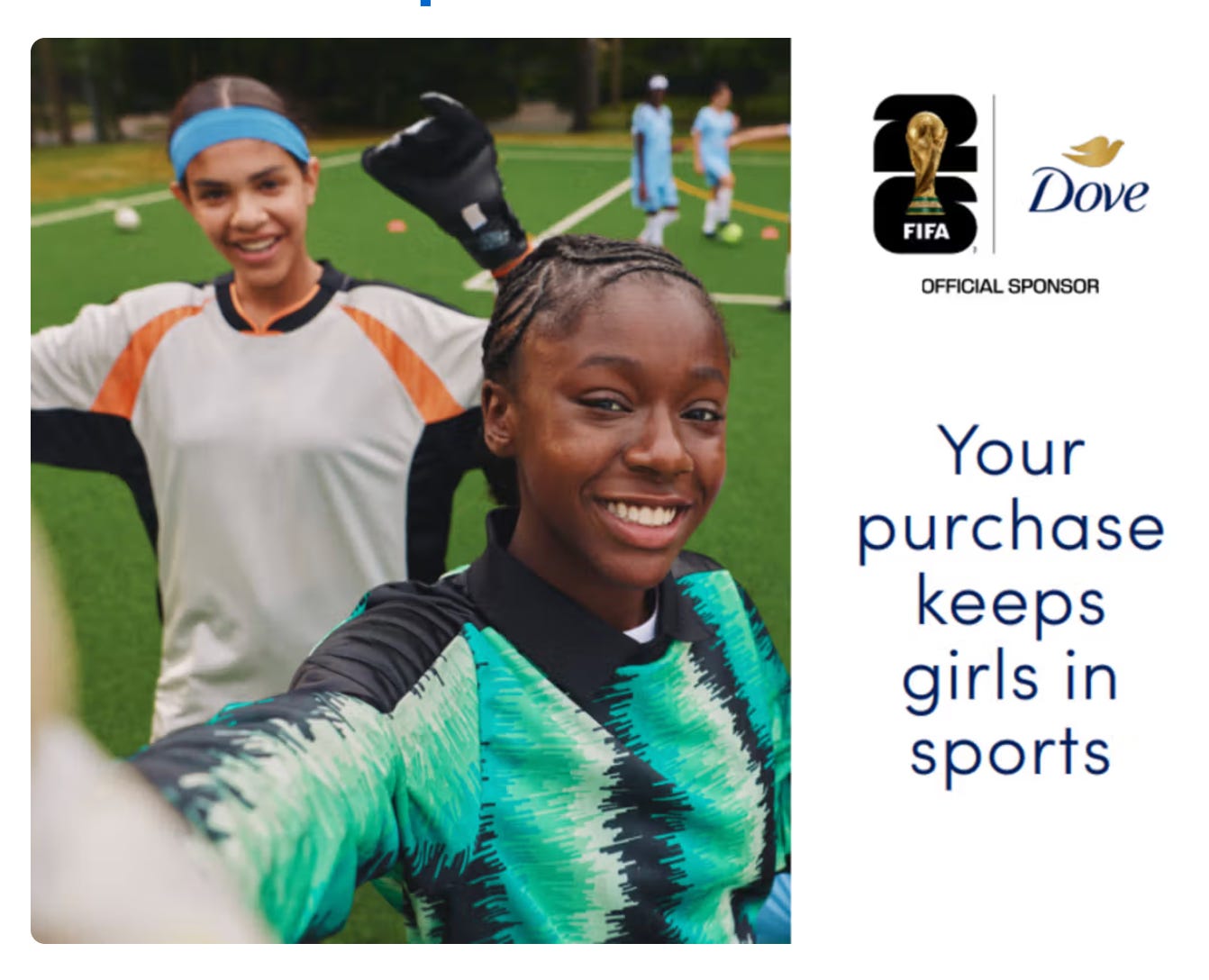
Then they refracted one fixed-cost cultural window across every brand, market and audience segment they own. Dove got confidence. Dove Men+Care got skin. Rexona got the sweat. Axe got the guy in the costume. Unilever’s own framing calls this “Desire at Scale,” and names the third pillar as “winning in commerce by converting intention into purchase.”
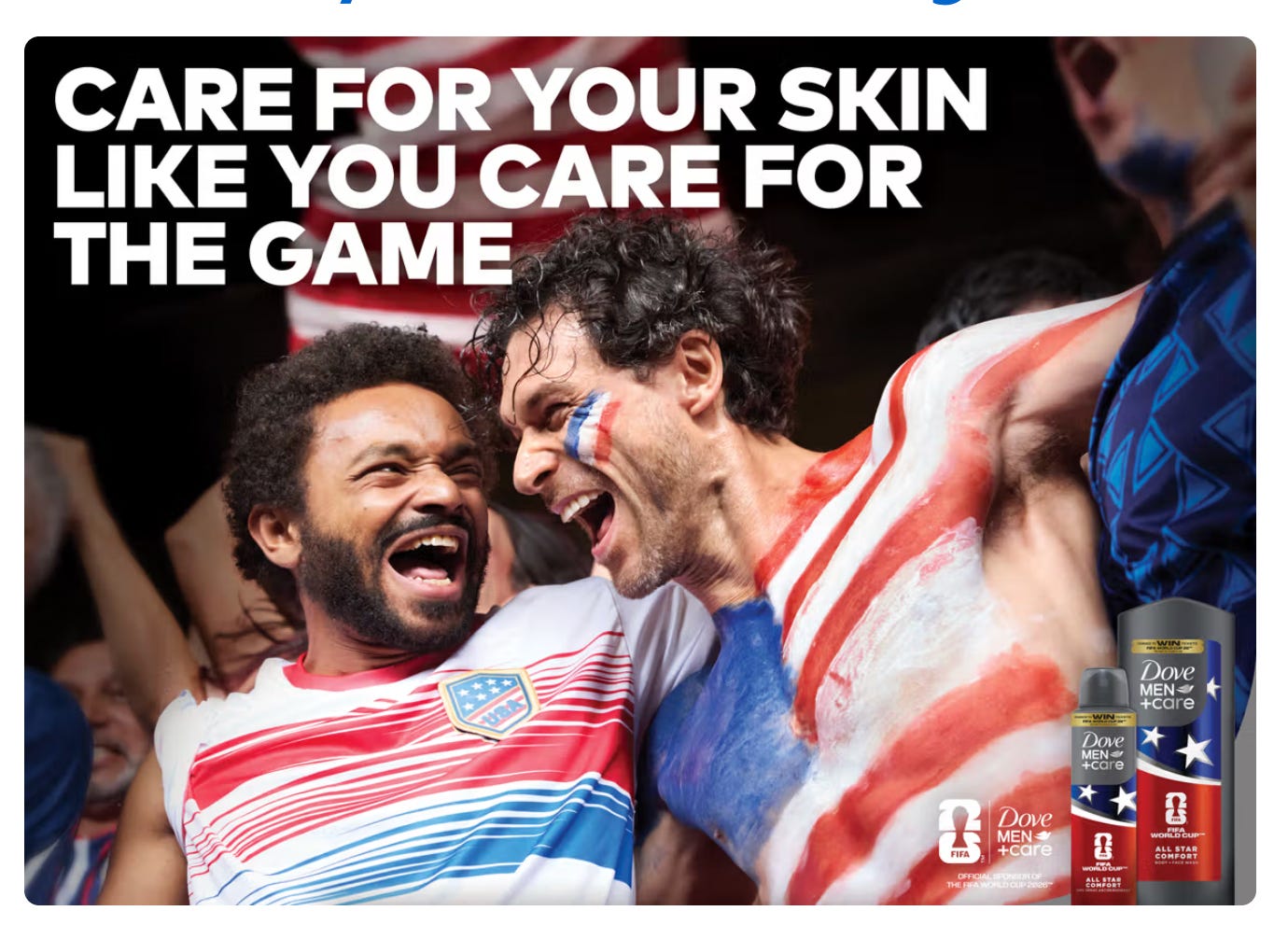
I ran this through 3 independent research passes. Each landed on the same mechanism and reached for different words.
“Concentrate infrastructure while distributing cultural authority.”
“Centralized infrastructure, decentralized output.”
“Centralize the expensive invisible layer, deliberately fragment the visible one.”
3 passes, 3 phrasings, 1 architecture. That convergence is why I’m willing to name it.
The Portfolio Prism.
What Unilever actually built
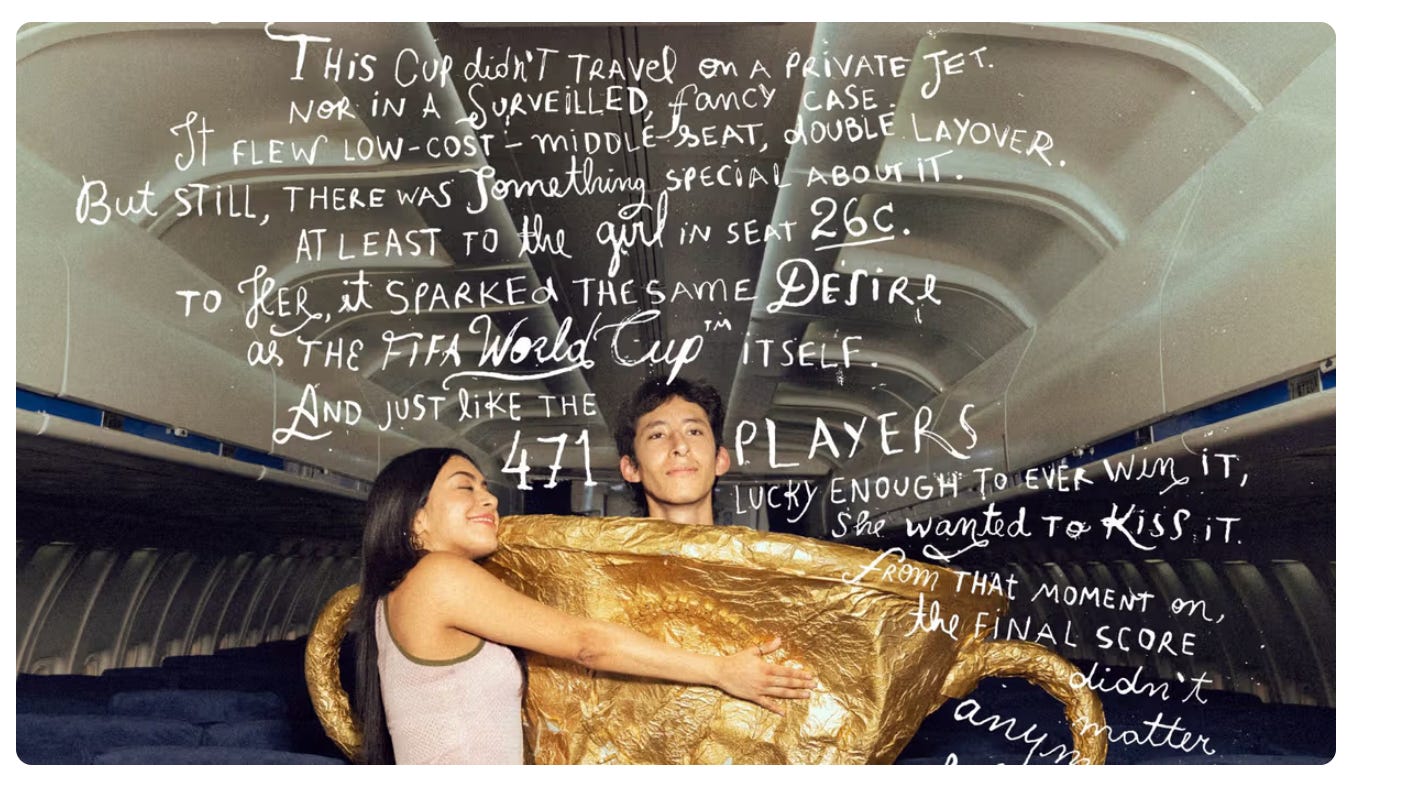
A content engine.
Unilever states that Personal Care’s AI Content Studio and Social Studios created more than 18,000 assets for 120 multi-brand, multi-market campaigns. That figure covers the whole portfolio production system. The World Cup ran through a machine already operating at that volume.
A creator graph.
Digiday reports the network has grown from 10,000 to roughly 300,000 creators, with AI handling discovery, vetting, brand-safety screening and briefing by scanning for people already saying favorable things about the products. Fifty thousand were activated for the tournament.
Physical creator hubs.
House of Fresh in Mexico City, New York and Miami, purpose-built so influencers could turn live fan experiences into social content without leaving the building.
A reactive newsroom.
The Locker Room, running 24/7 across TikTok and YouTube with creators, community experts and football strategists producing content at the speed of the tournament. Marketing Dive covered the setup as the center of the whole activation.
An attribution spine.
This one I found myself, in the Meta Ad Library. Every paid Unilever placement I pulled routes through MikMak retail attribution, landing on retailer-specific destinations for Target, Walmart, Costco and Sam’s Club. The tracking parameters inside Dove’s ads alone expose more than fourteen separately named audience segments.
Now look at that list and ask which items survived the final whistle.
The hubs closed. The newsroom stood down. The content engine, the creator graph and the attribution spine kept running, because all three existed before June and none of them were built for football.
The campaign spent the budget. The infrastructure kept the value.
Where else this shows up
P&G, Paris 2024.
Reuters reported that P&G focused its Olympic marketing on Pampers, Gillette and Ariel rather than the corporate brand, running ads for more than thirty brands while cutting US Olympic ad spend 50% over several Games. Chief brand officer Marc
Pritchard put it plainly: “In the past, we’ve had both a P&G and a brand focus, and this time we just really decided we’re going to go focus, not 100%, but much more prominently, on brands.”
Fixed cultural window, refracted across a portfolio, corporate message deliberately suppressed.
P&G ran the fragmentation half of this play two years before Unilever did.
The coverage describes no creator graph, no AI content engine, no retail attribution spine. Unilever’s contribution is the machinery underneath the fragmentation, and machinery is what makes a pattern repeatable.
Coca-Cola, America 250.
Eight days after the final, Dove Men+Care launched Ted Lasso limited editions. In that same window I watched Coca-Cola swap its entire live Meta library over to America 250: fifty-two collectible state mini-cans, four named creator partners, same architecture, next window.
P&G, London 2012, as the control.
Same rights scale, same portfolio, opposite architecture. One unified message, one hero film, brands as endorsers underneath it. “Thank You, Mom” is still the reference people reach for fourteen years later. Ask a marketer to name a single P&G asset from Paris 2024 and watch what happens.
Which is either an argument against the Prism or the price of it. Hold that question.
One marketing pattern per week. Each issue breaks down what worked, why it spread, and what it means for the next 12 months. Free.
Subscribe to The Strategy Signal →
Why this works now
Asset production collapsed in cost. Eighteen thousand assets across 120 campaigns is a number that would have required a small army in 2022. Fragmentation used to be the expensive road, because every additional version meant another shoot and another approval chain. AI moved it close to free, and the architecture followed the economics.
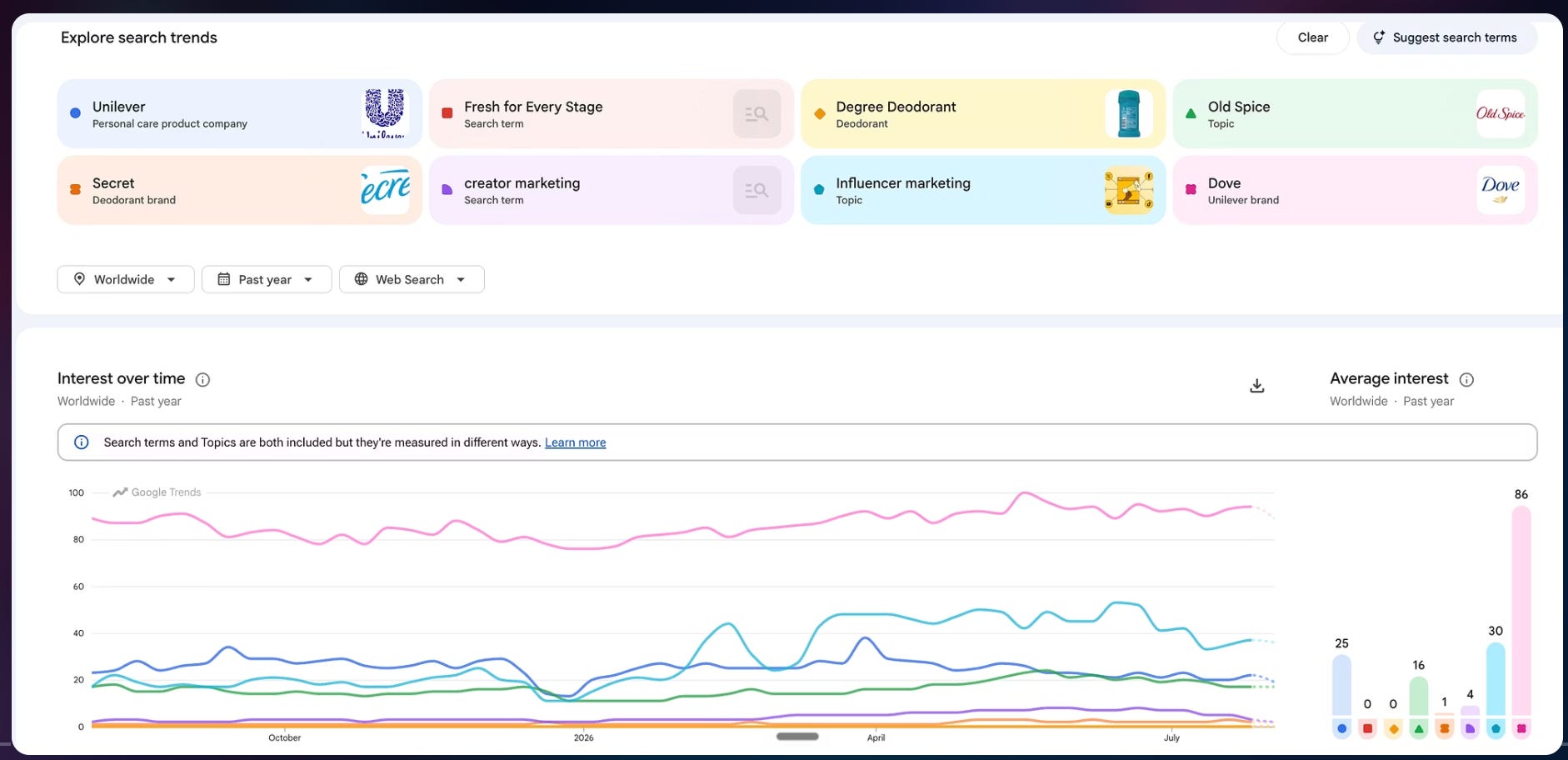
Demand shifted from creators to creator systems. This one surprised me. US search interest in “influencer program” is up 250%. “Influencer marketing” up 170%. “Amazon influencer” up 130%. Two Temu-related creator terms hit Breakout. Meanwhile “influencers” fell 40% and “instagram influencer” fell 30%.
Search demand has migrated from the people to the machinery that manages them. Google Trends reports relative interest in a normalized sample, so treat that as a directional read.
The direction is hard to miss.
Retail attribution matured. MikMak, Walmart Connect, retailer-level routing.
The paid half of the Prism became fully measurable at exactly the moment the creator half stayed dark.
Where it broke
Two failures. One is Unilever’s. One is mine.
Guaranteed screen time, zero conversation
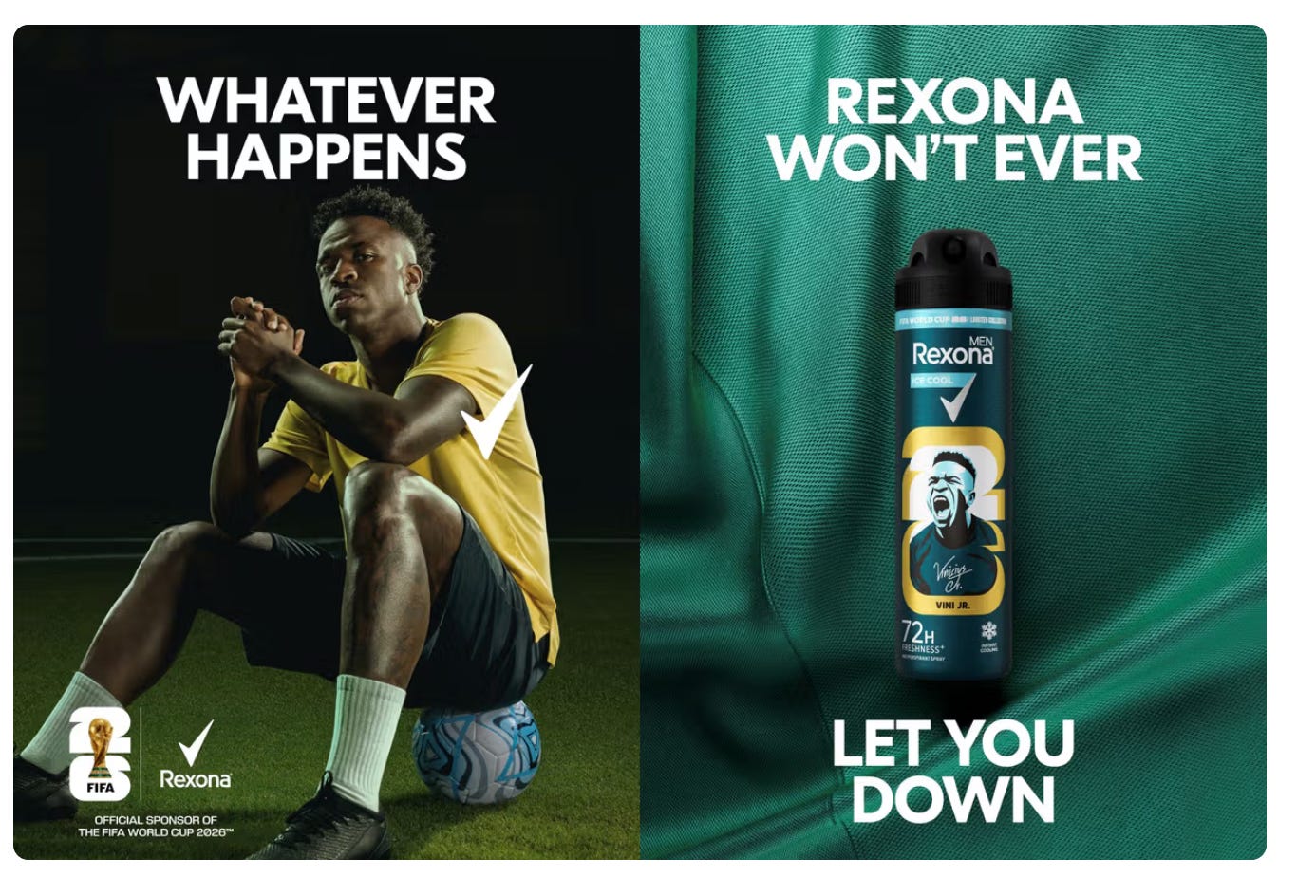
Rexona branded the fourth official’s substitution board. Guaranteed screen time, every match, unavoidable if you watched a single game.
r/soccer has 4.4 million weekly visitors. Search it and you’ll find silence. No complaint, no joke, no acknowledgment.
Now the control, from the same brand. Two years earlier Rexona ran a single stunt where Ronaldinho faked a retirement announcement and then revealed it as a campaign. r/soccer’s response: 4,500 votes and 386 comments
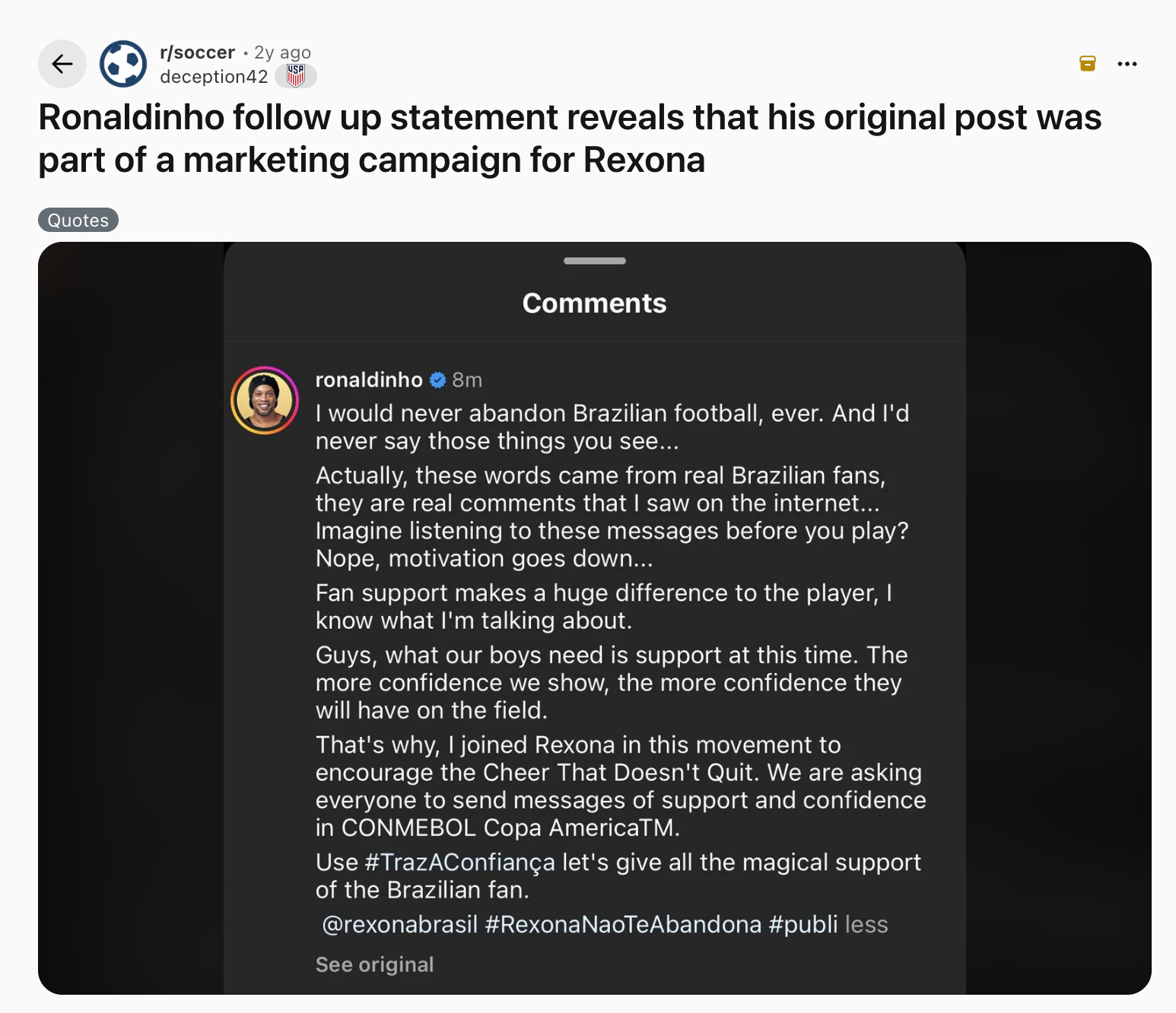
Same brand, same audience.
One stunt outperformed a tournament’s worth of guaranteed placement by a margin you can’t round away.
The Prism distributes presence.
Manufacturing a story out of a category truth is a separate problem, and it stayed unsolved.
Sweat, confidence, freshness before the match: real product benefits, and nobody has ever repeated one at a bar.
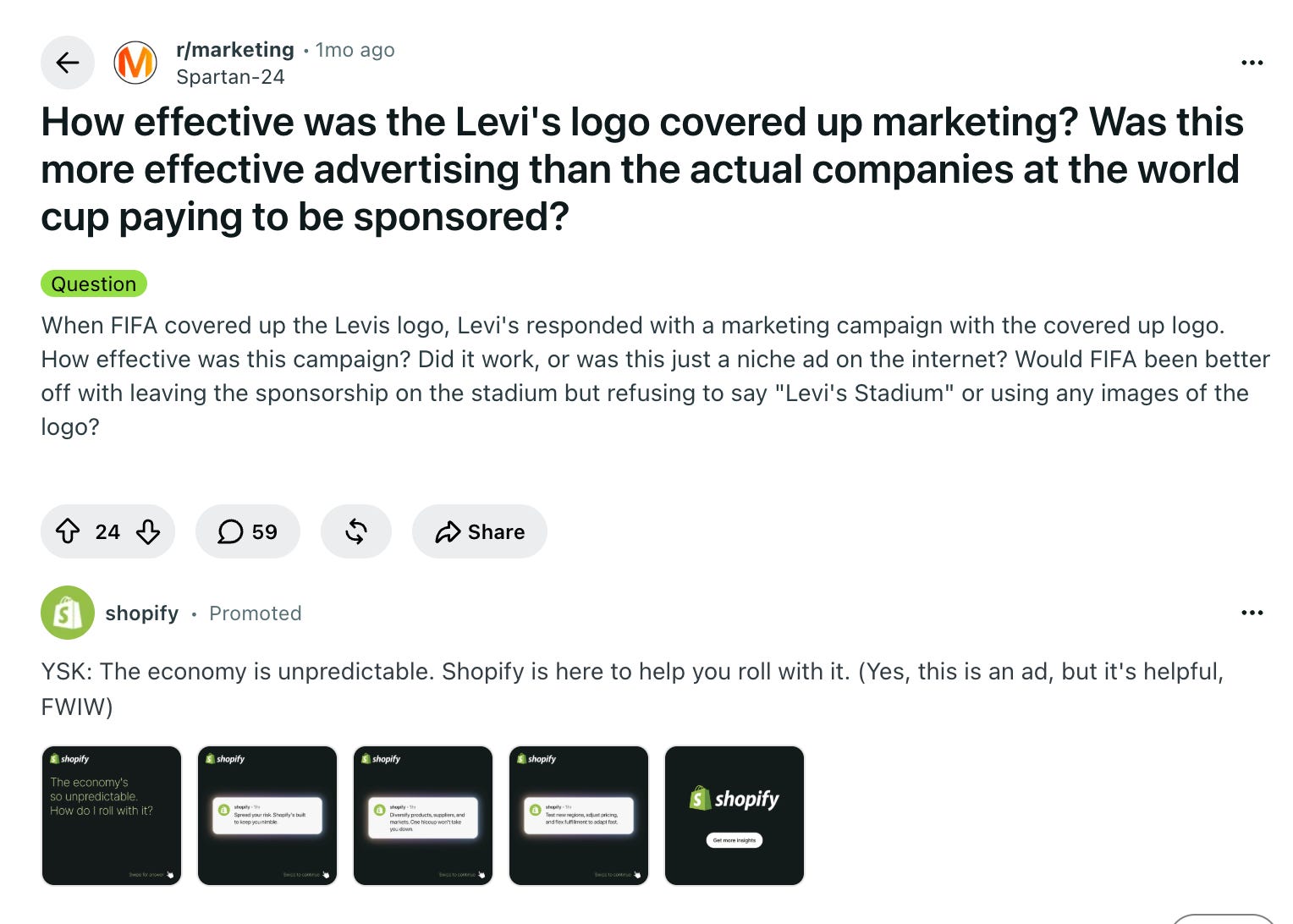
Worth noting who did generate conversation. Levi’s got banned from World Cup branding, and r/marketing spent 59 comments arguing about whether the ban beat the sponsorships.
The brand that couldn’t buy in got the discourse.
The measurement trap
Here’s where I got it wrong, and the mistake is worth more to you than my original conclusion was.
I ran 5 signal instruments on this campaign.
Google Trends, Meta Ad Library, TikTok Creative Center, YouTube, Reddit. All 5 came back near zero. Campaign name registered nothing. Brands absent from top-performing ads. Documentary at 275 views. Reddit silent.
5 independent tools, one reading. I wrote it up as a structural finding.
Then I found Tubular Labs data, reported in trade coverage, putting Axe Mexico’s World Cup content in the hundreds of millions of YouTube views. Rexona in the same territory.
Numbers that size are single-sourced through a secondary outlet, so I’d want a second confirmation before I put them in a client deck. The order of magnitude is enough to blow up my conclusion regardless, because I had been holding a 275-view corporate documentary against Nike’s 80 million and calling the whole campaign invisible.
Every one of those five instruments defaults to United States and English. I pointed a US-configured research stack at a 120-market campaign and concluded a global activation was invisible, when what I had actually measured was one country.
Take the lesson without paying for it: your signal research has a default geography, and it is almost never the campaign’s geography. Check the region setting before you write the conclusion.
The correction sharpened the finding. Brazilian trade coverage describes a separate campaign running under the same sponsorship: Ronaldo and Vini Jr. on limited-edition cans, Panini sticker bundles, a mascot promotion requiring multiple purchases to redeem. The United States got the creator bet. Latin America got a promotions machine.
And the invisible half is the half Unilever described to investors.
What the money actually says
Follow the money as they say!
One more correction, this one against my own thesis.
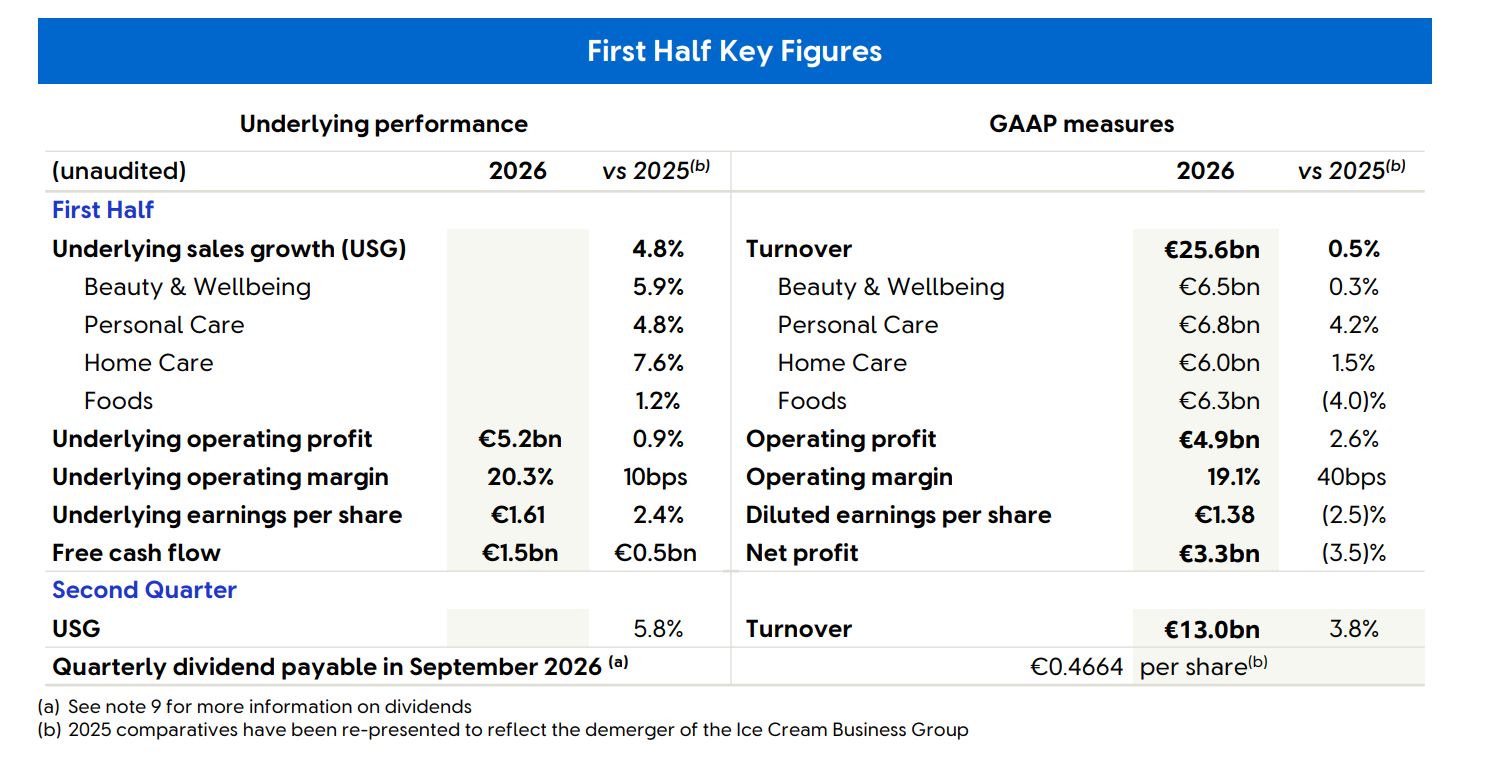
Personal Care volume grew 6.8% in Q2 against 5.9% underlying sales growth, per Unilever’s Q2 results.
When volume outruns sales growth, price went negative. Unilever names “planned FIFA World Cup 2026 promotional activity” as one of three reasons price growth fell in the quarter.
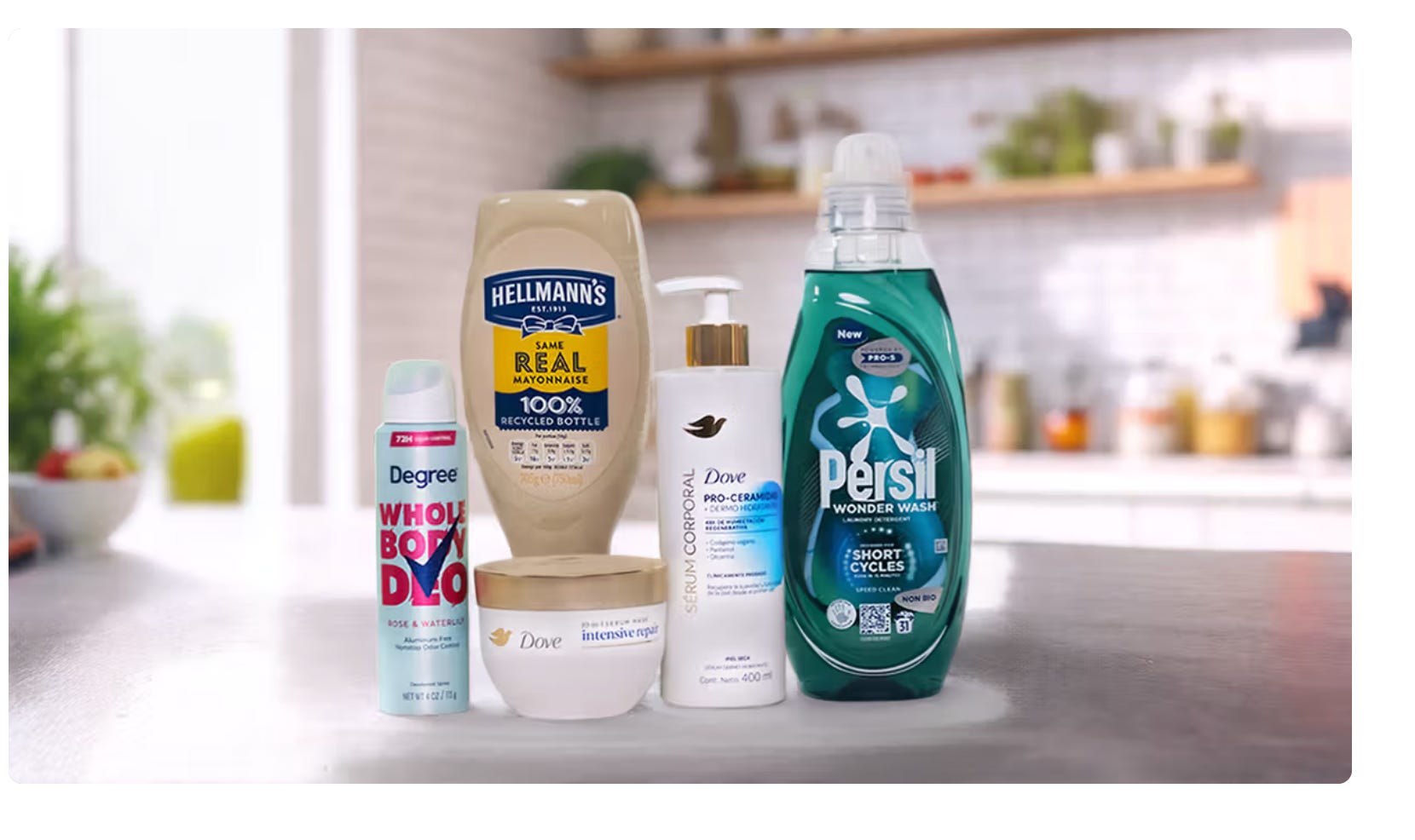
So the campaign moved product and gave up margin to do it.
That’s a solid commercial result, and it argues against reading any of this as a flop.
The creator layer is the only part with no number attached to it at all.
Questions to run this against a client
Before the diagnostic, an honest note about the pattern.
Three independent analysts, myself included, went looking for documented failures of this architecture. We produced nine cases with zero overlap. Not one of us picked the same example.
That evidence IS the definition was loose enough to exclude anything inconvenient.
So here’s a tighter one. If a client situation misses any of these four, it isn’t a Portfolio Prism and the pattern won’t transfer.
Under those criteria P&G Paris 2024 qualifies and London 2012 becomes the control. The pattern has two documented instances, which makes it far more forecastable than one ever could be.
Then ask your client these 4:
Do they own the point of sale? Retailers can capitalize a standing creator network because every post routes to their own register. A manufacturer has to work much harder to make that math close. This is the biggest single predictor of whether the infrastructure survives a CFO review.
Can you name the one asset a stranger would remember? If you can’t, you’re building a Prism whether you meant to or not.
Which half of the activation is instrumented, and which half holds the budget? If those are different halves, you have Unilever’s problem. Name it before your CFO does.
What’s the default geography on your research stack? You know why.
You have clients in three different industries. Every one of them is waiting on you to tell them where their market is heading, and which move to make before their competitors make it.
That’s the job. Read the signal, name the pattern, hand them the play. Running that research by hand for every client and every trend is the slow part.
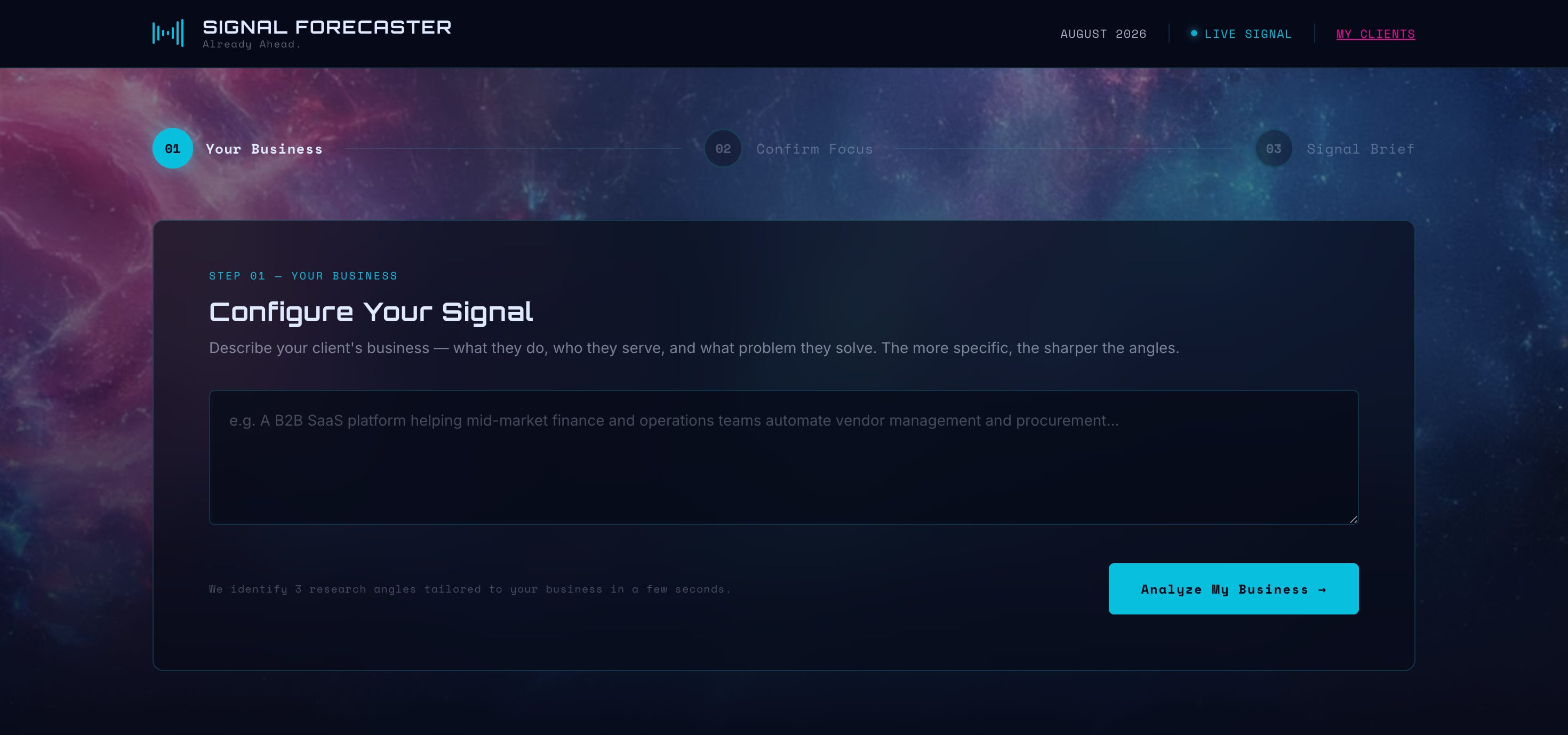
The Signal Forecaster does the research for you. Type any campaign or trend, and it searches the live web and returns a Signal Brief in about 30 seconds: the pattern name, a three-scenario Forward Hypothesis, and the recommended move. The same structure you just read, for any topic a client throws at you. You walk into the meeting already holding the answer.
I’m opening 5 pilot spots to marketing consultants with clients at no cost, in exchange for a 20-minute feedback call.
Matt’s Take
The Rational Narrative: The factory your client’s competitor is quietly building
This pattern is Growing.
Two documented instances exist. P&G at Paris 2024 and Unilever at the 2026 World Cup.
My estimate is 18 to 24 months before it becomes standard practice among conglomerates that already hold creator infrastructure.
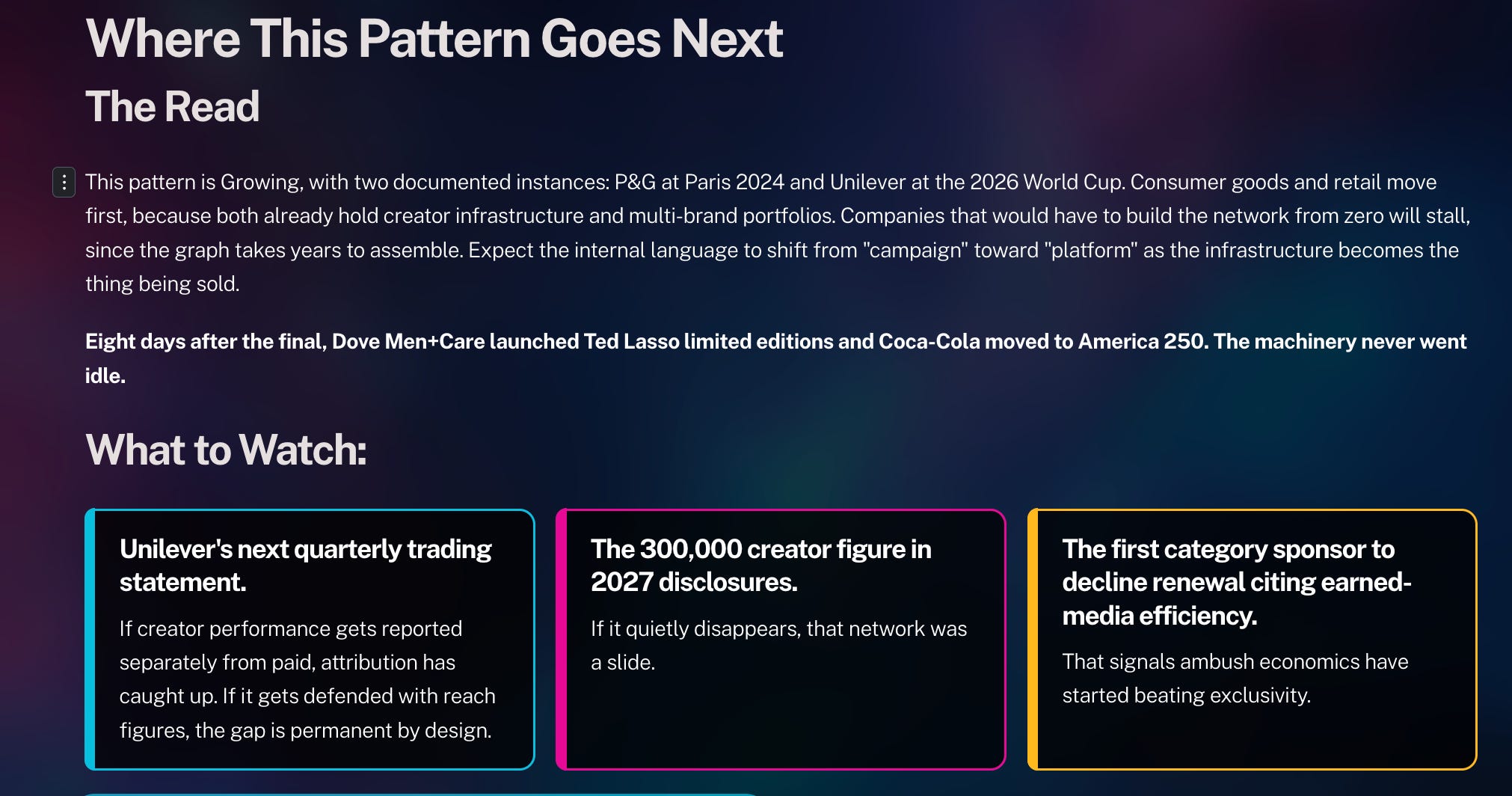
3 signals point the same direction, so I will state Scenario A plainly.
The infrastructure outlives the activation. Dove Men+Care launched Ted Lasso products eight days after the final. Coca-Cola moved to America 250 in that same window. The AI Content Studio and the 300,000-creator network both predate the tournament and both continue after it. Within twelve months, Unilever runs at least two more portfolio-wide cultural activations on the same spine. Consumer goods and retail feel it first.
There is a second direction worth watching. Attribution becomes the ceiling on this pattern. It is not confirmed. Confirmation arrives at the Q3 trading statement on October 28, in one of two forms. Either Unilever announces creator-layer measurement, or it defends the allocation with reach figures instead of attribution.
One signal could change everything, and I am not calling it yet. Ambush activity may be undercutting the value of category exclusivity. Levi’s was banned from World Cup branding and generated more practitioner discussion than the official sponsor did. Elevate this only if a major category sponsor declines renewal and cites earned-media efficiency.
A note on sources. Meta Ad Library shows creative and flight duration, not spend. Google Trends shows relative interest, not demand. YouTube view counts show earned attention, not sales.
What would change this assessment: if the 50,000 and 300,000 creator figures disappear from Unilever’s 2027 disclosures, the network was a slide rather than an asset, and Scenario A weakens considerably.
The Signal: Unilever cannot agree with itself about how many creators it hired
Here’s what I didn’t expect to find.
The CEO told investors 50,000 creators with a combined audience above 600 million. Digiday reports a network of roughly 300,000. And Unilever’s own president of US operations, Herrish Patel, told Fortune the company had close to 6,500 creators actually putting out content.
Fifty thousand. Three hundred thousand. Sixty-five hundred.
When Digiday pressed for clarification, Unilever restated the 300,000 figure. Digiday’s own verdict on that answer: “It’s not so much clarification as it is a restatement.”
A company this instrumented should report creator counts the way it reports retail conversion. Precisely, and once.
The figure blends three populations.
Paid creators with deliverables. Gifted attendees at the hubs. And people the AI found because they were already saying nice things, who were never hired at all. Olivia Ormos, who runs the creator platform MAVN, read the number to Digiday as competitive signaling: “We want to kill our competitors. Don’t even try.”
Then it got stranger. I went looking for creators who worked on this. Creator newsletters, Reddit, LinkedIn, native platforms, three languages.
Almost nothing. No disclosed rate. No confirmed NDA. Nearly every creator-adjacent quote in circulation traces back to a Unilever executive, an agency executive, or brand content hosted on Unilever’s own channels.
Fifty thousand people supposedly participated in the largest creator activation in the industry’s history and I could not find one of them describing what it was like.
Be clear about what this does to the forecast. It complicates Scenario A. If the graph is largely a scraping construct, the durable asset is smaller than the announcement implied.
The Keystone: Unilever just paid to learn the difference between being seen and being met
Rexona was on screen for a tournament. Unavoidable. And 4.4 million weekly r/soccer visitors said nothing at all.
One fake retirement announcement, two years earlier, produced 386 comments.
The Prism solved distribution and left transmission unsolved. Unilever can now put anything in front of anyone, in any market, at almost no marginal cost. Making being in front of someone the same as being encountered by them is a different capability, and nobody has built it yet.
Being seen and being met are two different events. Most marketing budgets are built as though they’re one.
The companies that work out the difference in the next eighteen months will own this pattern. The ones that keep buying reach will keep wondering why nobody remembers.
That’s the read. If you’ve seen this architecture running somewhere I haven’t, hit reply and tell me where. I’d like to know whether the P&G precedent has siblings.
Thank you for reading. We’ll see you on the flip side.
Matt
P.S. The Signal Forecaster turns any campaign or trend into a full Signal Brief in about 30 seconds, so you can run this play for any client, on demand. I have 5 free pilot spots open for marketing consultants with clients, in exchange for a 20-minute feedback call. Request a pilot spot →