

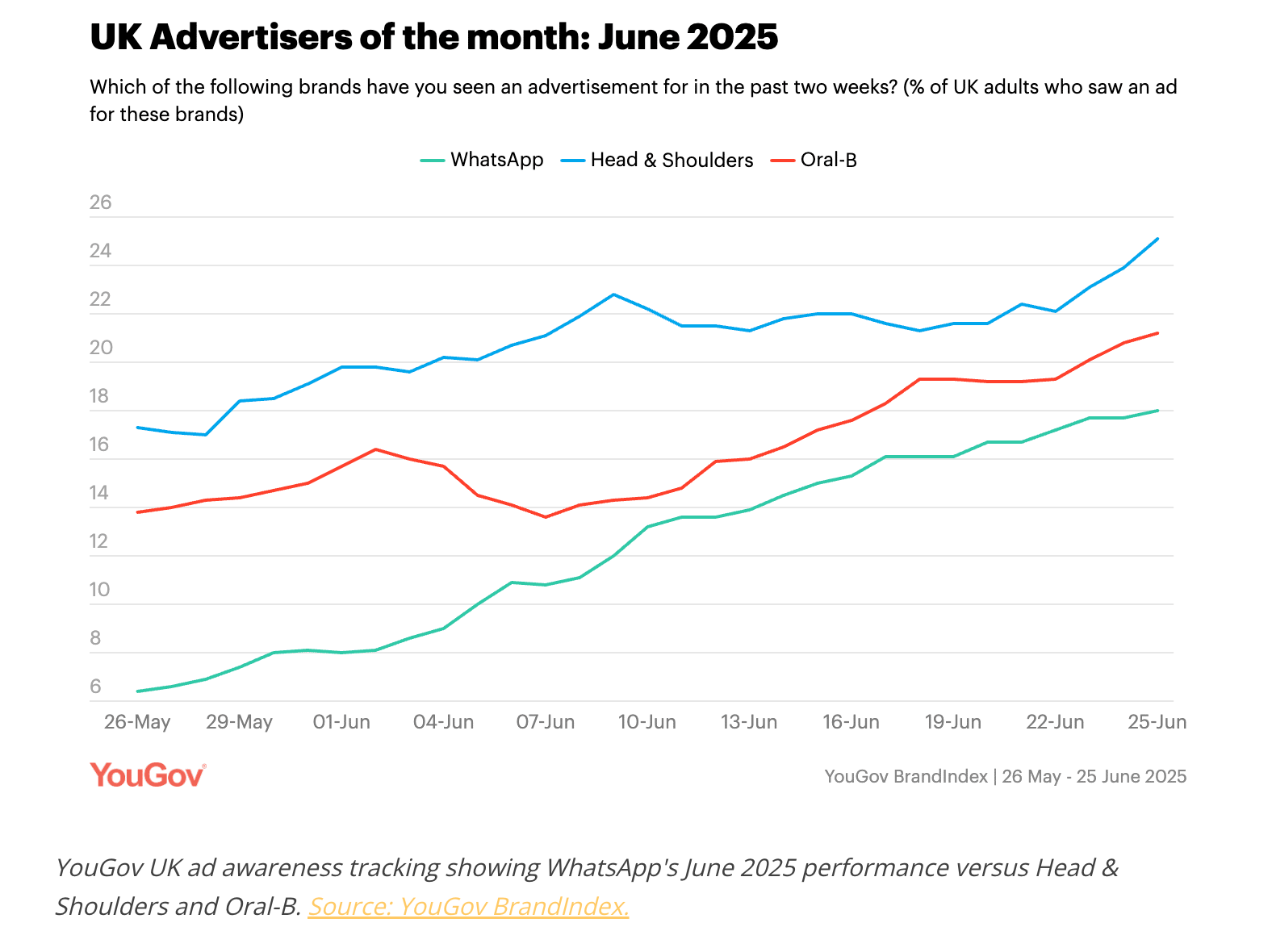
In June 2025, WhatsApp recorded the largest advertising awareness jump of any brand in the UK.
Ad awareness climbed 11.5 percentage points in a single month.
It went from 13.6% to 25.1%.1 YouGov tracked this number across the entire UK advertising market.
WhatsApp topped every brand on the list.
The campaign behind that result ran on TV, digital video, out-of-home, and audio across five countries: US, UK, Brazil, Mexico, and India. In Hong Kong, a billboard covered entirely in “encrypted” gibberish text went viral after local celebrities shared it. Nobody knew what it was until the WhatsApp logo appeared at the bottom.
The tagline was three words: Not even WhatsApp.
Designed to demonstrate that the platform itself cannot read your messages, that phrase became WhatsApp’s highest-performing awareness campaign ever. And the strategic reason it worked is exactly what most brands are afraid to do.
Here’s the Strategy Signal: the inoculation play
Here’s the signal for the week.
I call it “The Inoculation Play.”
A brand finds the single biggest fear, skepticism, or criticism customers associate with the product or category. Then they make that fear the centerpiece of their marketing, backed by overwhelming proof that they resolve it. In a sense the “inoculate” or immune their customers to their core brand weakness.
The pattern works because most brands do the opposite. They soften concerns. They redirect. They bury the anxiety under feature lists and aspirational imagery. The Inoculation Play puts the anxiety front and center. Being seen is the trust mechanism.
When it connects to something the brand actually, verifiably owns?
Primary case study: “Not even WhatsApp,” WhatsApp (Meta), May 2025
The situation
WhatsApp’s parent company is Meta.
Meta’s relationship with user data has been under sustained public scrutiny since the Cambridge Analytica scandal. In 2021, updated terms of service sparked a mass migration of users toward Signal and Telegram (love signal by the way). Elon Musk, with 170 million followers at the time, told people directly: “Don’t trust WhatsApp.”
WhatsApp had a perception problem. And the perception problem lived entirely outside the product itself.
End-to-end encryption has been built into every WhatsApp message since 2016. The technical architecture was solid and auditable. But the Meta stigma around data-sharing, ad targeting, and regulatory investigations kept attaching itself to WhatsApp’s reputation regardless of the underlying product reality.
The creative execution
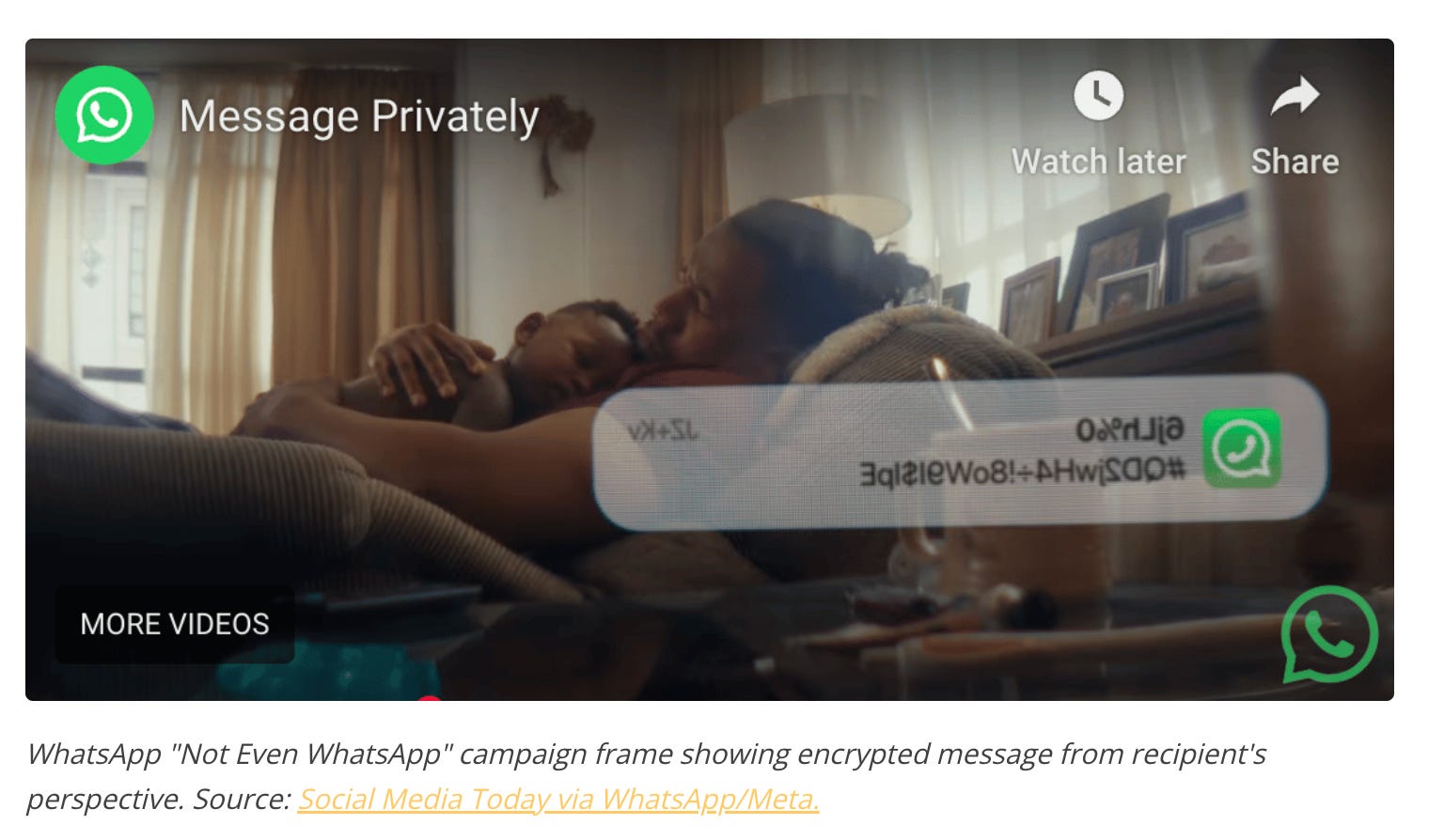
The 60-second hero spot flips the perspective completely.
You watch intimate, real messaging moments from WhatsApp’s point of view: a hospital call to a parent, a voice note from a sibling, an emotional late-night text. The actual content appears as blurred pixels, indecipherable code, scrambled fragments. Nothing readable.
The message: we cannot see this. West BBDO’s creative director described the brief this way:
“The weird voice notes, the emotional late-night texts — the stuff you only share because you know it’s private… that’s what this campaign is about: trust, intimacy, and total freedom to be yourself.”2
The campaign deployed simultaneously in US, UK, Brazil, Mexico, and India, with localized executions including Aamir Khan providing narration for the Indian market. Experiential activations ran on June 7–8, 2024 at London’s Southbank, New York’s High Line, Delhi’s Connaught Place, and São Paulo’s Ibirapuera Park.
The business result
Ad awareness in the UK hit +11.5 percentage points in one month, the highest single-brand gain YouGov tracked across the entire UK market in June 2025.3
WhatsApp Business Platform posted 55% year-over-year revenue growth to $519 million in Q4 2024.4
The campaign WhatsApp called their “largest ever” ran on a message that would have scared most brand teams straight into legal review.
“Not even us.” Said loud, in public, across five countries.
That willingness to be seen saying an uncomfortable truth, backed by a product that could actually deliver on the claim, is what made the numbers move.5
Cross-industry proof: where the same pattern won
Dove “Campaign for Real Beauty” (beauty/CPG, 2004)
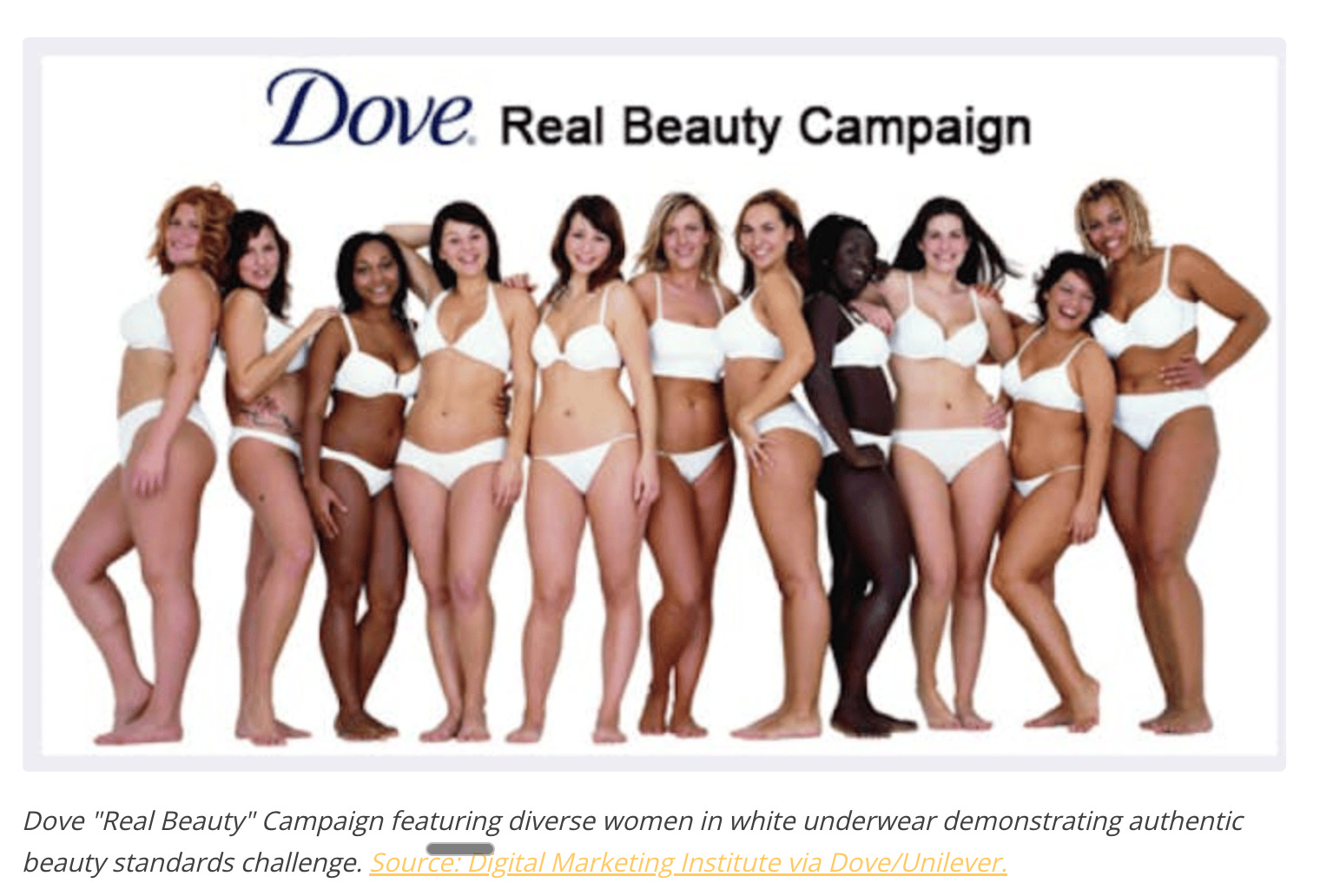
The beauty industry’s most uncomfortable reality in 2004: advertising had spent decades telling women they were physically insufficient. Dove’s core customers had absorbed that message for thirty years. Dove decided to put it in the headline.
The campaign featured real women: diverse body types, real ages, physical characteristics the industry had historically treated as defects. Every ad made the industry’s fear explicit. Beauty standards have caused harm, and we’re drawing a line here.Sales climbed from $2.5 billion to $4 billion over the campaign’s first decade.6
The campaign worked because Dove actually changed what they put in their ads. The claim had a product-level proof layer customers could verify every time an ad ran.
Patagonia “Don’t Buy This Jacket” (outdoor apparel, 2011)
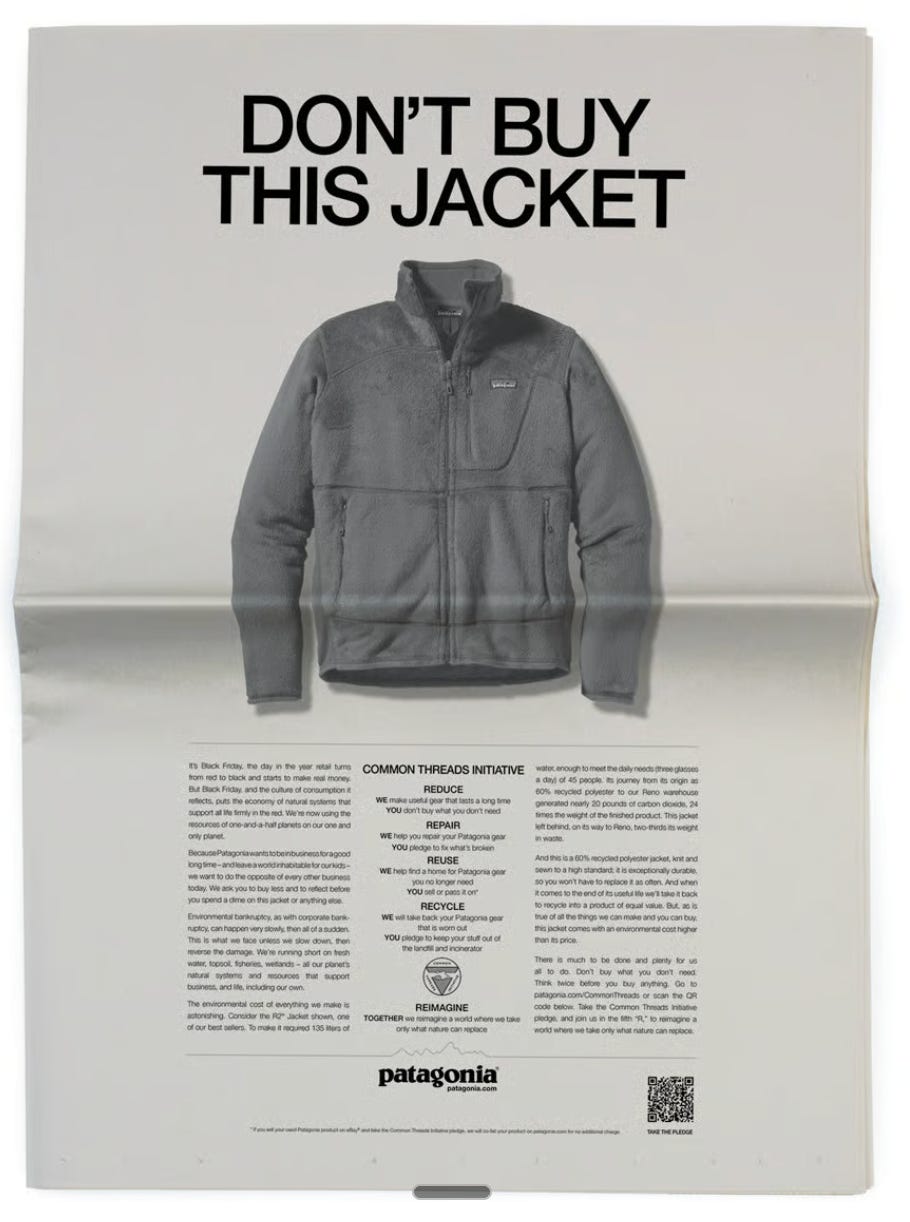

Apparel companies face a structural tension. Their business model requires customers to keep buying, and buying requires resource extraction. Patagonia’s entire brand was built on environmental stewardship. The tension was sitting there, unaddressed, visible to every environmentally conscious customer.
Patagonia addressed it on Black Friday, the year’s highest-revenue retail day, with a full-page New York Times ad urging customers not to buy their jacket. The ad listed the environmental cost of producing a single item: 135 liters of water, 20 pounds of CO2, 60% of its weight in waste.
Revenue grew 30% the following year, from $400 million to $543 million.7
The inoculation held because Patagonia backed it with Worn Wear repair programs, supply chain transparency reports, and an actual corporate pledge to give 1% of revenue to environmental causes.
McDonald’s “Our Food. Your Questions.” (QSR, 2012)
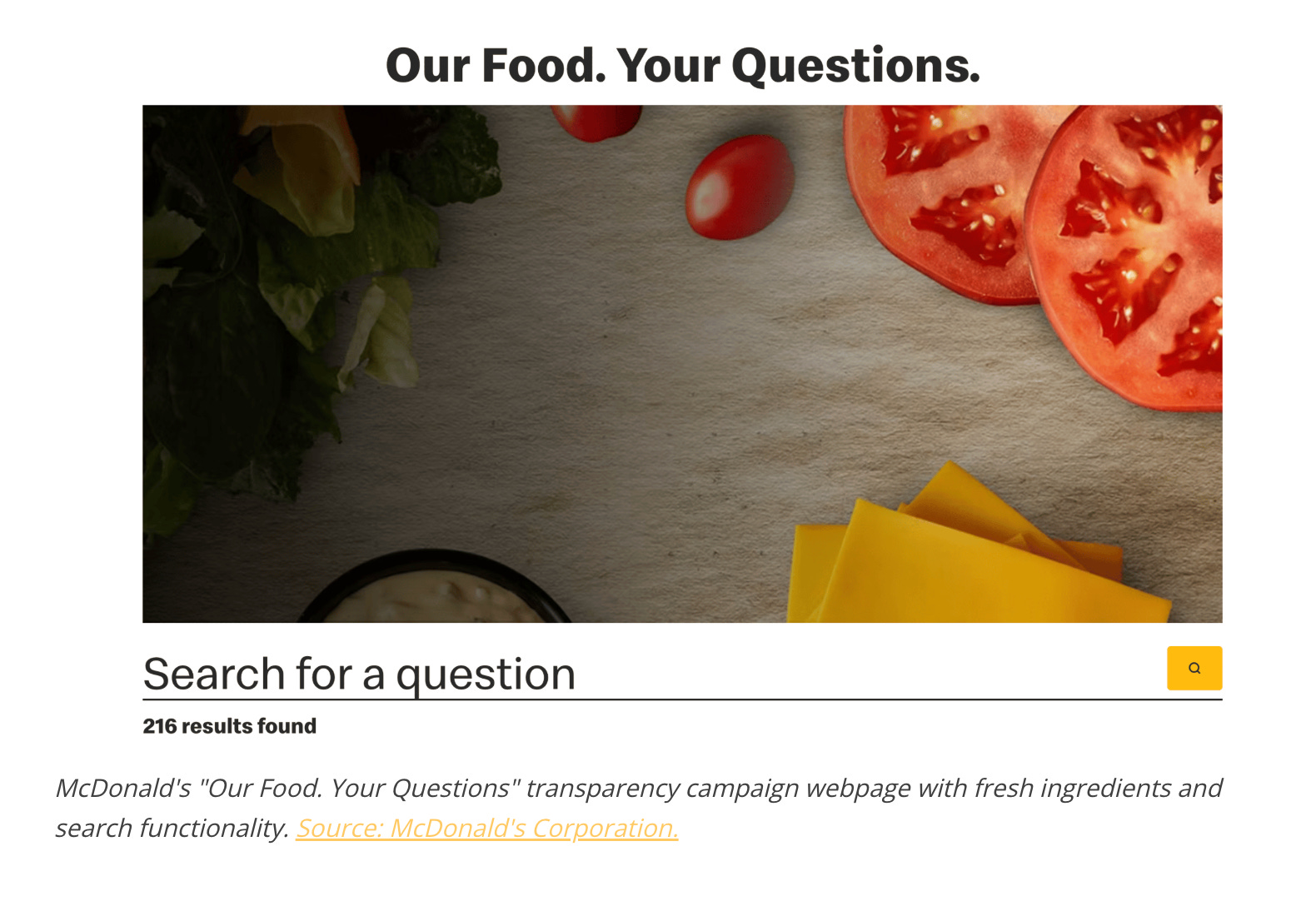
Fast food’s most persistent reputational anxiety: what is actually in this product?
McDonald’s Canada built a campaign around that question by inviting customers to ask it publicly, on camera, with full transparency. The campaign answered the hardest questions candidly: ingredient sourcing, processing methods, the infamous “pink slime” accusation. They produced videos shot at supplier facilities, hosted by a Mythbusters presenter.
Brand trust scores in Canada jumped 60% during the campaign period. The brand that had spent years fending off food-quality accusations turned the challenge into a conversation and walked away with measurably higher credibility.8
Where the same pattern went catastrophically wrong and how you can avoid it too
The two campaigns below attempted the Inoculation Play and failed. The failure conditions are worth studying more closely than the successes.
Dove “Real Beauty Bottles” (2017)
Dove tried to extend the Inoculation Play, which had worked brilliantly in their advertising, into product packaging. They released limited-edition bottles shaped like different body types to celebrate body diversity. The backlash arrived within hours and ran for weeks.10
Why it failed. The campaign that made Dove famous was built on the idea that women are more than their physical appearance. Packaging shaped to resemble different body types reduced women to the physical forms the original campaign had moved beyond. The execution violated the terms of the brand’s own inoculation. The underlying value was authentic. The execution contradicted it so directly that it looked like satire. When customers can’t distinguish your campaign from a parody of your campaign, the execution has failed regardless of intent.
Here’s a Rule. The proof layer must consistently reinforce the promise. Execution that contradicts the message destroys more trust than the campaign builds.
Volkswagen “Think Blue” sustainability campaigns (2015–2017)
After the Dieselgate emissions scandal, in which VW was caught deliberately engineering vehicles to cheat emissions tests during regulatory inspections, the company ran extensive sustainability campaigns positioning itself as environmentally responsible.11 The campaigns read as satire. Consumer trust scores in key markets stayed depressed through the campaign period.
Why it failed. VW’s cars had been engineered to deceive environmental regulators. The operational reality of the business directly, provably contradicted the values the campaigns claimed. The Inoculation Play cannot bridge a gap between what the brand says and what the product does. When the proof layer is toxic, marketing accelerates the deficit.
Here’s a Rule. If the product contradicts the claim, marketing makes it worse. The inoculation requires an operational reality customers can actually verify.
How do I turn my brand’s weakness into my strength? YOUTUBE Video
Everything here in this newsletter plus 4 questions and a red flag to see if it works for your business.
Matt’s Take: A Contemplative Marketing on This Strategy
When physicians at the University of Michigan hospitals began disclosing their mistakes openly to patients, malpractice lawsuits dropped in half.12
Patients were suing to find out what happened. They weren’t suing to punish their doctors. When the doctor shared, patients forgave.
I’ve spent fifteen years in healthcare. I know that room. I know what it costs a physician to walk in and say “I got this wrong.” The instinct running against that disclosure has a clinical name. Organizational psychologist Piers Steel calls it an ego-protective maneuver: we delay putting our reputations on the line because we’ve learned to equate our self-worth with our outcomes.13
Brands do this structurally. Every review meeting, every campaign brief, every positioning document arrives with the same protective architecture built in.
Here’s what I’ve noticed working in spiritual direction alongside marketing. Spiritual direction requires the practitioner to show up without an agenda, without a narrative they need confirmed. Business storytelling arrives with a fixed narrative. The facts get curated to support it. The Inoculation Play requires the posture of the spiritual director. You arrive without a fixed story about yourself. You let the real thing be seen.
Marketing errors are wrongs of omission. What the brand left out. What the brand shaped to look like certainty.
Now Your Free GPT - The Inoculation Play Analyzer
If you want to try this out on your brand The Inoculation Play Analyzer the runs the fit analysis for you. Fit score, implementation roadmap, failure mode checklist, client-ready deck. Built for fractional CMOs. Start here →
Bibliography
Edelman. 2025 Edelman Trust Barometer. Chicago: Edelman, 2025. https://www.edelman.com/trust/trust-barometer.
“Don’t Buy This Campaign in 2011 by Patagonia.” Marketing Maverick. Accessed April 2026. https://marketingmaverick.io/p/don-t-buy-this-campaign-in-2011-by-patagonia
“Dove: A Spotless Approach to Digital Marketing.” Digital Marketing Institute. Accessed April 2026. https://digitalmarketinginstitute.com/resources/case-studies/dove-a-spotless-approach-to-digital-marketing.
“Dove’s Body-Shaped Bottles Are a Misguided Mistake.” The Guardian, May 9, 2017. https://www.theguardian.com/commentisfree/2017/may/09/dove-real-beauty-bottles-body-positive.
Kachalia, A., S. R. Kaufman, R. Boothman, S. Anderson, K. Welch, S. Saint, and M. A. M. Rogers. “Liability Claims and Costs Before and After Implementation of a Medical Error Disclosure Program.” Annals of Internal Medicine 153, no. 4 (2010): 213–221.
Levitin, Daniel J. The Organized Mind: Thinking Straight in the Age of Information Overload. New York: Dutton, 2014.
“McDonald’s Q&A Content Campaign Tries to Build Consumer Trust.” Momentology. Accessed April 2026. https://www.momentology.com/2240-mcdonalds-reveals-all-in-live-qa-content-campaign.html.
Meta Platforms, Inc. “Fourth Quarter and Full Year 2024 Results.” Investor Relations, February 2025. https://investor.fb.com/investor-news/press-release-details/2025/Meta-Reports-Fourth-Quarter-and-Full-Year-2024-Results/default.aspx.
Steel, Piers. The Procrastination Equation: How to Stop Putting Things Off and Start Getting Stuff Done. New York: HarperCollins, 2010.
“Volkswagen Emissions Scandal: How It All Began.” BBC News, September 22, 2017. https://www.bbc.com/news/business-41190426.
“WhatsApp’s Global Campaign Proves Your Messages Are Truly Private.” Marketing Interactive, May 2025. https://www.marketing-interactive.com/whatsapps-biggest-global-campaign-proves-your-messages-are-truly-private.
“WhatsApp Underlines Commitment to Privacy in New Ad Campaign.” Social Media Today, 2025. https://www.socialmediatoday.com/news/whatsapp-privacy-focussed-ad-campaign/748552/.
YouGov Business. “June UK Advertisers of the Month: WhatsApp, Head & Shoulders and Oral-B.” YouGov, June 2025. https://business.yougov.com/content/52511-june-uk-advertisers-of-the-month-whatsapp-head-shoulders-and-oral-b.
Hey Folks, for real story on VW dieselgate controversy see the BBC here: "The Man Who Discovered the Volkswagen Emissions Scandal." BBC News. 2015. https://www.bbc.com/news/business-34519184.