Liquid Death didn’t lecture teens about sugar.
They cast Peter Dinklage as a radioactive mutant to do it for them.
And it worked better than anything Pepsi’s ad team has produced in years.
Here’s the thing. Everyone noticed the creative choice. What I kept coming back to was the structural decision underneath it.
Why does borrowing someone else’s credibility work better than building your own from scratch? Why does a cult franchise with a devoted niche fanbase outperform a celebrity endorsement with mass reach? And why can Liquid Death pull this off when Coca-Cola structurally cannot?
That’s the Borrowed Authenticity pattern.
In this breakdown I walk through the $5 million campaign, show you where the pattern has worked before (Old Spice, Dollar Shave Club, Poo-Pourri), and where brands have tried it and gotten burned.
Then three diagnostics to run before you try it yourself.
Not gonna lie. I went into this thinking it was a great creative case study. I came out thinking it was a structural business strategy disguised as an ad.
The full newsletter, with sources, failure case analysis, and the implementation framework, is below.
Skip to what matters most to you:
0:00 You’re outspent by the category giants
0:37 You don’t know what this campaign is actually doing
0:46 You saw the ad but missed the strategy underneath it
1:28 You wonder if your brand could ever pull something like this off
3:18 You need a name for the pattern and a framework to replicate it
4:27 You’re not sure if this moment will last long enough to matter
5:46 You think this only worked for one weird water brand
6:47 You think you need a big budget to compete
7:56 You think you need a polished brand to borrow credibility
9:07 You’re not sure one great piece of content is worth the effort
9:45 You want to try this but don’t know what to avoid
10:28 You need to know if your brand is actually ready for this
Apply the Borrowed Authenticity pattern to your own brand.
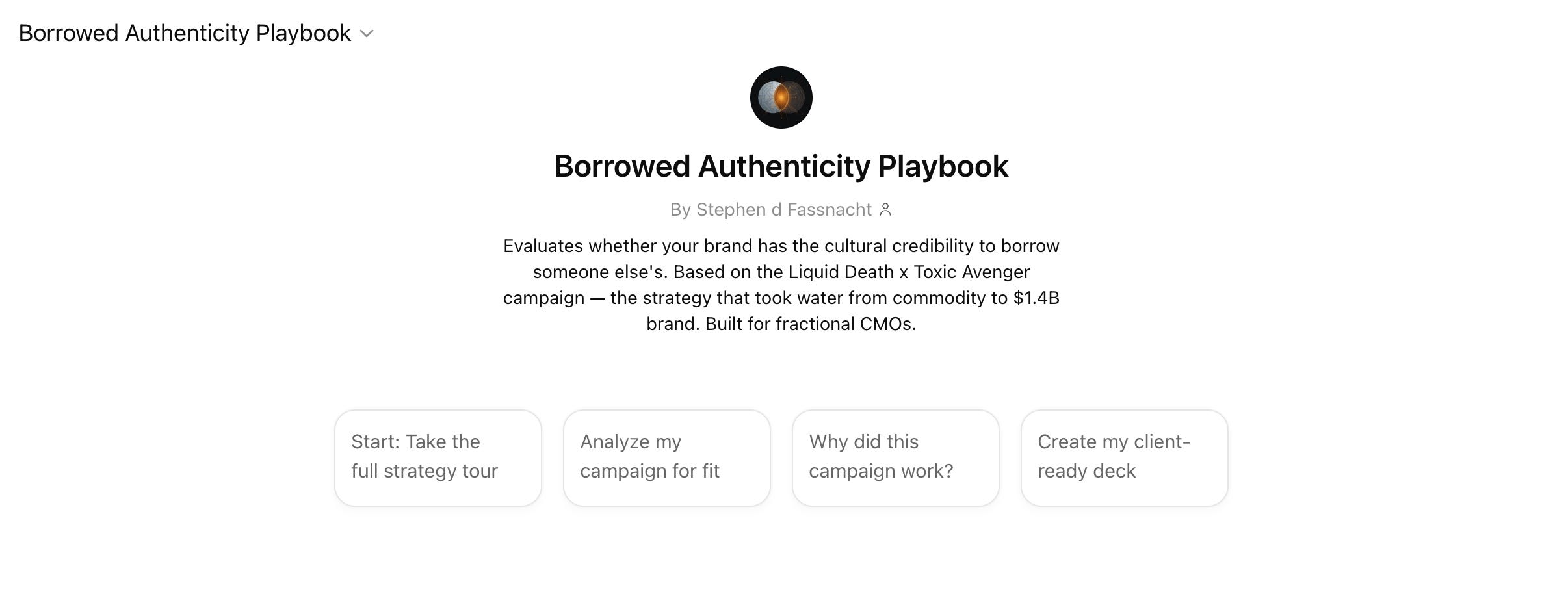
I built a GPT that walks you through these diagnostics against your actual business and surfaces the cultural assets your audience already trusts.
Get the Borrowed Authenticity GPT →
The full newsletter, with sources, failure case analysis, and the implementation framework, is below.
→