

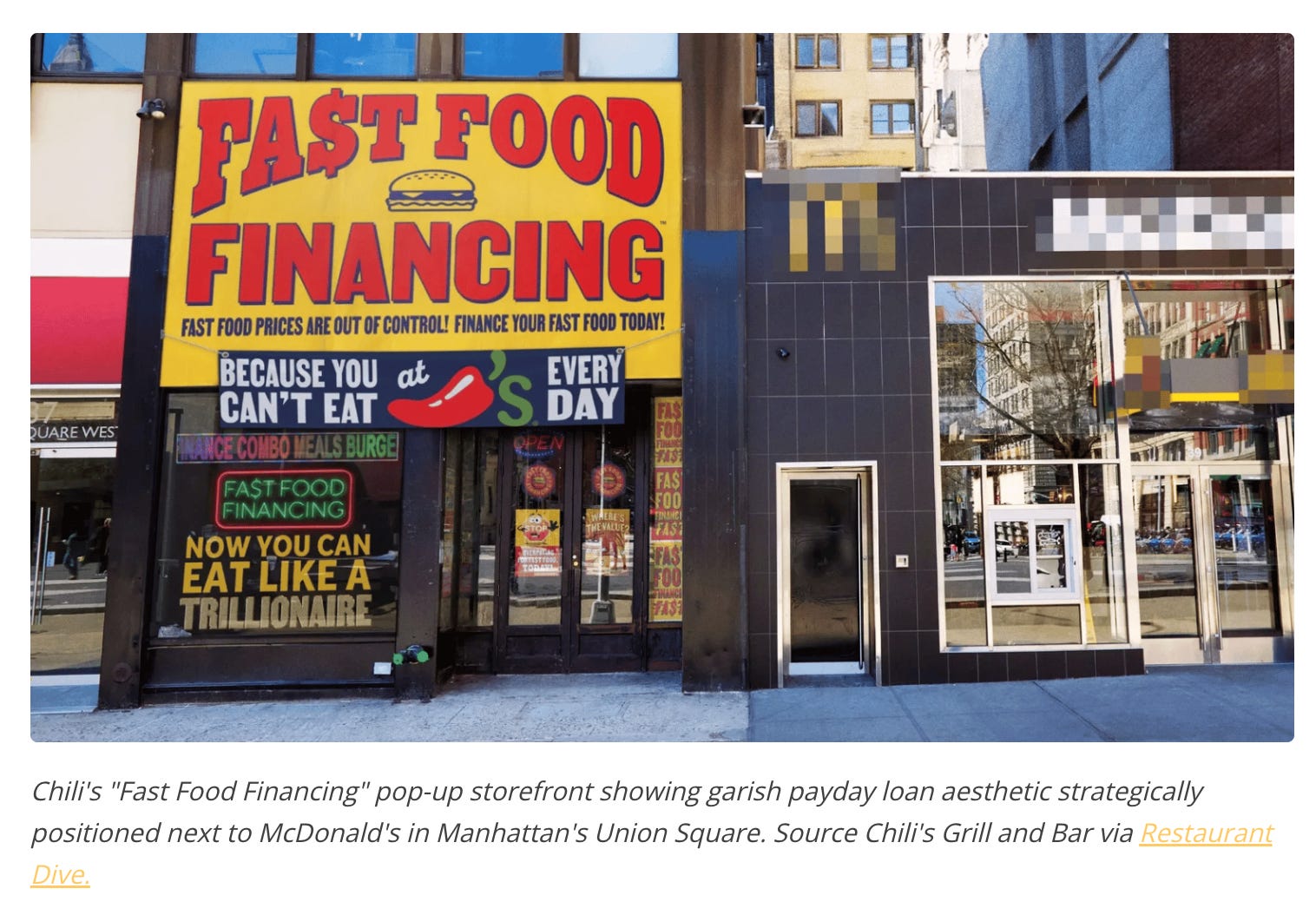
Chili’s set up a fake payday loan office next to a McDonald’s in Manhattan.
Two days. Three-hour lines. 6 billion earned media impressions. A 31.6% jump in same-store sales the following quarter.
The budget? Roughly $15 to $20 million by industry estimates. A fraction of what McDonald’s spends on a single Super Bowl slot.
This is how they did it. And the strategic pattern underneath it applies in nearly any industry where a dominant player has quietly broken its own promise to customers.
The pattern is called The Category Crasher.
If you’re a watch-it person, I broke this down on video.
Watch the Category Crasher breakdown on Youtube
Same pattern, different format.
What the Category Crasher is
The pattern works when a brand from a perceived higher tier deliberately attacks a lower-tier category at the precise moment that lower tier loses its defining advantage.
The key word is moment.
Category crashes happen when the incumbent is vulnerable (“incumbent” meaning the big cheese): when its core promise has started to fail and consumers are already feeling it.
For fast food, the walls got thin the moment inflation turned a $5 combo into a $12 to $15 meal.
The whole identity of the QSR industry (cheap, fast, reliable) began eroding.
McDonald’s Quarter Pounder crept toward $7 to $8. And a full sit-down Chili’s meal at $10.99 suddenly looked like the actual deal.
George Felix, Chili’s CMO, spotted it early. He’d been building toward this play for two years, starting with the “Big Smasher” burger (a direct challenge to the Big Mac) and the “3 For Me” value platform established in 2022. Fast Food Financing was the loudest note in a long, patient song.
Worth sitting with for a second.
The viral moment is the payoff.
The Category Crasher is built over years.
The Fast Food Financing campaign: what really happened
April 15, 2025. Chili’s launches with creative agency JM&D, PR firm Edelman, and experiential production house M ss ng p eces. (yes you read that right… M ss ng
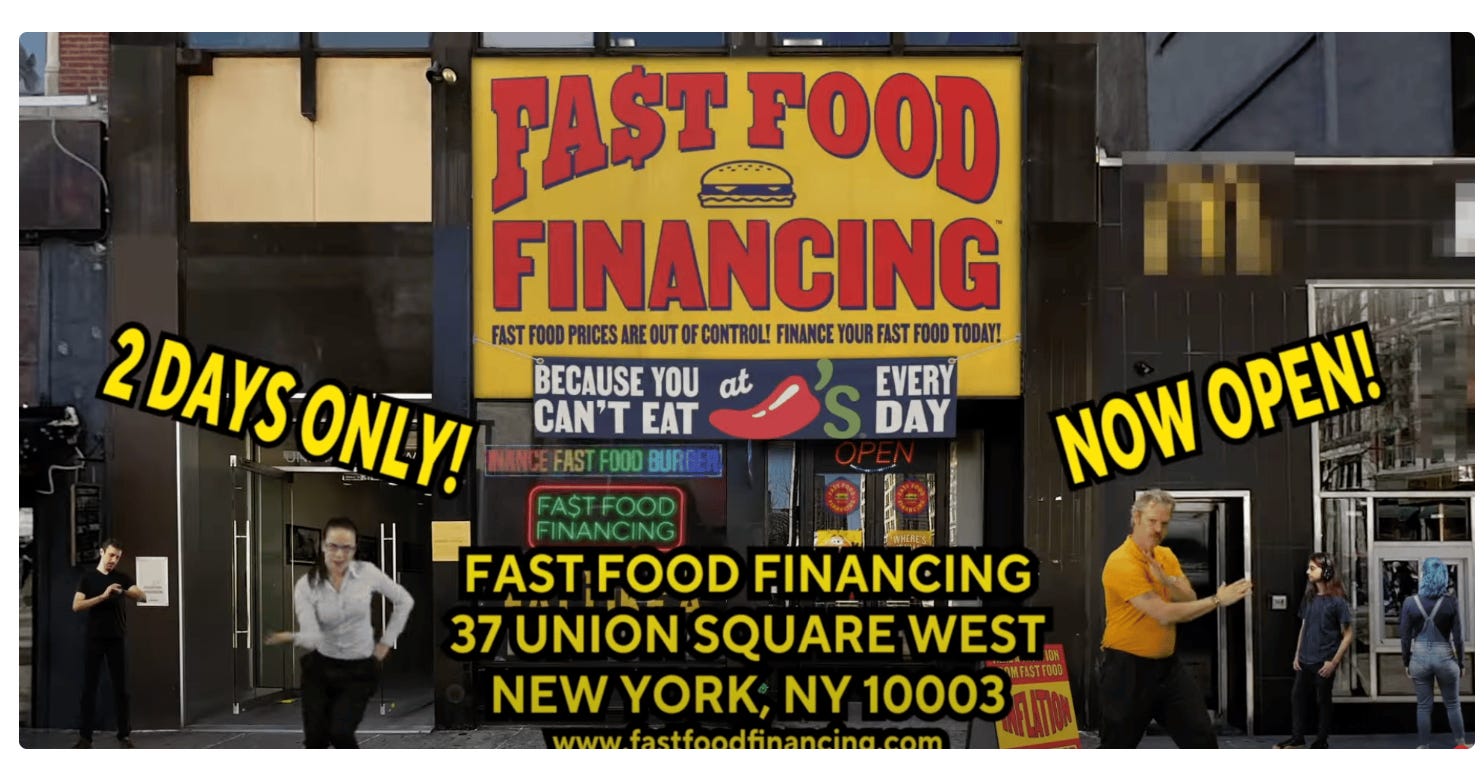
The centerpiece was a two-day pop-up at 37 Union Square West in Manhattan, a storefront designed to look exactly like a predatory payday loan office.
Garish signage.
An infomercial-style video on loop. Signs reading “Finance Your Fast Food Today.” And directly next door…you guessed it …a McDonald’s.
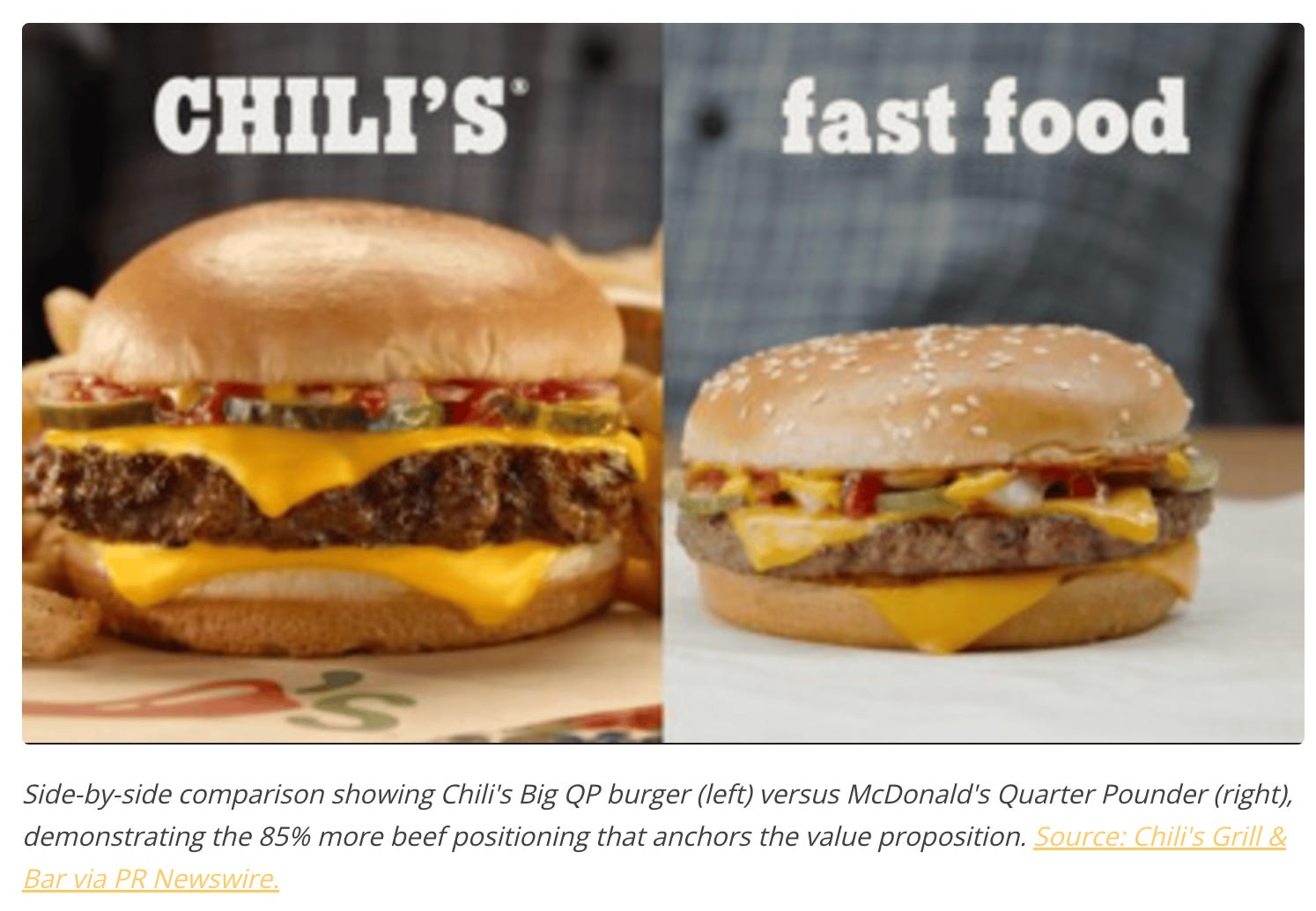
The inside of the “office” functioned as a speakeasy, serving Chili’s new Big QP burger (85% more beef than a McDonald’s Quarter Pounder) as part of the $10.99 “3 For Me” meal. Visitors who got “approved” received $20 gift cards.
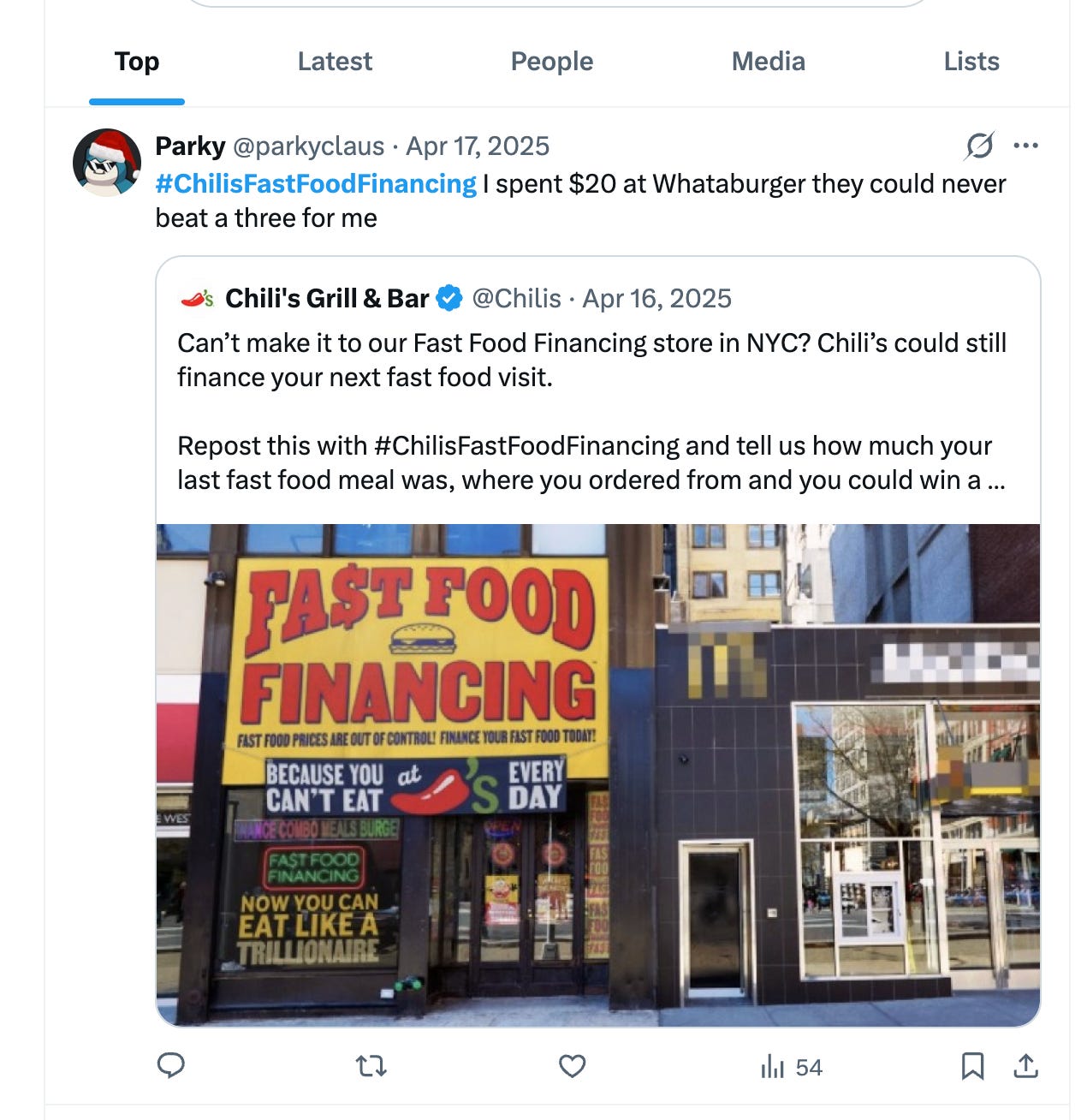
On X, Chili’s ran a simultaneous giveaway asking people to post the price and location of their last fast food meal using #ChilisFastFoodFinancing. Every frustrated McDonald’s customer who played along became unpaid Chili’s content
Lines ran three hours at peak.
The activation generated 6 billion earned media impressions, outperforming the prior year’s “Big Smasher” launch. Social conversation around the brand spiked 400%.
Q3 2025 earnings told the business story. Brinker International reported 31.6% comparable same-store sales growth for the Chili's brand. Average unit volume grew by $440,000, reaching $3.6 million per location. Customer traffic climbed 5.9%. CEO Kevin Hochman attributed the growth to marketing directly: "Marketing is driving guests in and operations is bringing guests back."
60% of the traffic increase traced to advertising. The other 40% came from organic TikTok virality.
The Category Crasher had worked.
The format IS the message in this youtube video above.
Chili’s built the commercial as a pitch-perfect infomercial parody, borrowing the most culturally loaded advertising vehicle in American memory…the predatory payday loan ad.
Every “Are you tired of overpaying?” moment and thumbs-up spokesman beat is a signal the audience already knows how to read. Fast food, Chili’s is saying, has become the very thing it used to mock.
The move here is precise.
Infomercials are the shorthand for “you’re desperate and we have the solution.” By putting fast food pricing inside that frame, Chili’s doesn’t have to argue that $15 combos are predatory.
The format does it for them.
3 other industries where this pattern wins
Planet Fitness vs. traditional gyms (2008)
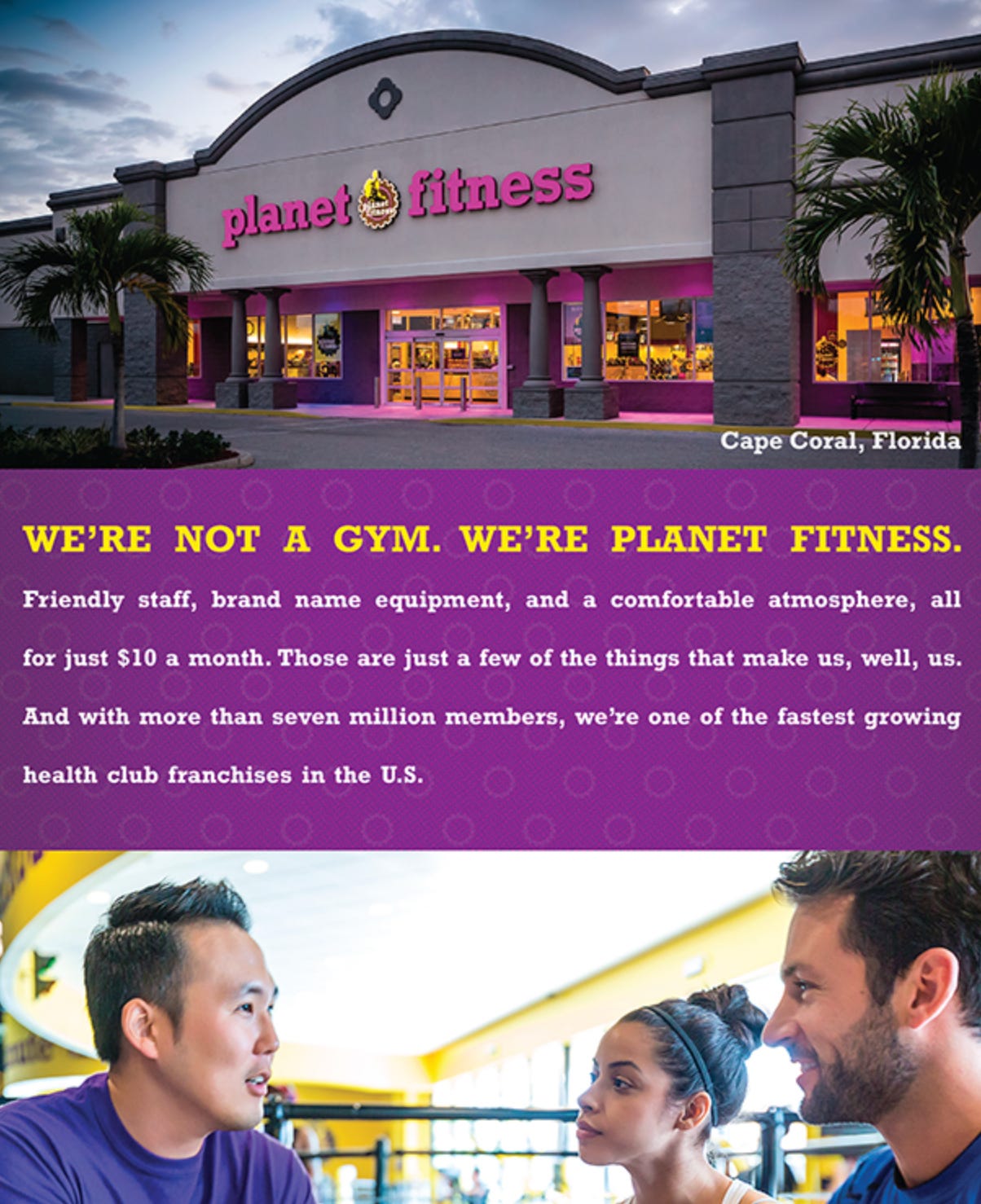
When the recession hit, traditional gyms at $50 to $80/month became inaccessible to millions.
Planet Fitness entered at $10/month and reframed their incumbent cultural authority as a liability. The “Judgement Free Zone” positioning said that serious gyms had become intimidating, expensive, and hostile to ordinary people. All of it was true, and all of it the major gym chains had ignored.
Same-club sales grew 18% in 2008 and 23% in 2009 as consumers traded down from pricier gyms.
By 2010 Planet Fitness had 389 locations. By 2023, over 2,400. The Category Crasher here went beyond price. It attacked the emotional experience that came with the price: the feeling that you didn’t belong there.
Newcastle Brown Ale “No Bollocks” (2014)
Honestly, this is one of the most brillant strategies…I just …Just think I might explode of joy.
Newcastle crashed the Super Bowl advertising category without buying a Super Bowl ad.
Agency Droga5 built “If We Made It”, a campaign about the amazing Super Bowl ad Newcastle would have made if they could afford it. Fake storyboards. Mock focus groups. Celebrity commentary from Anna Kendrick. The “No Bollocks” platform named big-budget beer advertising as polished, cliché-ridden, and fundamentally dishonest. A massive production budget became the evidence of inauthenticity.
Over 1 billion media impressions, a 416% lift in brand awareness, and an 18% increase in purchase intent, at 1/35th of a competitor’s Super Bowl budget.
Near-zero media spend. What!? Who does that? Risk-taking marketers do.
Dollar Shave Club (2012)
Gillette controlled the razor market through a “razor and blades” model.
Which meant cheap hardware, expensive proprietary cartridges sold through retailers who locked them in display cases. Michael Dubin made a 90-second YouTube video for $4,500 that named the absurdity out loud: the unnecessary blade technology, the frustration of asking a store clerk to unlock a case for a $30 pack of cartridges.
The D2C subscription model bypassed the retail environment entirely. Gillette’s distribution network went from moat to obstacle in the consumer’s mind.
The video crashed DSC’s website. 12,000 new orders in 48 hours. Revenue hit $225 million in 2016. Unilever paid $1 billion for the company that same year.
Dang…makes me think we’re all in the wrong business when I hear that number. And for blades?
In each case, the Category Crasher worked by finding the exact moment the incumbent’s core promise had failed, and naming it before anyone else did.
Why the window is open right now
Three forces converge in 2025 to 2026 to make this pattern more powerful.
Consumer trust in established categories has a shorter shelf life. Post-pandemic pricing decisions broke implicit contracts. When a $5 value meal becomes a $12 combo, a decades-old promise shatters. Consumers who feel betrayed by a category are primed for the brand that validates the feeling. And that window closes fast once the incumbent responds with value deals.
Earned media infrastructure scales faster than paid. A well-designed physical activation in 2025 can generate global reach through PR, influencer growth, and social impressions. The structural gap between “big brand media spend” and “small brand reach” has collapsed for any brand willing to give consumers something genuinely worth sharing. The Category Crasher is engineered for this environment which lends itself to a local event with national distribution built in.
First-mover advantage within a window is decisive. Executives across industries are studying this playbook. The brands that move first in any given moment of category betrayal capture the most territory. By the time the eighth brand runs a similar play, the press calls it derivative and consumers have moved on.
Where this pattern didn’t work
1. Attack without operational proof.
A smaller brand can name a Goliath’s broken promise all day. But when new customers arrive and the product fails, the campaign backfires twice: once for the unmet expectation, and again because the brand now owns the comparison it invited.
MoviePass named a genuine consumer frustration in 2017: movie tickets had become too expensive. The attack was clean. Unlimited movies for $9.95 a month, positioned directly against AMC and Regal’s $15 to $18 per-ticket pricing. The challenger move landed. The service grew from 20,000 subscribers to 3 million in a matter of weeks. The cultural moment was real.
Then the new customers showed up.
MoviePass was paying full ticket price to theaters for every film every subscriber saw. The average subscriber was seeing 2.11 movies a month. The business needed them to see 0.77. The gap was fatal. The company started restricting access, blocking popular showtimes, suspending accounts without warning. Every restriction was a public betrayal of the exact promise that had made them famous. MoviePass filed for bankruptcy in 2019.
The attack named the wound correctly, but product bled out before it could prove the point.
2. A manufactured cultural tension.
The Category Crasher requires a real wound in the incumbent’s armor. Brands that try to invent the consumer problem, implying a betrayal that doesn’t fully exist in the market, find that the humor reads as forced and the empathy reads as marketing theater. You can feel the difference immediately, and so can consumers.
Samsung ran years of ads mocking Apple for removing the headphone jack from the iPhone.
The frustration was known for some consumers. But Samsung overstated how universally it mattered, and when they needed to make the same engineering trade-off in 2019, they quietly deleted every one of those ads the same week the Galaxy Note 10 launched without a headphone jack. The wound wasn’t deep enough to build a platform on. The difference between a deep wound and a convenient one shows up the moment you can no longer avoid making the same choice yourself.
It’s a story of trying to crash upwards when Goliah (apple) doesn’t have that weakness.
3. Running the play past the window.
This pattern is most powerful at the peak of category betrayal, when consumer frustration is highest and receptivity to the challenger is widest. Sustaining the same posture six months later …well, you missed the moment.
Quibi raised $1.75 billion on the premise that mobile viewers needed short-form premium content for their commutes. The attack on Netflix and HBO was indeed there. Long-form streaming wasn’t built for a five-minute subway ride. Quibi launched in April 2020, two months into COVID lockdowns. The window, which was the commute-time entertainment, had closed before the doors opened. Six months after launch, the company shut down. Content sold to Roku for less than $100 million.
The Category Crasher needed a wound that still existed when the product arrived.
Fast food chains have already responded with value menus and $5 meal deals. The window Chili’s exploited in spring 2025 is likely not worth now. Any brand running this play in late 2026 needs a fresh wound: a new broken promise, a new category vulnerability.
The attack needs to feel true and original.
Questions to ask before running this play
Which lower-tier category has recently broken its defining promise? You’re looking for the specific moment a price, quality, or experience guarantee failed publicly, something consumers are already angry about on their own.
Does your brand have positioning runway? The Category Crasher lands loudest when it’s the culmination of an established narrative. Cold entry into a category attack with no prior context reads as opportunistic.
What’s the operational proof? The stunt earns the comparison. The product has to back it up when the new customers show up.
Can you execute with wit and genuine empathy? This pattern lives and dies on tone. Brands that attack with smugness or manufactured outrage miss the mechanic. The humor has to be true. It has to name something real.
What’s the shareable mechanicism? The #ChilisFastFoodFinancing hashtag turned every frustrated fast food customer into Chili’s content. What’s your version of that user-generated pain engine?
The humanizing act inside the payday loan office
Here’s something of a contemplative marketing angle on this.
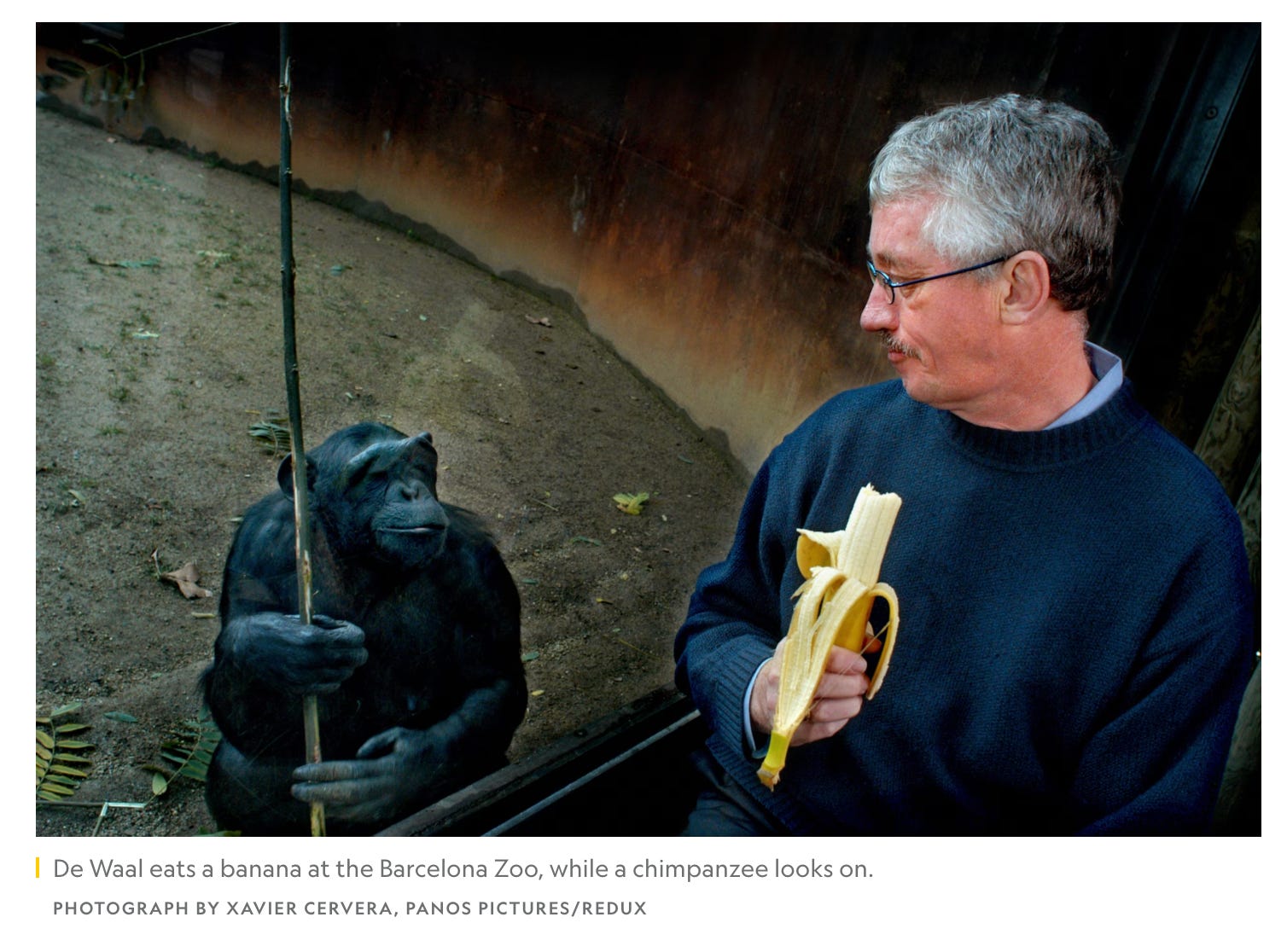
Frans de Waal, the primatologist, spent years studying capuchin monkeys and what he found made a lot of economists uncomfortable.
When one monkey received a smaller reward than another for completing the same task, the underpaid monkey went on strike. It stopped performing entirely. It refused to cooperate. It sulked.
De Waal called it a “moral calculation.” (Levitin, The Organized Mind, p. 283) The monkey was responding to something older than rational self-interest: the sense that a social contract had been broken.
Sound familiar?
Consumer frustration with fast food pricing runs through that same ancient circuitry.
The $15 combo carried the weight of a broken promise. The deal that used to exist — cheap, fast, reliable — had been quietly abandoned while the drive-thru kept running. As Levitin puts it, the rationality we bring to economic decisions is “partly illusory.” (p. 277) The sense of betrayal lands first, fast, and in the body.
Chili’s named that betrayal publicly, with humor, and then handed someone a better burger.
Here’s what 15 years in chaplaincy taught me about what to do with that kind of wound.
The answer is to name it. Name it when it’s happening. Not later.
The most effective thing I watched chaplains do across thousands of difficult conversations (with dying patients, with families in waiting rooms, with medical teams carrying impossible burdens) was to say: I see what’s happening to you. And it’s as bad as it feels. That act of accurate witnessing was itself the relief.
Chili’s Fast Food Financing was exactly that act.
“We opened Fast Food Financing to help customers in their time of need.” George Felix was doing humanizing work in a payday loan storefront next to a McDonald’s. He named the injury accurately. He showed up where the wound was. And then he offered something tangible.
The brands that win the next consumer loyalty cycle will have the courage to name what’s actually happening to their customers’ lives, accurately, in public, without flinching.
That’s the play. It’s older than marketing.
Close
By now you’re either nodding or you’re running a mental audit of your own category.
That second group is who this is for.
The question that follows every issue of The Strategy Signal is the same one: does this pattern fit my situation? Is there a window in my category right now? Am I the challenger with the opening, or the incumbent with the wound?
That’s exactly what the Category Crasher Playbook GPT was built to answer. Give it your industry, your competitive context, and what’s shifting in your category right now. It maps your situation against the full pattern, tells you whether the conditions are in place, and shows you where this play has worked and where it has broken.
It’s the fastest way to go from “interesting pattern” to “here’s whether and how I run it.”
If this issue sparked something, forward it to someone who’s been watching their category quietly betray its customers and doesn’t have a name for what they’re watching.
See you next week.
Matt
Sources
de Waal, F. B. M., K. Leimgruber, and A. R. Greenberg. “Giving Is Self-Rewarding for Monkeys.” Proceedings of the National Academy of Sciences 105, no. 36 (2008): 13685–13689.
van Wolkenten, M., S. F. Brosnan, and F. B. M. de Waal. “Inequity Responses of Monkeys Modified by Effort.” Proceedings of the National Academy of Sciences 104, no. 47 (2007): 18854–18859.
Levitin, Daniel J. The Organized Mind: Thinking Straight in the Age of Information Overload. New York: Dutton, 2014.
Research sources: Marketing Dive (Chili’s campaign mechanics and results), Brinker International Q3 2025 earnings, Restaurant Business Online (traffic attribution data), DesignRush (agency credits, George Felix quotes), LBBOnline (Edelman confirmation). Cross-industry case data: PlanetFitness investor reports, Droga5 campaign documentation for Newcastle, Inc. Magazine and public filings for Dollar Shave Club.