

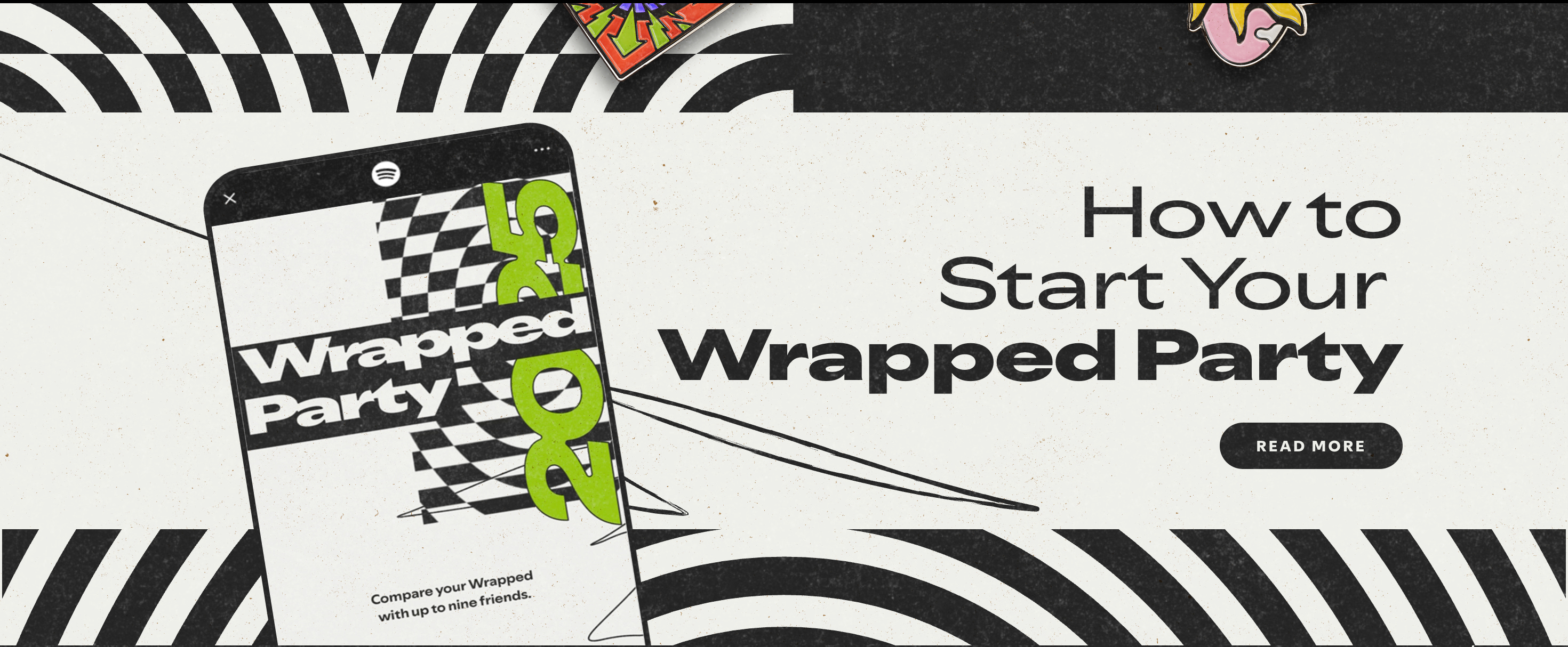
Image taken from Spotify’s 2025 Wrapped Campaign Website.
Here is what this newsletter covers
The Mirror Loop Protocol: why Spotify Wrapped generated 500 million shares in 24 hours without spending a dollar on Meta ads
The 2024 AI backlash that made 2025’s human-centered comeback hit even harder, and what Spotify learned from it
Four-stage breakdown of the exact mechanic: how raw data becomes a shareable identity artifact
Why Apple Music Replay, YouTube Music Recap, and Amazon Music all failed with nearly identical features, and the specific design decisions that killed each one
Strava, Monzo, and OpenAI: the cross-industry proof that this pattern transfers
The diagnostic questions that tell you whether your product has Mirror Loop potential
Why the brand that deploys this in B2B first captures a category that has not been built yet
Zero Paid Ads. 500 Million Shares. 1 Design Decision
Image capture from Spotify’s 2025 Wrapped Campaign Guide for Artists and Creators.
On December 4, 2024, Spotify released Wrapped.
The response was…well…brutal.
Users flooded Reddit, Twitter, and TikTok with complaints. The centerpiece feature, an AI-generated podcast powered by Google’s NotebookLM, landed as cold and impersonal. The quirky, unexpected data moments that had made previous Wraps shareable were missing. Marketing publications ran headlines about an “underwhelming flop.” Spotify’s own marketing team called the feedback “constructive.”
One year later, on December 3, 2025, Spotify launched Wrapped again.
Within 24 hours: 200 million engaged users. 500 million shares. Both all-time records. The 200-million milestone that took 62 hours to reach in 2024 arrived in under a day. Instagram shares nearly doubled. The “Listening Age” feature alone generated 65 million shares.
Zero paid Meta ads. Ever. In the entire history of Wrapped.
That contrast, the 2024 stumble and the 2025 record, reveals something important. The play was more than the data. This play was more like a mirror.
When users can see themselves in the data, not a record of what they did but proof of who they are, they broadcast it. You become the printer. They become the billboard.
This is the Mirror Loop Protocol.
How Behavioral Data Becomes a Media Budget: The 4-Stage Sequence
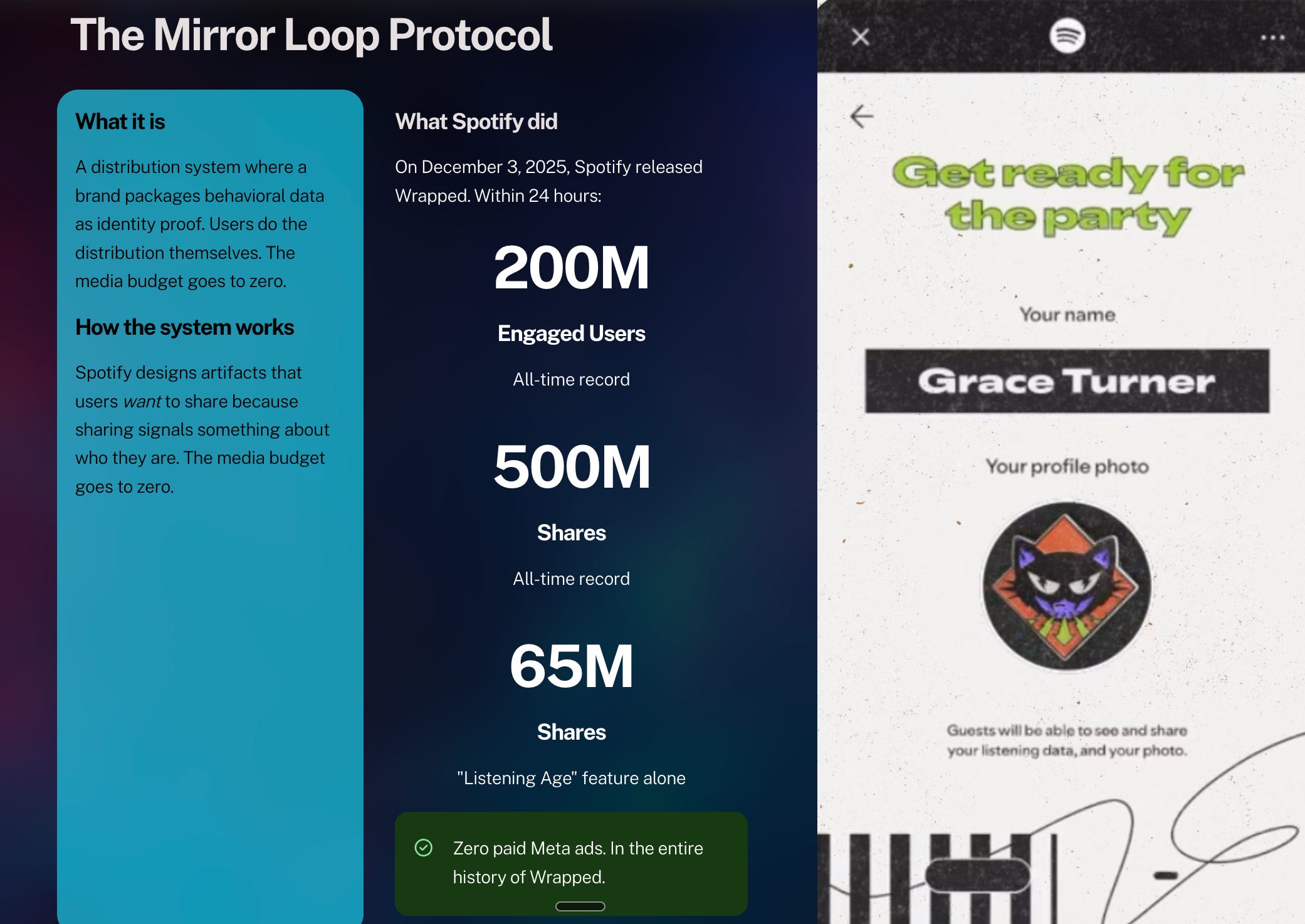
Image capture from Matt’s Gamma presentation on The Strategy Signal
The Mirror Loop Protocol is a distribution playbook where a brand packages behavioral data as identity proof. Users do the distribution themselves.
The sequence runs in four stages:
Stage 1: Data Harvesting. The product captures high-frequency behavioral data with emotional resonance: streaming history, workout stats, spending patterns, learning streaks.
Stage 2: Narrative Processing. Raw data gets translated through a “creative filter” into human experience. “You listened to 80s music” becomes “Your Listening Age is 42.” “You ran 500 miles” becomes “Top 10% of athletes globally.” The signal here is the interpretive layer: what the brand claims the data means about who you are.
Stage 3: Asset Generation. The output is a visual artifact, reverse-engineered from social platforms. Spotify builds every card in 9:16 vertical format, optimized for Instagram Stories and TikTok, with one-tap sharing and branding subtle enough not to feel like an ad.
Stage 4: Social Broadcast. Users distribute the artifact because sharing it signals something about them: taste, discipline, belonging, status. The product never paid for that distribution. The identity stake made it inevitable.
3 entities. Not 1. The product generates the data. The artifact packages the data as identity. The user’s social network is the distribution channel.
What Made 65 Million People Share a Single Data Point
The 2025 Wrapped worked because Spotify paid attention to why 2024 failed.
The 2024 version leaned on a consumer-facing AI podcast. The data moments users loved (personality types, city matches, listening quirks) were either missing or buried. The lesson the team took back: users do not want to see what the algorithm thinks about them. They want to see themselves.
So 2025 went back to human.
Nearly a dozen new features, all designed around one question: does this make someone feel special enough to post it?
The flagship was Listening Age, a feature that calculated the musical era a user’s taste most resembled, based on the release years of their most-streamed tracks. The design tapped directly into what psychologists call the Reminiscence Bump.
Adults (yeah you and me) form disproportionately strong emotional connections to music from their formative years, roughly ages 16-21. Telling a 35-year-old their Listening Age is 22 confirms their musical self-concept. Telling them it is 54 creates productive friction: debate, ironic self-deprecation, the kind of emotional spike that drives sharing more effectively than simple affirmation.
Hate = Heat and heat = attention.
Listening Age generated 116,000+ social mentions in its first week. 81% positive sentiment. 65 million shares from that single feature.
The other new play here is Wrapped Clubs, which sorted users into one of six listening styles:
“Soft Hearts Club,” “Club Serotonin,” “Full Charge Crew,” “Cosmic Stereo Club,” and others.
Each Club assigned users a role (leader, scout, archivist) based on their data. The Clubs mechanism tapped optimal distinctiveness theory, the documented psychological tension between the need to belong (I am in the Soft Hearts Club with millions of others) and the need for individuality (but I am an archivist, and that is specific to me). Satisfying both drives at once is what makes an identity artifact irresistible to share.
The Visual Mixtape aesthetic used grunge textures, analog typography, and 1980s-90s color pops. It was a deliberate rejection of 2024’s polished AI-influenced design. In an era of AI-generated everything, “lo-fi” signals human. It was reverse-engineered from the feeds it was designed to fill: high-contrast, immediately legible, built to stop a scroll.
The result: 200 million engaged users in 24 hours, 19% more than 2024, and 500 million shares, 41% more than the prior year.
And still: zero paid Meta ads. In the entire history of Wrapped.
Every ad Spotify ever ran on Meta was cause marketing: Pride, Black History Month, sustainability, with the most recent in 2023.
Meanwhile, Apple Music ran five active paid ads in May 2026, all with identical copy: “Switch and easily transfer your music.”
Apple is spending paid media to fight for users at the exact moment Spotify’s identity mechanism creates peak loyalty.
They are buying what Spotify gets for free because the product is designed differently.
Strava Did It With Fitness. Monzo Did It With Finance. OpenAI Never Had to Ask.
Running since 2014 and now in its 12th consecutive year, Strava’s annual recap packages fitness data as athletic identity proof.
Total distance becomes endurance. Kudos received becomes community standing. In 2025, Strava’s 180 million users generated 14 billion kudos. Users open Strava 35+ times per month versus under 15 for competitors. Strava moved the full Year in Sport experience behind its premium paywall, testing whether users would pay not just for analytics but for the shareable proof of who they are as athletes.
They did.
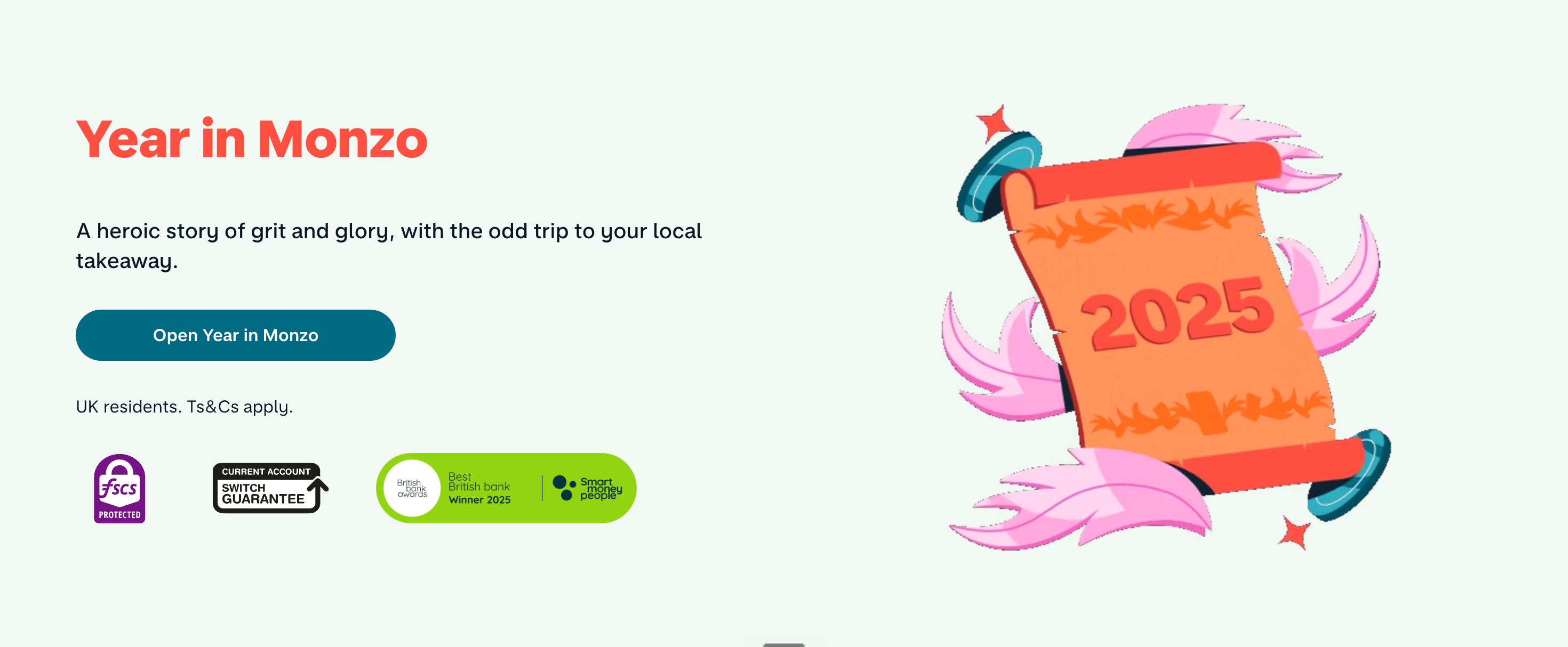
Running since 2018, now in its seventh consecutive year.
Monzo’s genius was making financial data safe to share. Raw spending is private and potentially shameful. “192 eras” with labels like “Percy Pig Era” and “McDonald’s Legend,” along with 120 merchant-specific jokes, turn transactions into personality badges. By framing spending as lifestyle identity and giving users “Nice vs. Savage” tone selection, Monzo gave people permission to share data they would normally keep private.
In 2025, Monzo reached 14 million customers, with 66% joining via word-of-mouth.
The “Book of Money” campaign won Campaign of the Year 2025.
OpenAI — ChatGPT Year in Review (December 2025).
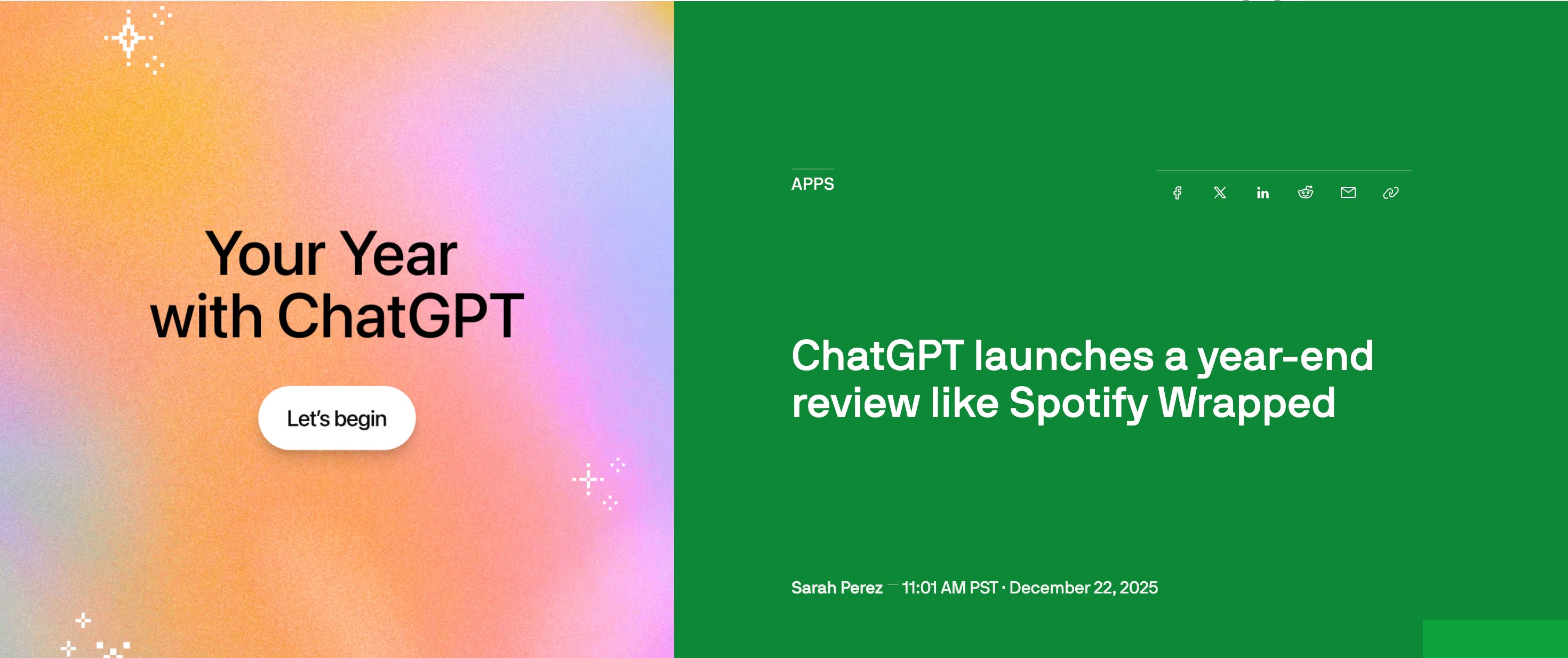
This one matters strategically. Users started building their own “ChatGPT Wrapped” on TikTok, parsing their conversation history into year-end recaps.
The user-generated demand was so culturally resonant that OpenAI launched an official version with personalized awards like “Creative Debugger” and AI-generated poems. What started as user behavior became product.
The Mirror Loop Protocol is now so embedded in consumer expectations that users will build it themselves if a brand does not.
The pattern is identical across every example: take data that already exists, frame it as identity proof, reverse-engineer the artifact for sharing.
1 marketing pattern per week.
Each issue breaks down what worked, why it spread, and what it means for the next 12 months.
Free.
Why This Campaign Would Have Flopped in 2018 and Broke Records in 2025
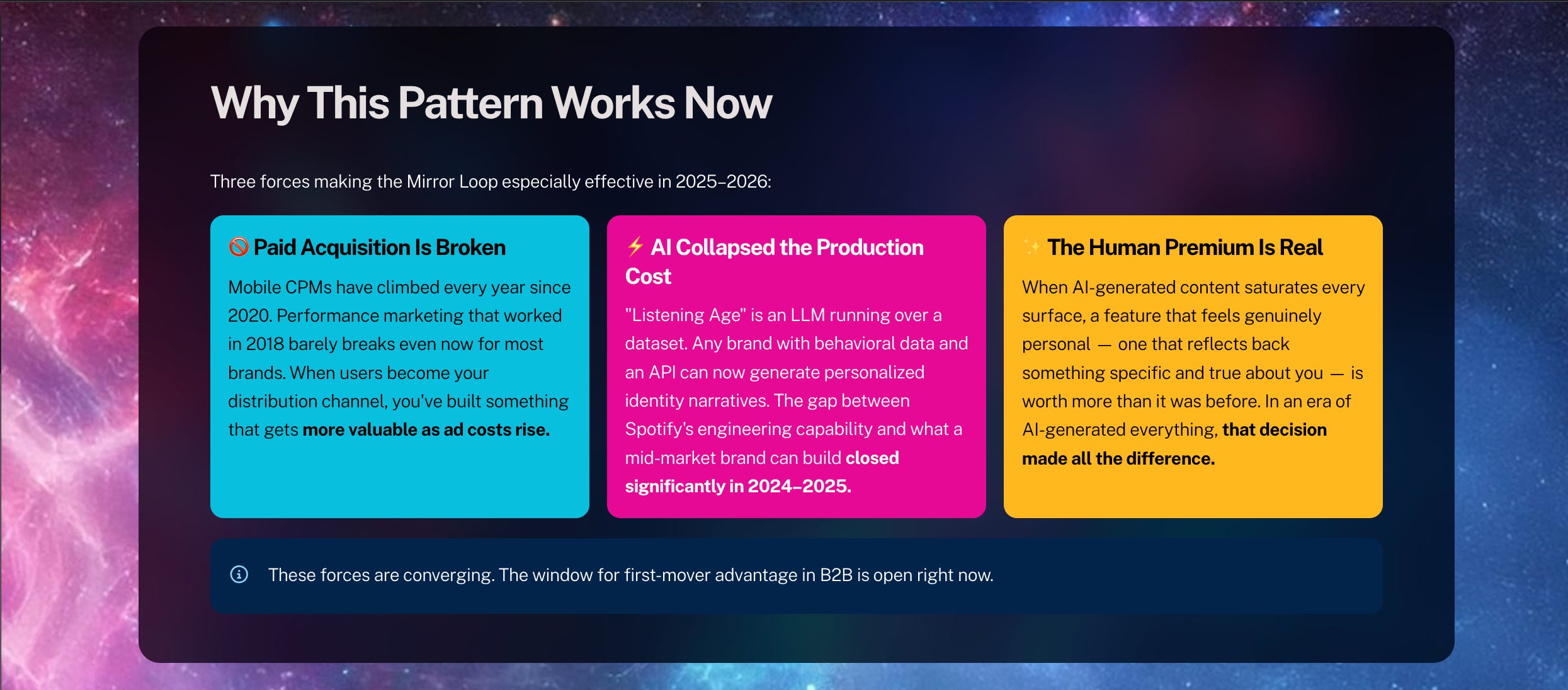
Image capture from gamma presentation on Campaign.
3 forces converged to make 2025 the peak year for this mechanism.
Paid acquisition is broken. Mobile CPMs have climbed every year since 2020.
Performance marketing that delivered profitable returns in 2018 barely breaks even in 2026 for most brands. Marketing teams are looking for organic distribution engines that do not require a media budget.
When users become your distribution channel, you have built something that gets more valuable as ad costs rise.
AI collapsed the production cost. The “Listening Age” feature is an LLM running over a dataset. Any brand with behavioral data and an API can now generate “You are a Midnight-era maximalist who discovered 47 artists before they crossed 100K listeners.” The cost to turn raw data into a personalized identity narrative dropped to near zero.
The gap between Spotify’s engineering capability and what a mid-market brand can build closed significantly in 2024-2025.
Identity is the new category signal. A Reddit thread captured it cleanly: “Spotify Wrapped is another flavor of wearing a band shirt.” Users are not sharing data. They are signaling tribal membership, using data as the proof. In a culture where what you consume (music, apps, fitness apps, restaurants) defines social belonging with unusual precision, behavioral data has become the most credible identity currency available.
The 2024 backlash revealed the fourth force: the human premium.
When AI-generated content saturates every surface, a feature that feels genuinely personal, one that reflects back something specific and true about you, is worth more than it was before. The 2025 Wrapped worked partly because the 2024 Wrapped failed. It proved that the mechanism is not just about personalization.
It is about the feeling of being known.
Why Most Attempts at This Fail: Three Case Studies and the Four Failure Modes Behind Them
Apple has over 100 million subscribers and nearly identical listening data to Spotify. Replay exists. It updates throughout the year. It offers personalized stats.
It generates less than 5% of Wrapped’s social mentions annually.
The problem is design, not data.
Apple’s brand guidelines enforce restraint: clean, minimal, utilitarian. The same guidelines that make every Apple product feel premium make Replay feel like a static report. It shows what you listened to. Wrapped tells you what that says about who you are. Replay is designed for reflection.
Wrapped is designed for broadcast.
There is also no ritual.
Replay updates throughout the year, which destroys the anticipation that makes Wrapped feel like an event. Spotify owns the first week of December as cultural real estate. Apple lets it pass quietly. This is the Maturation Pivot trap in reverse: a mature brand so committed to its identity that it cannot deploy a pattern its challenger uses to dominate the conversation.
YouTube has the infrastructure and the user base. But the data is polluted. YouTube Music users stream across devices and contexts: music, podcasts, video essays, tutorials, background noise. Your “Top Artist” might be a meditation channel or a news podcast you fell asleep to.
The mirror shows someone you do not recognize. Users do not share it because it does not reflect the identity they want to broadcast.
Amazon Music, for most users, is a Prime membership perk, not a primary music platform. Users have not built their music identity there. The behavioral data Amazon has is background listening. It reflects the circumstance of owning a Prime subscription, not the character of being a music person.
The Mirror Loop requires the user to feel ownership over the behavior.
When the data reflects convenience rather than choice, there is no identity stake worth sharing.
The pattern across all 3 failures:
Each had the technical capability: data, infrastructure, user base. What they lacked: cultural permission to be the “official” year-end music mirror, design optimized for sharing over comprehensiveness, and identity transformation mechanisms that show users not what they did, but who they are.
The 4th failure mode: when the data contradicts the desired self-concept.
The top Reddit complaint about Wrapped: “uncreative and inaccurate.” Thousands of posts about data that did not match users’ musical self-image.
Here is what is actually happening: the data is probably accurate. The users are rejecting accurate data because it conflicts with a valued self-image. Psychologists call this self-verification theory: people seek feedback that confirms their existing self-view, and reject information that does not fit.
When a user calls the mirror “inaccurate,” they usually mean: this does not show the version of me I want broadcast. The mirror is not broken. It is showing the wrong reflection.
Here’s the structural rule. the mirror has to be flattering to work. The data has to confirm the identity the user wants to project, not just the identity the data reveals.
7 Questions That Tell You Whether Your Product Can Run This Play
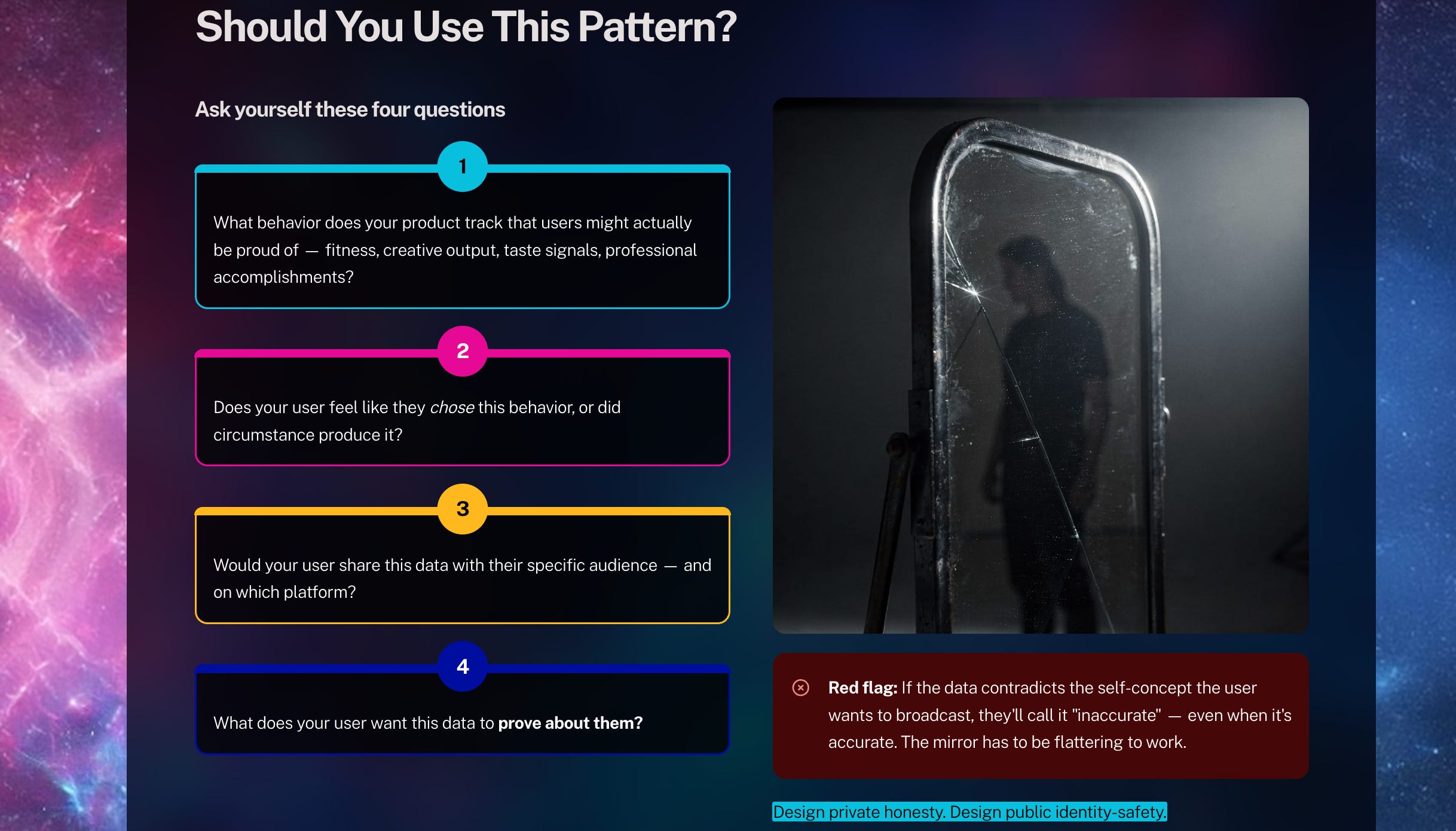
Before you ask how to build this, ask these first.
1. What behavior does your product track that users might actually be proud of? Fitness achievements, creative output, professional accomplishments, taste signals, and learning streaks carry identity weight. Usage volume and transaction counts usually do not.
2. Does your user feel like they chose this behavior? Chosen behavior reflects character. Circumstantial behavior reflects situation. Music taste feels chosen. Food delivery orders often feel like exhaustion. The mirror only works when users feel ownership.
3. Would your user share this with their specific audience? Think precisely about the channel. A VP’s organizational productivity analytics might share on LinkedIn. A fitness milestone goes on Instagram. The artifact has to fit the sharing context.
4. What does your user want this data to prove about them? Build backward from the identity claim the user already wants to make. What tribe membership signal does your product uniquely enable?
5. Is the artifact separable from the product? The most powerful version of the Mirror Loop Protocol is when someone who has never used your product sees the artifact and immediately understands what you do and what it says about the person sharing it. Can your artifact stand alone?
6. What does the interpretive layer do to the data? “You logged 900 minutes of sad music” is data. “You carried something heavy this year, and you did not carry it alone” is a mirror. The interpretive layer is the product.
7. Where is the failure mode? Map the scenario where a meaningful segment of your users get a mirror they do not want to share. Design a private version. The private insight can be honest. The public card has to be identity-safe.
If you are working with a client who has Mirror Loop potential, the paid tier includes the full client-ready strategy deck for this pattern + the growing library for every pattern in the archive.
Built for practitioners who need to walk into a meeting with this
3 Scenarios for Where This Goes Next, and the B2B Category Nobody Has Built Yet
The Rational Narrative: The Campaign Brief Every Agency Is Already Writing for Your Competitors
The Mirror Loop Protocol is in two places at once.
In consumer products, the pattern is peaking.
The first wave of adoption is complete. Year-end identity recaps have moved from novelty to expectation. Acquisition value is declining as saturation builds. Retention value is compounding.
Brands that adopted the mechanism in 2022-2024 are entering institutional infrastructure mode. Each year of accumulated user data transforms the product from utility into chronicle.
This is Memory Equity operating at its most durable tier. Users who leave lose the diary.
In B2B, the pattern has not been built yet. The category does not exist. The vocabulary does not exist. That absence is the opportunity.
Three scenarios describe where this goes over the next 18-24 months.
Scenario A (65% confidence).
The first DevOps or engineering infrastructure tool to package operational behavioral data as shareable organizational identity proof creates a new category.
Incident response patterns.
Deployment frequency.
Escalation architecture.
Postmortem rates.
It shows what kind of organization they are.
The first tool to name and package this owns both the market position and the vocabulary. Google Trends confirms Wrapped-adjacent search terms at Breakout status across adjacent categories. Reddit anthropology confirms that users build the mechanism themselves when brands do not deploy it first. TikTok Creative Center confirms third-party Mirror Loop content outperforming branded content by 770x.
The B2B signal comes from absence: no competing vocabulary, no competing products, no competing frameworks.
The territory is unclaimed.
Scenario B (25% confidence).
Consumer Wrapped fatigue accelerates faster than B2B adoption develops.
Privacy regulators in the EU classify behavioral identity profiling as a high-risk AI application under the EU AI Act. Brands with weak consent infrastructure pull back. Enterprise legal posture mirrors consumer caution.
The B2B rollout stalls before the category vocabulary is established.
Scenario C (10% confidence). The pattern evolves at the micro level rather than crossing into B2B. Monthly archetypes replace annual recaps. Consumer brands absorb the mechanism as retention infrastructure. B2B attempts produce cringe rather than conversion.
The vocabulary never develops for organizational use.
What would change this assessment? If a major marketing publication names and defines the Mirror Loop Protocol before a B2B product builds it, the vocabulary becomes shared infrastructure rather than a proprietary category advantage. The naming opportunity disappears. Scenario A confidence drops significantly.
Tracked judgment, May 29, 2026: Mirror Loop Protocol… Peaking (consumer B2C) / Emerging (B2B). Scenario A call: first DevOps or engineering infrastructure tool to package organizational behavioral data as shareable identity proof owns the category. Confidence: High. Review date: November 29, 2026. let’s check it then!
The Signal: The Vocabulary Gap Is the Opportunity. Nobody Has Claimed It Yet.
Here is the research anomaly that matters most.
I searched Reddit for “shareable data identity.” The results came back entirely about identity theft, data breaches, and privacy violations. Privacy discourse had colonized the language completely. There is no marketing vocabulary for “behavioral data as identity proof.”
The mechanism is everywhere. The language for it does not exist.
That gap is not an accident. It is a structural condition. Users do not experience Wrapped as a data product. They experience it as a moment of being known. The Reddit thread with 968 upvotes was not excited about analytics. It was excited about recognition.
“Spotify Wrapped is another flavor of wearing a band shirt.”
That is not a description of a data product. That is a description of belonging. The band shirt does not tell you anything the wearer could not tell you themselves. What it does is make the tribe membership visible, confirmable, legible to the people who matter.
Spotify is running belonging infrastructure. The data is the evidence, not the product.
Every brand that deploys this as a personalization strategy gets adequate results. The brand that deploys it as a belonging confirmation strategy builds something that compounds.
The contemplative tradition has a word for this: attunement.
Not only technique but relationship. Not achieving a state but becoming resonant with something already present. Spotify does not create the identity. It makes the existing identity visible. The data is confirmation, not construction. The practiced stillness of Wrapped is not about the algorithm.
It is about the person who was already there.
The vocabulary for this mechanism does not exist in marketing media.
No YouTube results. No Substack results. No marketing publications.
The brand that names it first captures both the market and the intellectual territory.
The Keystone: 3 Entities. 1 Winner. The Brand That Owns the Artifact Owns the Category.
The single design decision that separates the brands that own this pattern from the brands that copy it:
Design the artifact around the identity the user already claims. Not the behavior they already exhibit.
These are not the same thing. Behavior is what users did. Identity is what users want that behavior to mean.
The Mirror Loop Protocol runs on 3 entities. The product generates the data. The artifact packages the data as identity. The user’s social network distributes it. The brand that controls the artifact controls the loop. The brand that names the artifact controls the category.
B2B has not built this yet.
DevOps and engineering infrastructure tools capture behavioral data that reflects organizational character. An engineering leader who can share an artifact that says “your team resolves incidents through peer escalation, not manager escalation” has proof of organizational identity worth broadcasting on LinkedIn and at conferences.
That artifact does not exist. The vocabulary for it does not exist. The window is open.
The diagnostic question for your next creative brief: What tribe membership signal does this user already broadcast, and how can your product become the most credible proof they have found?
The first B2B product to answer that question does not win a campaign. It names a category.
Watch: The Mirror Loop Protocol Breakdown
The Window Is Open. Here Is How Long It Stays That Way.
The Mirror Loop Protocol has no name yet.
Search YouTube for “Mirror Loop Protocol marketing.” Zero results. Search Substack. Zero. Marketing publications. Zero. The playbook is seemingly everywhere: Spotify, Strava, Monzo, Duolingo, and now OpenAI. The vocabulary just doesn’t exist.
That gap will likely not stay open forever.
If you are building a product with behavioral data, or advising a client who is, the next 12 months are when this pattern institutionalizes. The brands that move first will own both the market position and the vocabulary. The brands that move second will explain that they are doing what the first brand already named.
If this issue reframed something you have been working on, I would genuinely like to hear what. What data does your product capture that your users would share if you packaged it differently?
Reply and tell me.
— Matt
The Strategy Signal breaks down one marketing pattern per issue: what worked, where it failed, and what it means for the next 12 months.